On July 29, 2026, Google published a guide alongside the global rollout of platform properties in Search Console. One of its recommendations is easy to overlook: look at query groups, the themes of search terms sending traffic to your content, including the ones trending up and down, and use them as data-driven inspiration for what to make next. The advice was written for social and video creators, but it describes a habit most website owners never form.
Most sites are built the other way round. Somebody picks a topic, writes the longest guide they can, and hopes it ranks for everything. Then a shorter page from a competitor answers one specific question better, and the long guide loses that query. Repeat for every question inside the topic and the guide is quietly beaten ten times.
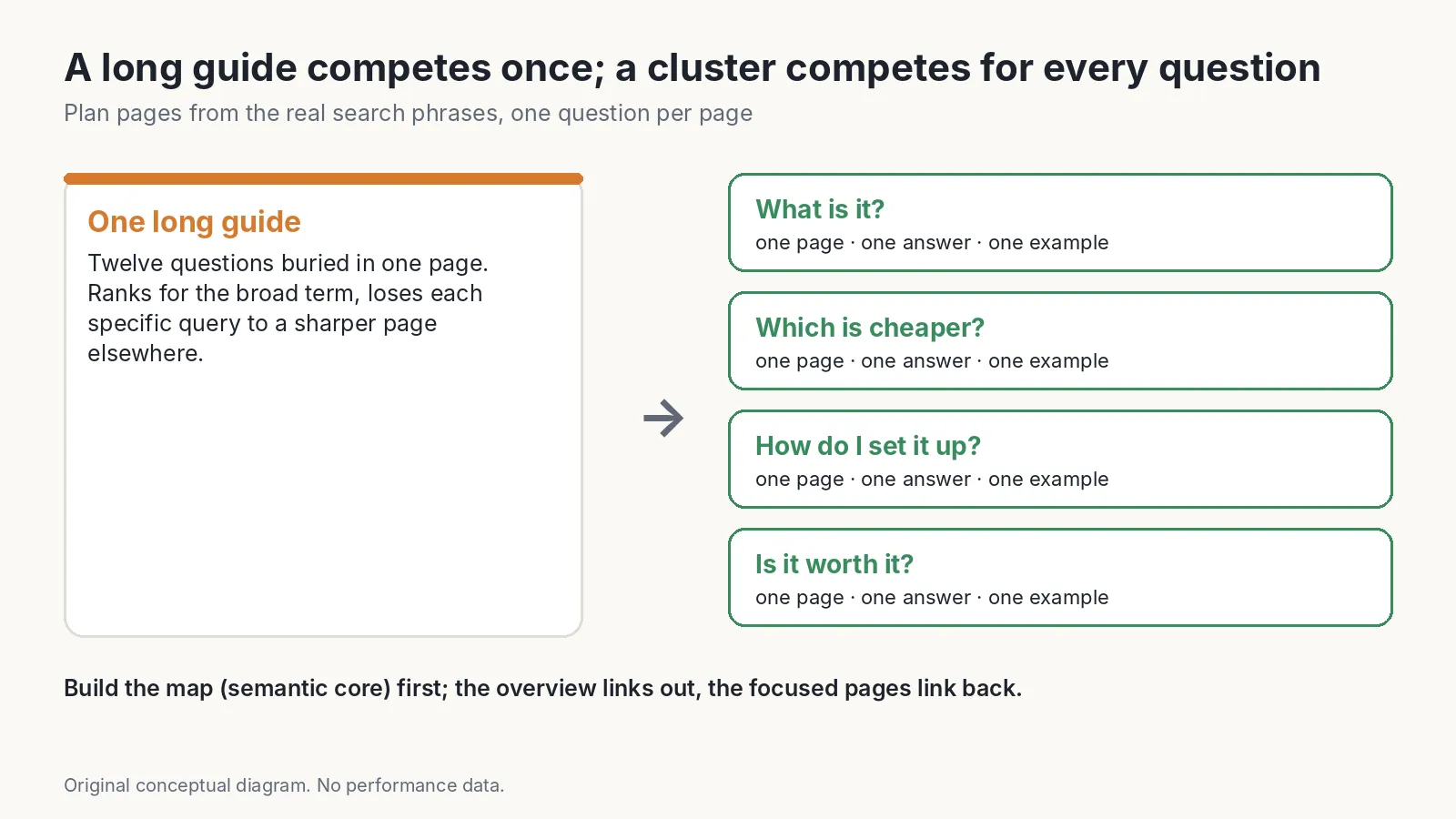
A long guide competes once; a planned cluster competes for every question — original conceptual diagram; no performance data.
Start from the questions, not the headline
Before writing, collect the actual phrases people type around the subject: the “how do I”, “what is the difference”, “is it worth it” variants, plus the comparisons and the price questions. Group them by intent. Someone asking what a thing is wants a definition and an example. Someone asking which option is cheaper wants a table. Those two readers should not land on the same page and scroll past each other.
This grouping has a name in SEO practice. A semantic core is the organised map of the real search phrases a site should answer, clustered so that each cluster becomes one page with one job. Building it first turns “write about X” into a list of pages, each with a clear reader and a clear question, and it stops two of your own pages fighting for the same query.
Give every page one promise
A page that answers one question can state the answer in the first paragraph, use the question as its heading, and prove it with one example. That structure is easier for a reader to trust and easier for a search engine, or an AI summary, to quote accurately. A page that tries to answer twelve questions buries each answer under the others.
Be strict about the one-promise rule when the questions look similar. “How much does it cost” and “is it worth the price” feel like one topic, but the first reader wants a number and the second wants a judgement. Two short pages, each honest about what it answers, will serve both better than one page that hedges between them. If you cannot say in a sentence what a page is for, it probably needs splitting.
Keep the long guide if you already have it, but change its job. Let it be the overview that links out to the focused pages, and let the focused pages link back. Readers who want depth find it; readers who want one answer get it without scrolling.
Check the map monthly
Query groups move. A phrase that sent nobody last year can become the main entrance this year after a product change or a news cycle, and Google’s own guide points at the “trending up” list for exactly that reason. Once a month, compare the search terms actually reaching your pages against the clusters in your map. A term that shows up with no page of its own is a page to write. A page that no term reaches any more is a page to merge or retire.
The discipline is small: list the questions, give each one a page, and read the report. It is far cheaper than discovering, one lost query at a time, that the big guide was never really competing.
FAQs
Ten focused articles can perform better because each page targets a specific search query and user intent. Instead of covering multiple questions broadly, each article provides a direct and relevant answer.