On June 3, 2026, Google announced Search Generative AI performance reports in Search Console: dedicated views of how often a site’s pages appear inside AI Overviews, AI Mode and generative features in Discover. The reports started with a subset of sites. According to the note Google added to the same announcement, they reached all websites worldwide on August 31, 2026.
For a blogger or a small content team, that changes the conversation. Until this year, “we got cited in an AI answer” was a screenshot and a hope. Now it is a number in a report you already use. The number is useful only if you know what it does and does not say.
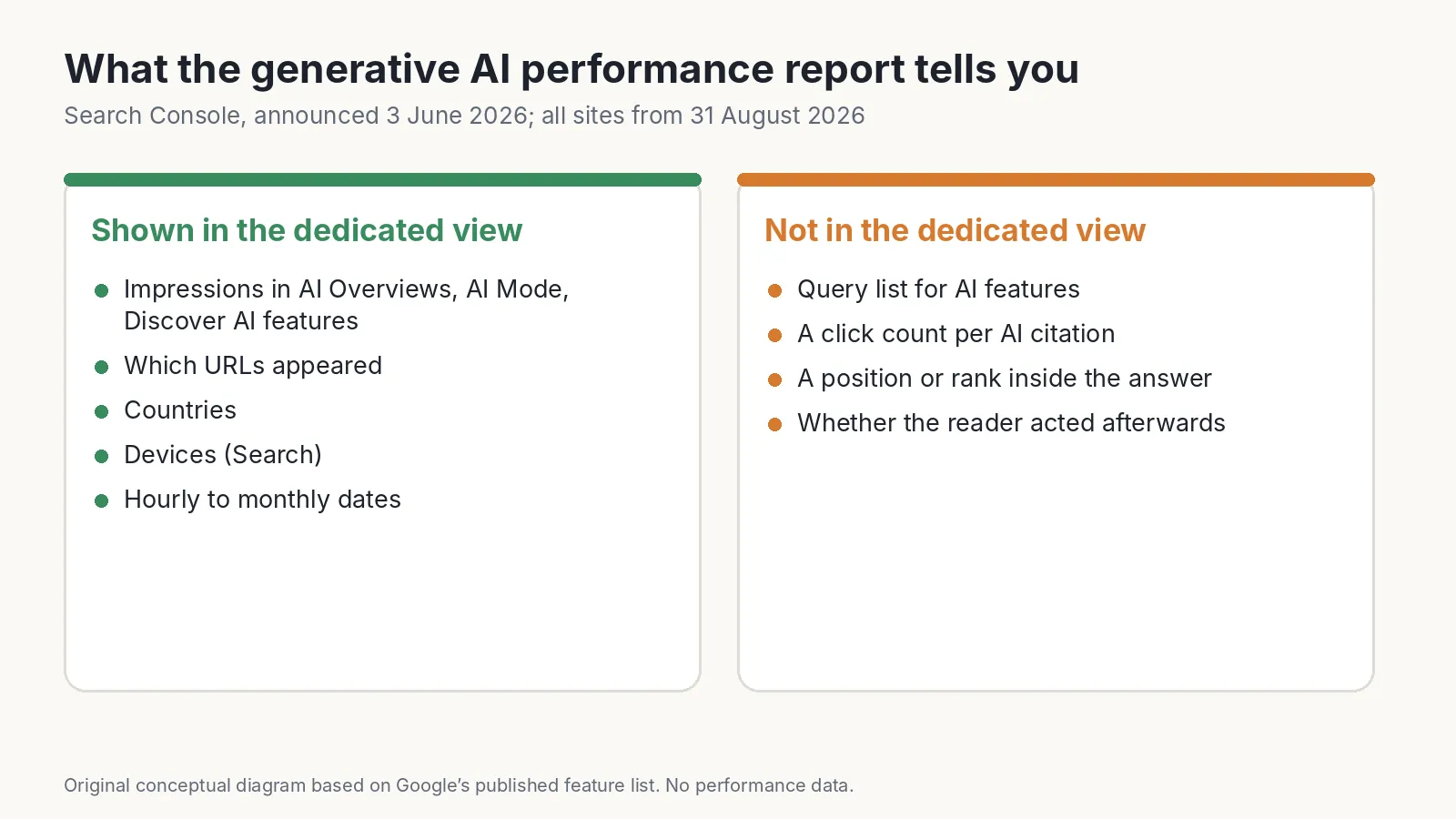
What the new report shows, and what you still have to work out yourself — original conceptual diagram; no performance data.
Read the report for what it is
Google listed five things the generative AI reports show: impressions, which URLs appeared, countries, devices, and performance over time with hourly to monthly granularity. Read that list again and notice what is absent. There is no query list in the dedicated view, and no click count is promised for an AI Overview citation the way it is for a blue link. Google also said this data was already included in the overall performance report; the new view separates it out.
So the honest statement after opening the report is: “These pages were shown inside AI features this many times, in these countries, on these devices.” It is not: “AI search sent us this much traffic,” and it is not: “We rank first in AI Mode.”
Three questions the report can answer
Which pages does the AI reach for? Sort the Pages view by impressions. Most sites will find a small set of pages carrying most of the AI impressions, and they are not always the pages the team is proudest of. A plain, well-structured explainer often outperforms a long opinion piece here. That is information about format, not a verdict on quality.
Where is the audience? The Countries view matters for a site that writes in English for readers in several markets. A page that is mostly shown in AI features to readers in a country you do not serve is reach you cannot convert. A page shown mostly in your home market is a candidate for a stronger call to action.
Did a change move the number? Because the report has daily and even hourly granularity, you can mark the date you restructured a page, added a clear definition near the top, or rewrote headings as questions, and then watch whether impressions in AI features changed over the following weeks. One page and one change at a time keeps the lesson readable.
Pair impressions with signals you control
Impressions tell you a page was shown. They do not tell you whether a reader arrived, stayed or acted. Put the AI impressions next to three other sources before deciding anything:
The ordinary Search performance report for the same URL, to see whether classic clicks rose, fell or held while AI impressions grew.
Your analytics landing-page report for the same dates, to see sessions, scroll depth or sign-ups.
The page itself, read as a first-time visitor who arrived after seeing a summary. Does the opening confirm they are in the right place, and does it offer the next step the summary could not?
If AI impressions are high and clicks are flat, the page may be answering the whole question inside the summary. That is not automatically a problem. It is a prompt to decide what the page offers beyond the answer: a tool, a template, a worked example, a comparison, a way to contact you.
Make the next edit specific
When a page shows up in AI features but readers do not continue, the usual fault is structure rather than topic. A short, direct definition near the top, headings phrased as the questions readers actually ask, and a paragraph that states the answer before the explanation all make a page easier for a summarizer to quote and easier for a human to trust. A content optimizer can flag missing terms and weak headings against the top-ranking pages for a query; treat that as a checklist for an editor, not as a guarantee of a citation.
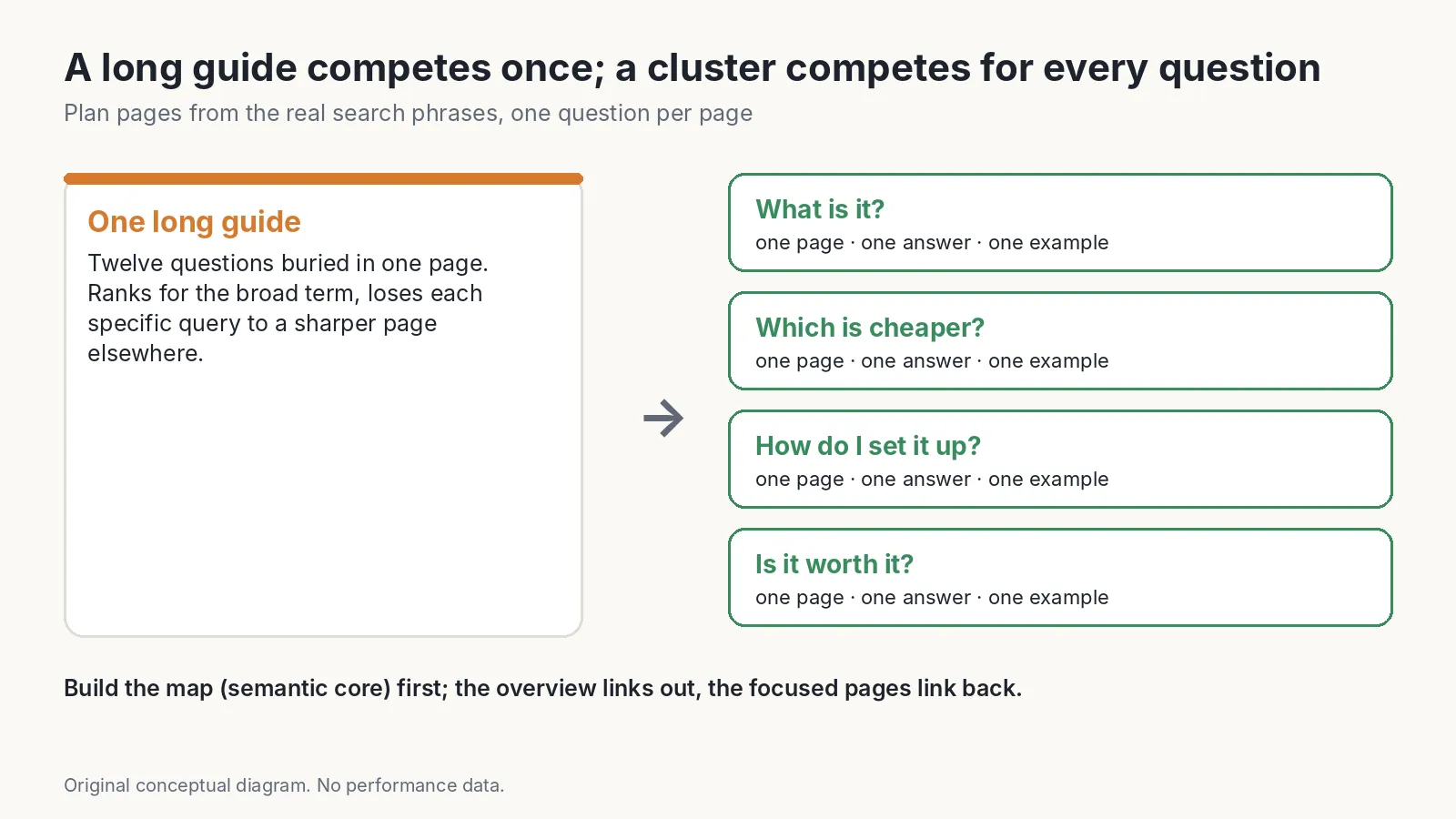
The second common fault is scope. Many pages try to cover a whole topic and end up being quoted for a single sentence. Grouping the questions readers ask into a planned set of pages, each with one clear job, usually serves both human readers and AI features better than one sprawling guide. Teams that want that mapping done methodically sometimes commission a semantic core that clusters the real search questions before any writing starts.
Keep the claim modest
Google said it is still working with site owners on which metrics to add. Until a click or query dimension exists in the dedicated view, resist publishing “AI traffic grew by X percent” charts built from impressions. Report what the data supports: visibility in AI features went up or down for these pages, in these markets, after these changes, and here is what classic clicks and on-page behaviour did over the same period.
That discipline is what makes the report valuable. It turns a screenshot into a routine: look at which pages the AI reaches for, decide what those pages should offer beyond the answer, change one thing, and check again next month.