The average radius of the Earth is approximately 6,371 kilometers (3,959 miles). This is the internationally accepted value used in geography, astronomy, navigation, and Earth science. However, the Earth is not a perfect sphere. It is slightly wider at the equator and slightly flattened at the poles, so its radius changes slightly depending on where it is measured.
Key Takeaways
-
The Earth's average radius is 6,371 km (3,959 miles).
-
The equatorial radius is 6,378.1 km (3,963.2 miles).
-
The polar radius is 6,356.8 km (3,949.9 miles).
-
Earth is an oblate spheroid, not a perfect sphere.
-
The difference between the equatorial and polar radius is about 21 km (13 miles).
-
The Earth's radius is essential for GPS, mapping, satellite technology, and scientific research.
Earth's Radius at a Glance
| Measurement | Value |
|---|---|
| Average Radius | 6,371 km (3,959 miles) |
| Equatorial Radius | 6,378.1 km (3,963.2 miles) |
| Polar Radius | 6,356.8 km (3,949.9 miles) |
| Average Diameter | 12,742 km (7,918 miles) |
| Shape | Oblate Spheroid |
What Is the Radius of the Earth?
The radius of the Earth is the distance from the center of the planet to its surface. Scientists use this measurement to calculate many other important values, including the Earth's diameter, circumference, surface area, and volume.
The value most commonly used is the average radius of 6,371 kilometers (3,959 miles). This average makes scientific calculations simpler because the Earth is not perfectly round.
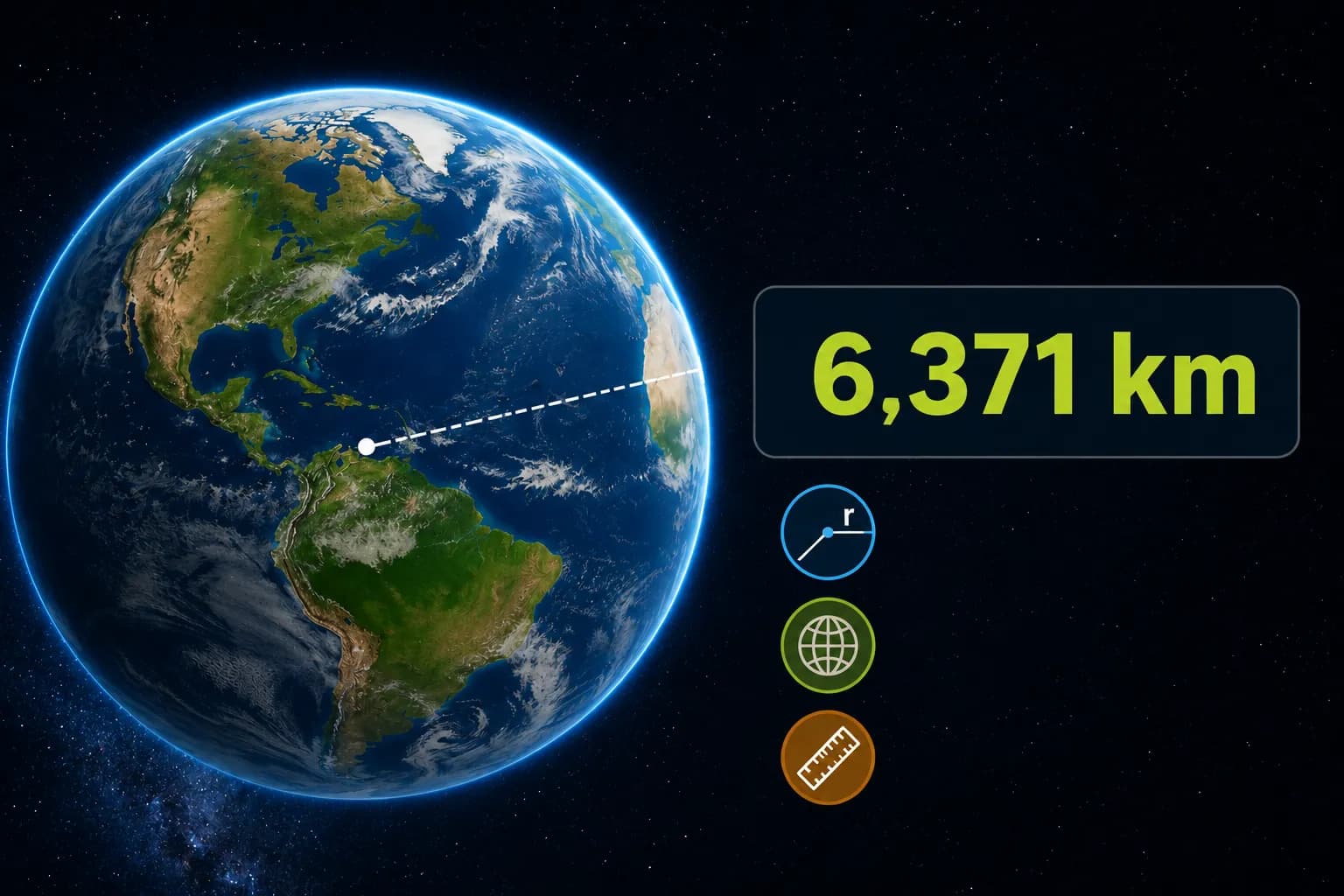
Whether scientists are studying the planet, launching satellites, creating digital maps, or planning space missions, the Earth's radius is one of the most important measurements they use.
Why Isn't the Earth a Perfect Sphere?
Although the Earth looks perfectly round from space, it actually has a slightly different shape.
The Earth spins continuously on its axis. This rotation creates a small outward force that causes the planet to bulge around the equator while becoming slightly flattened at the North and South Poles.
This shape is known as an oblate spheroid.
Because of this:
-
The equator is slightly farther from the Earth's center.
-
The poles are slightly closer to the Earth's center.
-
The difference between the two measurements is about 21 kilometers (13 miles).
Although this difference is relatively small compared to the Earth's overall size, it is significant enough to be considered in mapping, navigation, engineering, and scientific research.
Average Radius vs. Equatorial Radius vs. Polar Radius
Scientists use different radius measurements depending on the purpose of their work.
| Radius Type | Measurement | Description |
|---|---|---|
| Average Radius | 6,371 km | Standard value used in most calculations |
| Equatorial Radius | 6,378.1 km | Distance from the Earth's center to the equator |
| Polar Radius | 6,356.8 km | Distance from the Earth's center to either pole |
Average Radius
This is the internationally accepted average value and is used in textbooks, GPS calculations, scientific research, and educational materials.
Equatorial Radius
Because the Earth bulges at the equator, this radius is the largest measurement.
Polar Radius
Since the Earth is slightly flattened at the poles, this is the smallest radius measurement.
Radius vs. Diameter
People often confuse the Earth's radius with its diameter.
The radius is the distance from the center of the Earth to its surface.
The diameter is the distance from one side of the Earth to the other, passing through the center.
Earth's Measurements
| Measurement | Value |
|---|---|
| Radius | 6,371 km |
| Diameter | 12,742 km |
A simple formula to remember is:
Diameter = Radius × 2
Why Is the Earth's Radius Important?
The Earth's radius is much more than a number found in geography books. It is one of the basic measurements used in many scientific and technological fields.
Scientists and engineers use the Earth's radius to:
-
Calculate the Earth's circumference.
-
Determine the Earth's surface area and volume.
-
Study gravity and the planet's internal structure.
-
Measure distances across the globe.
-
Design GPS and navigation systems.
-
Plan satellite launches and space missions.
-
Create accurate digital maps.
-
Monitor climate and environmental changes.
Without an accurate value for the Earth's radius, many modern technologies would not function as precisely as they do today.
How Do Scientists Measure the Earth's Radius?
People have been trying to measure the Earth's size for thousands of years.
One of the earliest known estimates was made by the Greek mathematician Eratosthenes around 240 BCE. By observing the angle of sunlight in two different cities and applying geometry, he calculated the Earth's circumference with remarkable accuracy.
Today, scientists use advanced technologies, including:
-
Earth-observing satellites
-
Global Positioning System (GPS)
-
Geodetic surveys
-
Laser ranging systems
-
Space-based measurements
These modern techniques provide highly accurate measurements that are used worldwide.
Did You Know?
Even though the Earth appears perfectly round in photographs from space, it is actually about 21 kilometers wider at the equator than from pole to pole because of its rotation.
This small difference is one of the reasons scientists use different radius measurements for different types of calculations.
Earth's Key Measurements
| Measurement | Approximate Value |
|---|---|
| Average Radius | 6,371 km |
| Diameter | 12,742 km |
| Equatorial Circumference | 40,075 km |
| Polar Circumference | 40,008 km |
| Surface Area | 510.1 million km² |
Frequently Asked Questions
What is the average radius of the Earth?
The Earth's average radius is approximately 6,371 kilometers (3,959 miles).
Is the Earth a perfect sphere?
No. The Earth is an oblate spheroid, meaning it is slightly flattened at the poles and wider around the equator.
Why are there different Earth radius measurements?
The Earth's rotation causes it to bulge slightly at the equator, making the equatorial radius larger than the polar radius.
What is the Earth's diameter?
The Earth's average diameter is approximately 12,742 kilometers (7,918 miles).
Who first measured the Earth's size?
One of the earliest accurate estimates was made by the Greek mathematician Eratosthenes, who used geometry and sunlight to calculate the Earth's circumference more than 2,000 years ago.
Why is the Earth's radius important?
It is used in geography, astronomy, engineering, navigation, GPS technology, climate science, and space exploration.
Final Answer
The Earth's radius is one of the most important measurements in science because it helps us understand the size and shape of our planet. Although the Earth is not a perfect sphere, its average radius of 6,371 kilometers (3,959 miles) serves as the global standard for scientific calculations and everyday technologies.
From creating accurate maps and navigation systems to launching satellites and exploring space, this single measurement supports countless activities that affect our daily lives. Understanding the Earth's radius not only answers a common geography question but also shows how a simple scientific measurement plays a vital role in advancing knowledge, technology, and our understanding of the world.
Read More : what is the shape of earth?



.jpg&w=1200&q=75)