
Yes and no. That depends upon whether you are looking at Hinduism from the point of view of mythology or philosophy.
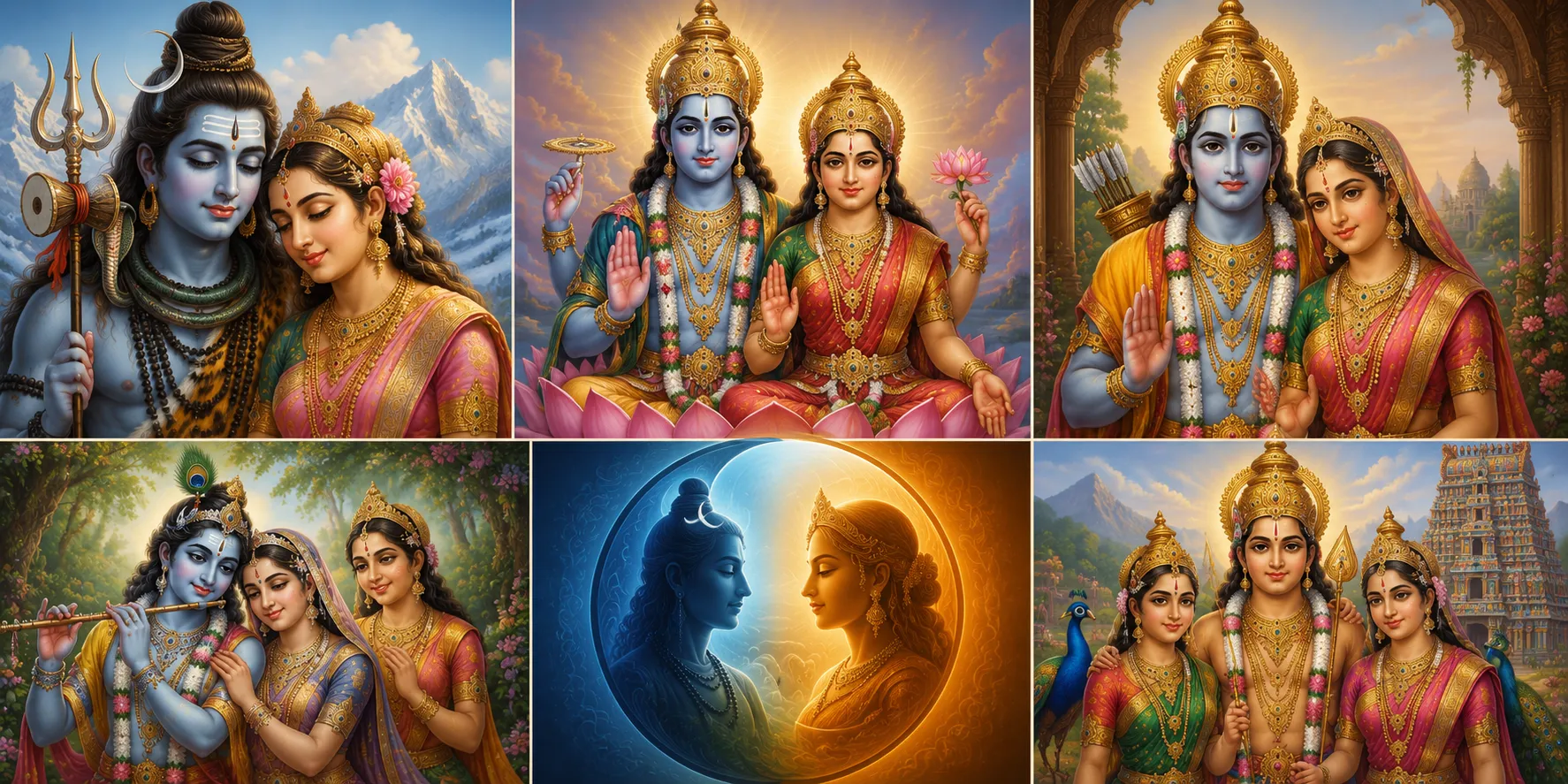
Many of the principal deities of Hindu Mythology are reputed to be married. For instance, Lord Shiva and Goddess Parvati, Lord Vishnu and Goddess Lakshmi, and Lord Brahma and Goddess Saraswati are portrayed as celestial couples in texts, temples, festivals, and devotional legends.
Summary of Practices
In Hindu traditions across India, holy spouses are venerated in temples and homes.
Some of the most famous divine couples are:
- Lord Shiva & Goddess Parvati
- Lord Vishnu with Goddess Laxmi.
- Lord Rama and Goddess Sita.
- Lord Krishna and Goddess Rukmini (and Radha as the supreme devotee and divine consort in the devotional traditions)
- Many South Indian traditions show Lord Murugan (Kartikeya) with Devasena and Valli.
Festivals, rituals, temple worship, classical dance and literature, and religious art all celebrate these relationships. For millions of Hindus, they are not only family life but also spiritual ideals of love, devotion, harmony, prosperity, and dharma.
Why do so many Hindu gods have wives?
There are a lot of reasons—religious and figurative.
To symbolize the balance of masculine and feminine celestial forces.
To illustrate the relationship between Shakti (divine energy) and the Divine.
To offer moral and spiritual role models as sacred myths.
To represent cosmic functions such as creation, preservation, wealth, wisdom and transformation.
To clarify complex spiritual concepts to followers by use of familiar family relationships.
For example:
- Shiva and Parvati are forms of consciousness and divine energy.
- Vishnu and Lakshmi mean preservation together with prosperity.
- Rama and Sita are typically considered ideals of virtue, devotion, and conjugal virtue.
Causes of variations
Hindu traditions do not all hold the same view of divine marriages.
Hinduism is a complex religion with many philosophical schools and therefore it is
Some traditions:
- Imagine divine marriages as historical or sacred events within religious stories.
- Read them as allegories.
- Focus mostly on one deity and their consort.
- Worship the Goddess (Devi or Shakti) herself as the Supreme Reality.
- Stress the ultimate unity of all gods as manifestations of Brahman.
Consequently, the definition of divine marriage might differ depending on the scripture, tradition, or school of philosophy.
Cultural Disparities
The worship of celestial couples also varies across India.
Example:
- In North India people worship Rama-Sita and Radha-Krishna.
- In South India, Shiva-Parvati, Vishnu-Lakshmi, and Murugan with Valli and Devasena are very popular.
- In Shakta traditions, the Divine Mother (Devi) is often seen as the Supreme Reality, with male deities sometimes understood in connection to her power.
Different temples celebrate major festivals every year symbolically as divine weddings (Kalyanotsavam).
These regional traditions are an expression of the richness of Hindu culture, not of differences in the core faith.
Philosophically, divine weddings are chock full of meaning.
They typically depict:
- Consciousness and energy.
- Creation and keeping.
- Knowledge and wisdom.
- Growth and safety.
- Masculine & Feminine Principles in Harmony.
- The unity of the Divine appearing in different forms.
A well-known example is Ardhanarishvara, a form of Shiva as being half male and half female, symbolizing the masculine and feminine aspects of the Divine being as ultimately one and inseparable.
Common Misconceptions
"All Hindu gods are married."
No.
Many of the major deities are represented with consorts, although not all deities are depicted as married, and different traditions have different views.
"The marriages should be interpreted just like human marriages.
Not so.
Many of the Hindu philosophical schools interpret these marriages as symbolic representations of the divine unity, as opposed to literal human relationships.
"Hinduism has only one interpretation."
No.
There are many schools of thought such as Vaishnavism, Shaivism, Shaktism, and Smarta traditions that may stress differing theological interpretations, but they share many fundamental ideas.
"If a deity has a consort, they are two wholly independent divine entities."
Not necessarily.
Many traditions teach that the deity and his consort are two parts of the same ultimate divine truth and should be understood together, not as distinct contending gods.
FAQs
1. Do Hindu gods have wives?
Many of the prominent gods in Hindu mythology are shown as married. Philosophically these interactions are generally understood as symbols of divine unity and cosmic equilibrium.
2. Why do the gods of the Hindus have wives?
Their consorts are frequently Shakti (divine energy), wealth, knowledge, compassion, or other divine attributes. Symbolism makes deep spiritual concepts easier to understand.
3. Is Goddess Laxmi Lord Vishnu’s wife?
Yes.
Lakshmi is the goddess of wealth, success, and prosperity. In Hindu religion, she is the partner of the god Vishnu.
Must Read: According to Hinduism, why did Lord Krishna marry Tulsi Devi?