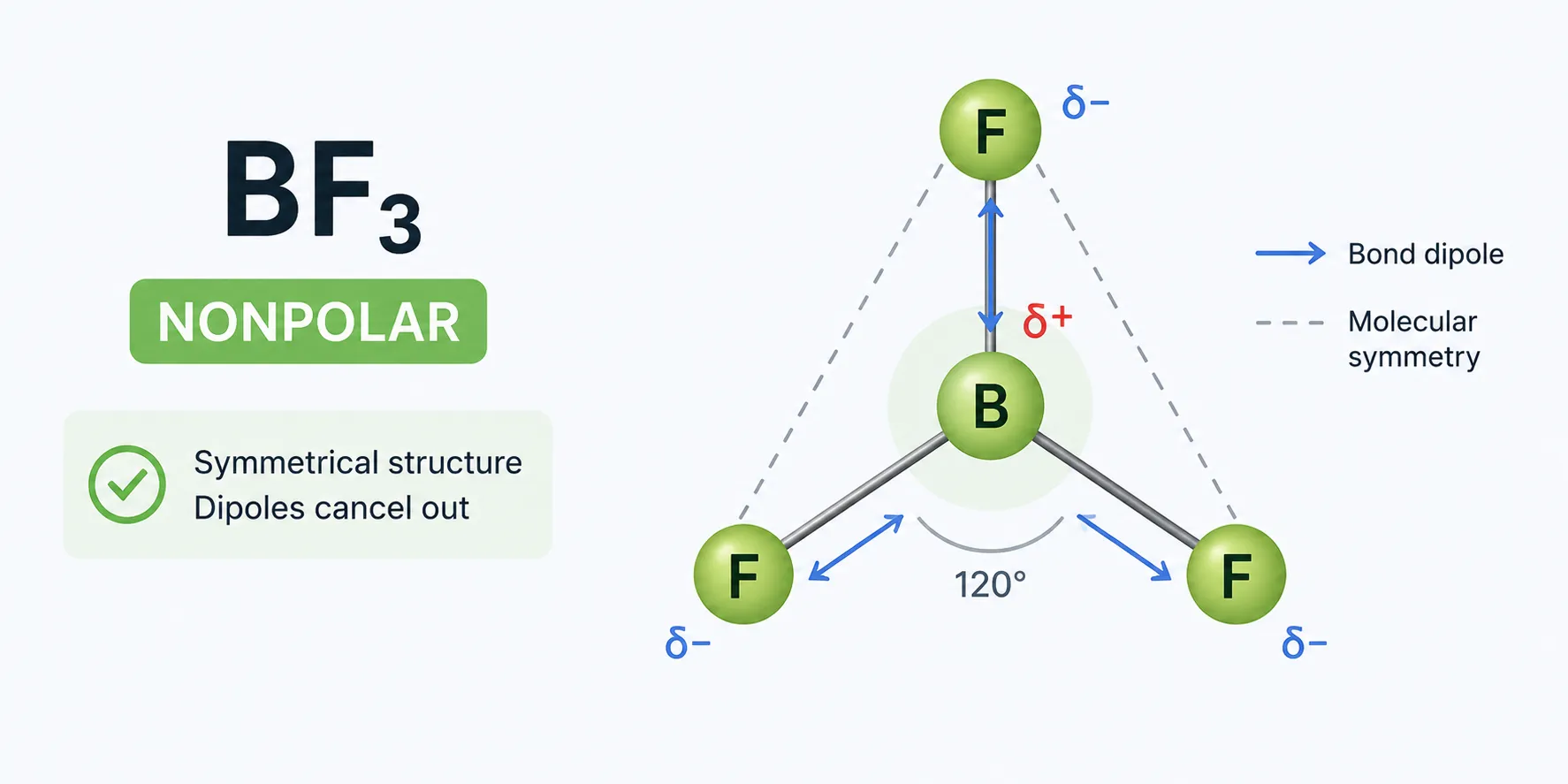
BF₃ (boron trifluoride) is a nonpolar molecule. Although each boron-fluorine (B–F) bond is individually polar because fluorine is much more electronegative than boron, the molecule has a perfectly symmetrical trigonal planar shape. This symmetry causes the bond dipoles to cancel each other out, resulting in zero net dipole moment.
To be honest, this confused me the first time I studied molecular polarity. I thought, "If every B–F bond is polar, then the whole molecule should also be polar." Later, I realized that a molecule's polarity depends not only on its bonds but also on its overall shape. That's exactly why BF₃ is considered nonpolar.
Molecular Structure
BF₃ consists of:
-
1 Boron (B) atom
-
3 Fluorine (F) atoms
The boron atom sits at the center and forms three single covalent bonds with three fluorine atoms.
According to VSEPR theory, BF₃ has a trigonal planar geometry with bond angles of approximately 120°.
Because the three fluorine atoms are evenly spaced around the central boron atom, the molecule is perfectly symmetrical.
Bond Polarity
Each B–F bond is polar.
This happens because fluorine is one of the most electronegative elements in the periodic table, so it pulls the shared electrons closer to itself.
As a result:
-
Boron develops a slight positive charge (δ⁺).
-
Fluorine develops a slight negative charge (δ⁻).
So, while the individual bonds are polar, that doesn't automatically make the entire molecule polar.
Why Is BF₃ Nonpolar?
This is where many students get confused.
The three polar B–F bonds point in different directions, but because the molecule has a perfectly symmetrical trigonal planar shape, the pull from one fluorine atom is balanced by the other two.
In simple words, all three bond dipoles cancel each other out.
Therefore:
-
Polar bonds: ✅ Yes
-
Symmetrical shape: ✅ Yes
-
Net dipole moment: 0
-
Overall molecule: Nonpolar
This is one of the classic examples showing that bond polarity and molecular polarity are not always the same thing.
BF₃ at a Glance
| Property | BF₃ |
|---|---|
| Molecular Shape | Trigonal planar |
| Bond Angle | 120° |
| Individual B–F Bonds | Polar |
| Overall Molecular Polarity | Nonpolar |
| Net Dipole Moment | Zero |
Common Misconceptions
Myth: If a molecule has polar bonds, it must be a polar molecule.
Reality: Not always. Molecular geometry is equally important. BF₃ has polar bonds, but its symmetrical structure cancels the dipoles.
Myth: Fluorine automatically makes every molecule polar.
Reality: Fluorine creates polar bonds, but the overall molecular polarity depends on whether those bond dipoles cancel each other.
Myth: BF₃ and NH₃ have similar polarity because both contain three bonds.
Reality: BF₃ is trigonal planar and symmetrical, while NH₃ is trigonal pyramidal due to a lone pair on nitrogen, making NH₃ polar.
BF₃ is nonpolar, even though its individual boron-fluorine bonds are polar. The reason lies in its perfectly symmetrical trigonal planar structure, which causes all three bond dipoles to cancel each other. This makes BF₃ one of the most common examples used in chemistry to demonstrate that molecular shape plays a crucial role in determining polarity, not just the polarity of individual bonds.
Frequently Asked Questions (FAQs)
1. Is BF₃ a polar or nonpolar molecule?
BF₃ is a nonpolar molecule. Although its B–F bonds are polar, the trigonal planar geometry causes the bond dipoles to cancel, resulting in zero net dipole moment.
2. Why are the B–F bonds polar?
The B–F bonds are polar because fluorine is much more electronegative than boron, causing the shared electrons to be pulled toward fluorine.
3. Why doesn't BF₃ become polar if its bonds are polar?
The molecule is perfectly symmetrical. Since the three bond dipoles point in equally spaced directions, they cancel one another, making the overall molecule nonpolar.
4. What is the molecular geometry of BF₃?
According to VSEPR theory, BF₃ has a trigonal planar geometry with bond angles of approximately 120°.
5. Which is more polar: BF₃ or NH₃?
NH₃ is polar, while BF₃ is nonpolar. NH₃ has a lone pair on the central nitrogen atom, giving it an asymmetrical trigonal pyramidal shape. BF₃ has no lone pairs on boron and remains perfectly symmetrical, making it nonpolar.
 Answered by