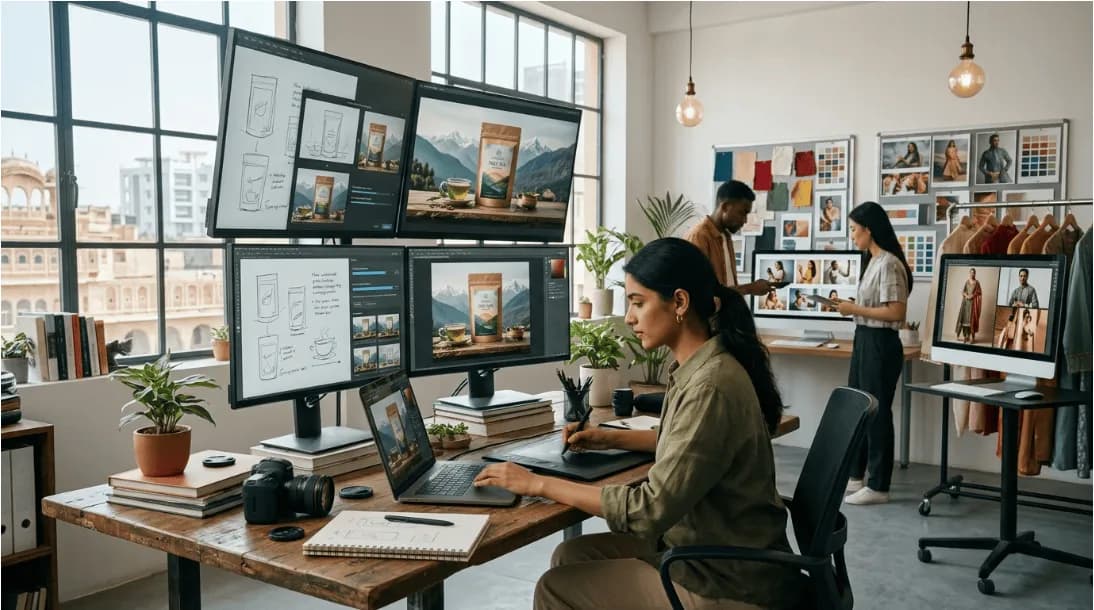
UI UX design courses of today immerse us in a world where creativity is going hand, in, hand with artificial intelligence. It is true that designers have always depended on human instincts and creative abilities. But Artificial Intelligence is revolutionizing the work of designers entirely.
Design education has to brace the changes in the field. If you are looking for a design course in Hyderabad, you will discover that the forward, thinking schools have now adopted AI, powered methods in their curriculum. AI is not replacing designers, it is collaborating with them. This teamwork enables us to be more efficient and more creative in generating user experiences that are pleasing to users.
Why is AI such a game-changer for visual design?
-
It changes the approach from gut, feel design to decisions based on data
-
It helps designers create interfaces that are more user, friendly and practical
-
It reveals user behaviour patterns that people might not have noticed
-
It is able to forecast the interaction of users with designs
In this article, we explore how Artificial Intelligence is transforming visual design practices as well as reshaping the entire user experience.
Understanding Data-Driven Visual Design
Data, driven visual design is pretty much a game changer when it comes to the design process. It gets rid of guessing and remake decisions based on actual user behaviour data instead of just personal preferences or assumptions.
Nowadays, UI UX design course pay a lot of attention to this method as it results in more user, centric experiences. In the past, designing was mostly a matter of intuition or a sense of style, however, the data, driven approach leverages the real user insights that dictate the design components.
This methodology relies on two complementary data types:
Quantitative data, numerical information illustrating user behavior, comprising metrics such as click, through rates, session duration, and conversion rates
Qualitative data, the reasons behind user behavior, thus the insights that are gathered through interviews, usability testing, and feedback forms
This approach offers significant benefits:
-
Better decision-making with objective evidence
-
Higher user satisfaction by meeting real needs
-
Better participation by removing friction points
-
Business objectives that match user goals
-
Tailored interfaces for specific audiences
Design courses in Hyderabad now teach these analytical skills among creative ones. Students learn to create visually appealing interfaces that work well and meet user expectations.
How AI Enhances UX Through Visual Design
Today's Artificial Intelligence (AI) technologies are transforming the landscape of visual design, creating interfaces that cater to the users' needs and emotions.
Students enrolling in a full UI UX design program get to know the ways Artificial Intelligence (AI) can be utilized to enhance visual design.
AI adds emotional intelligence to user interfaces by:
-
Detecting user sentiment through interaction patterns that adjust designs naturally
-
Spotting frustration points where users pause or hesitate
-
Creating interfaces that respond to emotional cues beyond functional needs
-
Changing visual elements based on users' previous behaviours
Predictive UX shows AI's power in another way. AI analyses behavioural patterns to:
-
Predict user needs before they ask
-
Recommend next steps based on common usage patterns
-
Make complex workflows simpler through smart predictions
-
Change layouts and content for each user's profile
The system analyses how users engage with various visual elements and customizes the journey accordingly. With smart AI, personalization can be achieved on a large scale through adaptive interfaces that develop with each user interaction.
Contemporary art and design classes in Hyderabad increasingly consider these AI functionalities as basic professional skills. Learners are taught to harmonize the visual aspects with the data, driven parts that help them come up with designs that are attractive yet easy to use.
To rise above the ordinary, designers and AI join forces. Such experiences get the hang of even our most minor gestures, forecast our requirements, and change according to our preferences in a way that was unimaginable to us before.
Tools and Techniques for AI-Powered Design
AI tools have become essential in visual design as professionals integrate them into their daily work. Designers now use multiple platforms to spark creativity and work efficiently.
Figma Make leads the pack with features that change text descriptions into editable interfaces:
-
Creates complete UI elements from simple prompts
-
Makes rapid prototyping of user flows possible
-
Lines up elements and spacing automatically
-
Lets you edit and test in real-time
Adobe Sensei adds smart features to Adobe products:
-
Takes care of repetitive design tasks
-
Suggests better layouts and colour matches
-
Measures content performance effectively
Canva weaves AI throughout its platform with:
-
Design suggestions based on user priorities
-
Smart colour palette and font picks
-
Templates that adapt to match specific needs
Specialised tools like Uizard provide:
-
Screenshot-to-editable mockup conversion
-
Sketch-to-design transformation
-
Attention heatmap generation to predict user focus
Students studying UI UX design get taught balancing AI tools and human insight. Very good designers allow AI to take care of the regular/clich work while they concentrate on strategy, emotions, and understanding of users. This mixture of abilities is the basis of design courses in Hyderabad and equips students for an AI partner future.
AI and visual design together create remarkable benefits:
• Data replaces guesswork, allowing us to create interfaces based on actual user behaviour rather than assumptions • Emotional intelligence within interfaces adapts to users' feelings and frustrations • Predictive capabilities anticipate needs before users explicitly request them • Tailored experiences at scale become possible through adaptive interfaces • Routine tasks become automated, freeing our creative energy for strategic thinking
AI works as our collaborative partner rather than our replacement. Designers will without doubt combine technological capabilities with uniquely human qualities like empathy, creativity, and strategic thinking to succeed.
Conclusion
Those who join up for the latest UI/UX design courses are bound to be geared up for the world of digital technology which keeps on changing, more so when there are such varieties of programmes in Hyderabad. The content of their study is a mixture of the technical AI skills and the core design principles.
Designers who are friendly and embrace AI as a very strong tool to help them do their work rather than seeing it as their rival will be those who prosper. These advanced gizmos give us the power to craft visual experiences that are astonishingly easy to understand, very close to the individuals, and are basically more human than if we hadn't used the tools at all. In fact, the combination of human wit and artificial intelligence results in what matters mostcreating better experiences for the users of our designs.