
Learning about demand and supply is a basis of market basics of the way markets operate in economics. Goods and services prices vary every day and this variation is influenced by the demand and supply aspect. There is a tendency of high demand whereas the supply is low leading to a rise in price of a product. On the other hand, when supply is high and demand is low then the prices usually go down. It is this fine balance that defines the law of demand and the law of supply which are fundamental aspects that define the market dynamics. These principles are used by all business, consumers as well as policy makers to make sound decisions. This blog will discuss factors that influence demand and supply, examine demand-supply curve analysis and underscore demand-supply errors to be avoided.
The knowledge of these majority of these concepts will help you better understand the process behind the daily economic choices people make and the factors that cause prices to change in real markets.Learning about demand and supply is a basis of market basics of the way markets operate in economics. Goods and services prices vary every day and this variation is influenced by the demand and supply aspect. There is a tendency of high demand whereas the supply is low leading to a rise in price of a product. On the other hand, when supply is high and demand is low then the prices usually go down. It is this fine balance that defines the law of demand and the law of supply which are fundamental aspects that define the market dynamics. These principles are used by all business, consumers as well as policy makers to make sound decisions. This blog will discuss factors that influence demand and supply, examine demand-supply curve analysis and underscore demand-supply errors to be avoided. The knowledge of these majority of these concepts will help you better understand the process behind the daily economic choices people make and the factors that cause prices to change in real markets.
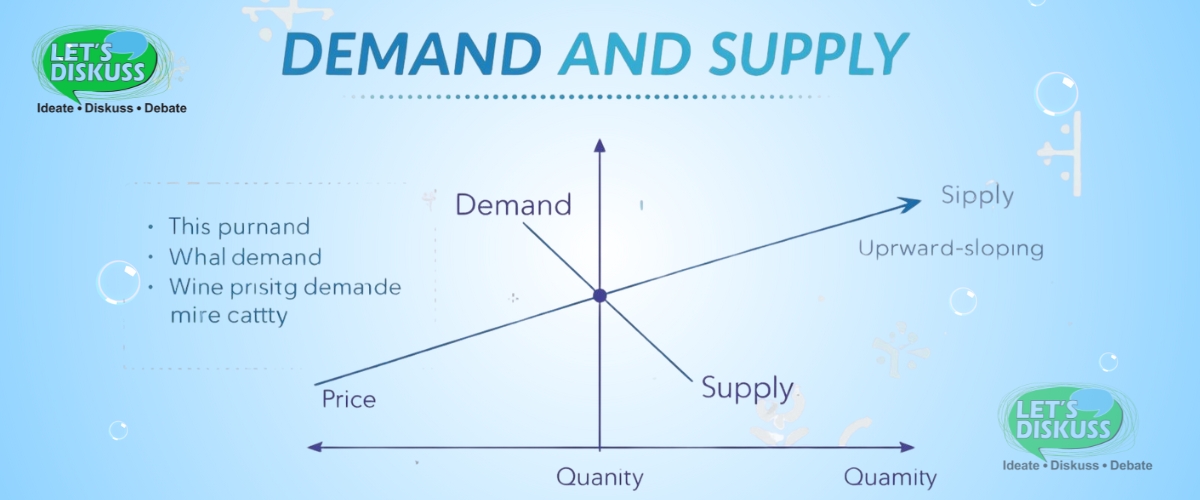
What is Demand?
The quantity of a good or service that consumers are ready and capable of purchasing at various prices in the situation of microeconomics is called demand. According to the law of demand, the higher the price is, the lower is the amount demanded and vice versa. Some of the factors influencing the demand include the income of consumers, consumer preference, price of other related goods and future price expectations. Knowing demand assists businesses to predict sales, price and to prevent the usual demand-supply mistakes.
What is Supply?
Supply refers to the amount of a commodity or service that manufacturers can and will be prepared to sell at different charges. According to the law of supply, as price increases, its quantity supplied increases and as price falls its quantum supplied falls. The supply is influenced by the cost of production, technology, government measures and the prices of the input. Supply analysis aids the businesses in efficient actions by planning production, ensuring profitability, and responding to the changes in the market.
The Interaction of the Demand and Supply
Demand and supply are the most crucial aspect of economics as they dictate the way prices are set in the market. When the quantity that suppliers produce in the market is the same amount that is demanded, that point is known as the market equilibrium.The shortages become evident in case the demand is larger than the supply, which increases the prices.
In case the supply is more than the demand, surpluses increase and the price falls.
Demand or supply changes may have a drastic effect to the market:When the consumer income increases, demand can be enhanced and therefore the demand curve shifts to right.
Industrial development may boost supply pushing the supply curve to the right which may reduce the price.
Following the supply and demand patterns, businesses will be able to make wiser decisions regarding the price, inventory, and production, and consumers will be able to predict the changes in the market. This equilibrium is important in the real world market as it helps us make wise economic decisions.
Sometimes the main errors in the analysis of demand and supply.There is a tendency of misinterpretation of demand and supply trends by many businesses and any student of economics. Being aware of these demand-supply errors avoidance can be used to avoid improper pricing and production mistakes.
Common Mistakes in Demand and Supply Analysis
The often used confusion is between movement tangent to a curve and a change of the curve. Movement is brought about by a price change whereas changes in consumer income or technology result in shifts.
- Ignoring Multiple: Factors In most cases, analysts tend to give attention to one cause and ignore other causes that influence demand or causes that influence supply thus prejudice the outcome.
- Misreading Market: Trends The result of wrong perception of supply and demand trends can be overproduction, underproduction, or loss of market share.
- Misapplying Economic Laws: The inability to implement the concept of the law of demand and law of supply correctly may cause wrong assumptions in terms of pricing and other market phenomenon.
- Ignoring External Influences: Demand or supply can change suddenly, unexpectedly due to changes in government policy, world occurrences or consumer preferences that can lead to strategic mistakes.
Applications in Modern Economics
The laws of demand and supply are very critical in the development of contemporary economics. These ideas are useful in making more prudent financial and production choices by businesses, consumers, and policymakers.
- Price Determination: Demand and supply determine the price of the market. The law of demand and supply have a real-life effect when demand is high and supply is at a fixed level, hence the price is high as illustrated by the law.
- The Business Planning and Strategy: The analysis of demand-supply curve is used by companies to make predictions about sales, establish inventory, and modify production in line with the demands of the market.
- Policy: Formulation Governments analyze supply and demand patterns in order to formulate policies that stabilize prices, curb inflation and spur economic growth.
- Consumer Behavior: Analysis Knowledge of determinants of demand is useful to enable firms anticipate how consumers will react to changes in prices and devise superior market strategies.
- Managing Market Shifts Monitoring any changes in supply and demand, expounded, one can make the organizations react immediately to the conditions, remaining competitive and efficient.
Law of Demand
Something about the Law of demand is fundamental to micro-economics and it states that the quantity demanded of a product is responsive to changes in price. It mentions that with everything held constant, the lower the price of a good, the higher the quaint demanded, and the higher the price of a good, the less a good, the quantity demanded. Such is an inversion of price to demand which shows the behaviour of the consumers and assists the businesses to learn how sales can be impacted due to decisions of the pricing.
The main facts regarding the Law of Demand:
- It exhibits negative correlation of price and quantity demanded.
- This relationship between the demand and the price is usually a downward sloping demand curve to the right.
- Fluctuations of the demand curve take place because of price variation, whereas fluctuation of the curve takes place because of other factors such as income or preferences.
- The forces of demand are the income of the consumer, taste, price of other related goods as well as the expectation in te future.
- Knowledge of this law assists the business to be able to charge the right prices as well as be able to predict the behavior of consumers.
- It forms the foundation to the study of market equilibrium and general demand-supply interactions in economics.
Law of Supply
Another basic concept of microeconomics is the Law of Supply that explains how the price of a commodity and the output level of suppliers relate directly to each other. According to it, all other things held constant, as the price of a good increases the quantity supplied increases and when price falls, then the quantity supplied falls. This is because when prices are high they will offer more incentives to the producers to produce more goods since they will make high profits. The supply law is applicable in explaining the reaction of producers to changes in price within a competitive market.
The Law of Supply: The following are some of the major points regarding the law of supply:
- It depicts that price has a direct correlation with quantity supplied.
- This relationship usually is characterized by the supply curve rising on the left to the right.
- Movements along the supply curve will be caused by changes in prices, whereas movements along the curve are caused by factors such as technology or cost of production.
- Some of the factors that influence supply are the cost of inputs, technology, government policies or prices of related products.
- Knowledge about this law is useful in planning production by businesses, avoiding excessively or insufficiently powerful inventory at any time, and react to market price fluctuations in an efficient manner.
- It is critical in the determination of the market equilibrium in a combination with the law of demand.
Conclusion
To sum up, demand and supply are core concepts of microeconomics and very important in describing the operations of markets. Combined the law of demand and the law of supply will elaborate on the way in which the prices are made and how consumers and producers respond to the shifts in market conditions. The market trends are constantly influenced by factors which influence demand, including income, preferences, other related goods, and those influencing supply including production costs and technology. Through the analysis of demand-supply curves, individuals and businesses are able to make good decisions, predict market changes and prevent the pitfalls of the demand-supply curves. Whether you are a policymaker, businessman or an economic student, learning these principles will ensure that you understand how the forces of demand influence prices and supply responds to demand and lastly, it is the natural way that real-life market forces maintain equilibrium. The modern economies require an effective realization of efficiency, stability, and growth based on a clear understanding of these dynamics.
Frequently Asked Question (FAQs).
- What is the economic law of demand?
According to the law of demand, all other other factors remaining constant, when the price of an item goes down, its quantity demanded rises whereas when the price goes up, its quantity demanded drops. This negative correlation serves to explain the behaviour of consumers in buying. - What is meant by the law of supply?
The law of supply is whereby producers are ready to supply more of a product when its price increases and they are ready to supply less when the price of a product decreases. It underscores the direct correlation between supply and price and assists businesses in making production choices. - Which forces influence the demand and supply within a market?
The demand factors include the consumer incomes, tastes, the price of products that relate to the ones in demand, and future expectations.
Supply would be influenced by the cost of production, technology, government policies and costs of inputs or related goods. A combination of these drives equilibrium and market prices in the market. - What is the relationship between demand and supply and the prices?
Market prices are influenced by the demand and supply. At times when demand is higher than the supply, the price increases owing to scarcity. In case of increase in supply with exchange in demand, the price reduces because of excess supply. This balancing through constant adjustment keeps markets in equilibrium. - What are the pitfalls of demand and supply analysis?
Misunderstanding of movements and shifts on a curve, ignoring any several influencing factors, inappropriate reading of market trends, wrong application of law of demand and supply, and overlooking external forces such as policies or world happenings are some of the usual error on demand and supply.