Introduction
One of the most basic aspects of electromagnetism is the interaction between an electric current and the magnetic field that it produces. This relationship is the foundation of modern electrical technology, whether it is a simple electrical device like an electric motor or a complex one like a particle accelerator. This controlling mathematical expression is referred to as the Biot-Savart law.
An example is the Biot-Savart law, first stated in the early nineteenth century by Jean-Baptiste Biot and Félix Savart, which gives the magnetic field at a point in space in terms of the current that causes it. It is in magnetostatics analogous to the Coulomb law in electrostatics. In the following article, we will give an analytic discussion of its statement, derivation, and applications with textbook-style explanations, figures, and examples of how to solve them.
Understanding the Origin of Magnetic Fields
Electric fields are produced through the movement of electric charges, and at the same time, magnetic fields are produced by the same charges. All the observed magnetic fields can therefore be said to be due to two basic processes:
-
Currents (moving charges) – e.g., conduction current in wires.
-
Intrinsic magnetic moments of particles – e.g., the spin and orbital motion of electrons inside atoms.
The Biot-Savart law itself only concerns itself with the first mechanism, which is a question of how a continuous macroscopic current creates a measurable magnetic field.
Statement of Biot-Savart Law
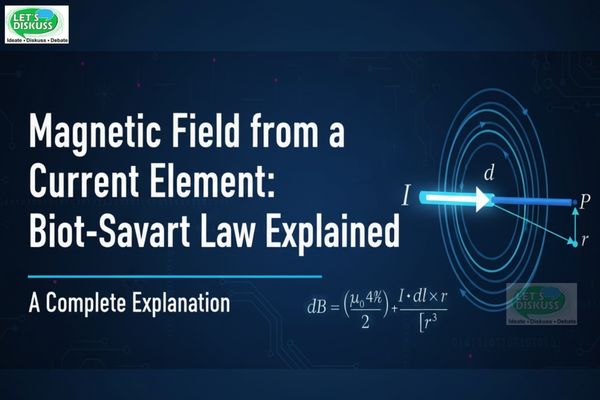
To understand the Biot-Savart law, let us consider a finite conductor XY carrying a steady current I, as shown in the Figure. Let us take an infinitesimal current element of length dl. We want to calculate the magnetic field dB produced at a point P at a distance r from the element.
The Biot-Savart law states that:
-
The magnetic field dB is directly proportional to:
-
The current I
-
The length of the element |dl|
-
The sine of the angle θ between dl and r
-
-
The field is inversely proportional to the square of the distance r2
-
The direction of dB is given by the right-hand rule for cross-product, i.e., perpendicular to the plane containing dl and r.

Vector Form of the Law
The vector form of the Biot-Savart law is:

Here:
-
μ0 is the permeability of free space, a universal constant,
μ0=4π×10−7Tm/A
-
dl is the current element vector,
-
r is the position vector from the element to point P,
-
r = |r|.
Thus, the Biot-Savart law provides a way to compute the magnetic field from current-carrying elements by integrating over the entire conductor.
Magnitude of the Magnetic Field
The magnitude of dB is obtained by taking the absolute value of the cross product:

This expression shows three important dependencies:
-
The field is maximum when θ = 90° (i.e., dl ⟂ r).
-
The field is zero when dl ∥ r.
-
The field decreases rapidly with distance as 1/r2.
Important Features of Biot-Savart Law
The Biot-Savart law has many similarities and differences with Coulomb’s law of electrostatics. Let us highlight them:
(i) Long-Range Nature
Both the electrostatic field and the magnetic field fall off inversely as the square of the distance from the source.
(ii) Scalar vs. Vector Source
-
The electrostatic field arises from a scalar source: the electric charge q.
-
The magnetic field arises from a vector source: the current element I dl.
(iii) Direction
-
The electric field is directed along the line joining the charge and the field point.
-
The magnetic field is directed perpendicular to the plane containing dl and r.
(iv) Angle Dependence
The Biot-Savart law has a sine dependence. Along the axis of the current element (θ = 0°), the field vanishes.
(v) Superposition Principle
Just like electric fields, magnetic fields from different current elements obey superposition—they can be vectorially added.
Physical Constants in Biot-Savart Law
The proportionality constant in the law is:

An interesting connection exists between the permittivity of free space (ε0), the permeability of free space (μ0), and the speed of light in vacuum (c):

This shows that electromagnetism and optics are deeply interconnected, as the speed of light itself is determined by these constants.
Solved Example: Magnetic Field of a Current Element
Example (Fig.)
Problem:
An element Δl = Δx î is placed at the origin and carries a current I = 10 A. What is the magnetic field at a point on the y-axis at a distance of 0.5 m? Assume Δx = 1 cm.

Solution:

Direction:
Using the cross-product rule, the field is along the +z direction.
Final Answer:
B = 4 × 10⁻⁸ T (along +z)
Applications of Biot-Savart Law
The Biot-Savart law is extensively used in electromagnetism to calculate magnetic fields in different configurations:
-
Straight Conductors – Used to derive the magnetic field at a point near a long straight wire.
-
Circular Current Loops – Basis for calculating the field at the center or along the axis of a loop.
-
Solenoids and Toroids – Extended to continuous current distributions to find uniform fields.
-
Design of Electromagnets – Engineers use this law to predict and optimize magnetic field strength.
Conclusion
The Biot-Savart law is one of the cornerstones of electromagnetism, which provides the necessary correspondence between the currents of electricity and the resulting magnetic fields. The law allows the determination of the magnetic field of even complex current arrangements by mathematically describing the magnetic field at a point as the result of an integration of the current element that generates it.
In addition, the law is found to have far-reaching interrelations among electricity, magnetism, and optics, mostly through the relation ε0μ0 = 1/c2, thus highlighting the underlying similarity of these seemingly separate areas.
As a result, the Biot-Savart law not only explains the principle through which the current-carrying conductors produce magnetic fields, but also supports the design of the practical devices, both electromagnets and transformers, and modern particle accelerators.