Introduction
A capacitor is one of the simplest gadgets in physics and electrical engineering when it comes to storing electricity. Simply, a capacitor is a combination of two conductors that have an insulating material in between. The easiest and most familiar and common of these is known as the parallel-plate type, and this type of circuit allows us to understand how capacitance, electric fields, and energy storage all combine in a circuit.
Structure of a Parallel Plate Capacitor
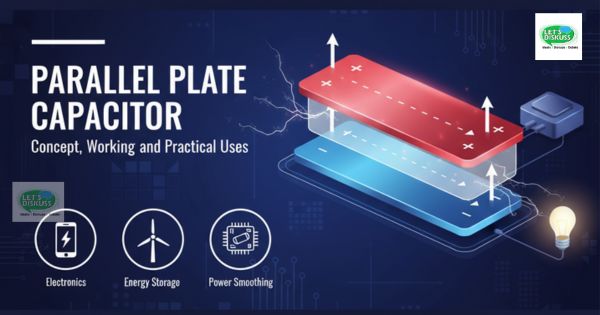
A parallel plate capacitor consists of essentially two metal sheets, which are flat, shiny, and lie side by side. The area of each sheet, A, is equal, and the distance separating them, d, is very small. You take one sheet +Q and the other sheet -Q in order to get equal contrary charges.
The interspersal material between the sheets may be air or some special substance called a dielectric. In practice, the capacitance is increased by increasing the dielectrics constant by reducing the effective electric field. In the simplest theory, however, we simply assume that it is a vacuum.
Since d is far smaller than the plates (d² << A), we can assume that the plates are infinitely large, which makes the calculations significantly simpler and allows us to understand that the electric field in the centre is homogeneous.

Electric Field Distribution
The key to understanding capacitors lies in analyzing the electric field generated by the charges on the plates.
-
Outer Regions (Above and Below the Plates):
Outside the capacitor, the fields due to each plate cancel each other out. This results in a net electric field of zero in the regions above the top plate and below the bottom plate. In other words, the influence of the capacitor is confined largely to the space between the plates. -
Inner Region (Between the Plates):
Inside the capacitor, the electric fields due to the positive and negative plates add together. The result is a uniform electric field throughout the region between the plates, given by:

Here,
-
E is the electric field strength,
-
Q is the charge on one plate,
-
A is the area of the plates, and
-

This uniform electric field is a defining feature of the parallel plate capacitor.
Direction and Nature of Electric Field
Instead, the electric field lines are straight as they pass through the positive plate and to the negative plate. The central space, the space between them, is parallel and equally spaced, and that is why people would love to use capacitors to study electrostatics.
However, at the edges of the plates, the field lines are not perfectly parallel. They bend outward, creating what is known as the fringing effect. In real-world capacitors, this effect means the electric field is not perfectly uniform everywhere. But when d << plate dimensions, fringing is negligible, and we can safely use the uniform field assumption.
Potential Difference Between Plates
It is the electric field that is tightly connected to the potential difference between the plates. Potential difference V is merely the product of the electric field E and the distance d between the plates:

This association highlights how the geometries of a capacitor determine the level of voltage given a definite charge. A doubling of the plate area is essentially a reduction of the potential difference of the given amount of charge at the same value, and a doubling of the plate spacing is likewise an increase of the potential difference.
Capacitance of a Parallel Plate Capacitor
The defining property of a capacitor is its capacitance (C). This is the ability of the capacitor to store charge per unit potential difference, mathematically expressed as:

Substituting the earlier relation between V, Q, and the geometry of the capacitor, we get:

This simple yet powerful equation tells us that capacitance depends only on geometry and the medium between the plates. Increasing plate area increases capacitance, while increasing plate separation decreases it.
Example Calculation
To get a sense of scale, let’s plug in some values:
Suppose each plate has an area of 1 m², and the separation between them is 1 mm (0.001 m). Using the formula:

That is, about 9 nanofarads (nF).
This fact explains why the unit of capacitance (F) is so huge; when practical capacitors, depending on their intended use, have capacitances between microfarads (µF) and nanofarads (nF) or picofarads (pF).
Understanding the Scale of 1 Farad
The size of a one-farad parallel-plate capacitor is simply astonishing. Supposing that we should proceed to construct a 1 F capacitance of just one farad, and that the plates are separated by a distance of 1 centimeter, then the surface area thus necessary would be:

That’s about a 30 km × 30 km plate, which is clearly impractical.
This example explains why capacitors in real circuits rely on dielectrics, rolled foils, and advanced materials to achieve large capacitance in a small volume.
Practical Uses of Parallel Plate Capacitors
Although the so-called ideal parallel plate capacitor is mostly a theoretical concept, the basic principle is the basis on which a multiplicity of useful devices are based. The following are some common applications:
-
Energy Storage:
Capacitors store the energy in their electric field, which then releases it at high rates when the situation demands. This feature makes them essential in circuitry that requires bursts of power, e.g., flash systems on cameras or defibrillators. -
Filtering Signals:
In radio and communication circuitry, any capacitor opposes the passage of direct current (DC) and allows alternating current (AC) to pass. They are, therefore, essential to sieve unwanted frequencies, as well as fine-tune resonant circuits. -
Power Supply Smoothing:
Capacitors are used in the design of a power supply to smooth out the variation in voltage, hence providing a stabilized power supply, which shields electronic components that are sensitive to transient interruptions. -
Studying Dielectrics:
The parallel plate capacitor is a simple model for studying the effect of dielectric materials, which are used to increase capacitance in practical capacitors. -
Timing Circuits:
When paired with resistors, capacitors form RC circuits, which are the basis for timers and oscillators in electronics.
Conclusion
The parallel plate capacitor may appear to be a mere two plates with a gap in between but it is really of great significance in physics and engineering. It gives us a clear picture of the functioning of the electric fields, the way in which potential difference occurs, and how you can store and utilize charge effectively.
A capacitor constructed in that way would be enormous--so that would not be convenient. Nevertheless, all modern capacitors are based on the concept. New materials, smaller designs, and with additional dielectrics, the current capacitors perform all we require in electronics, including phones and satellites.
The best part of the parallel plate capacitor is that it is so simple, two plates, and a single electric field, and has a myriad of uses.