How close were Russian COSMOS craft and what's their capability?
0
1K
Join this conversation
Sort By
Replying to the question above
Answered on05/08/26
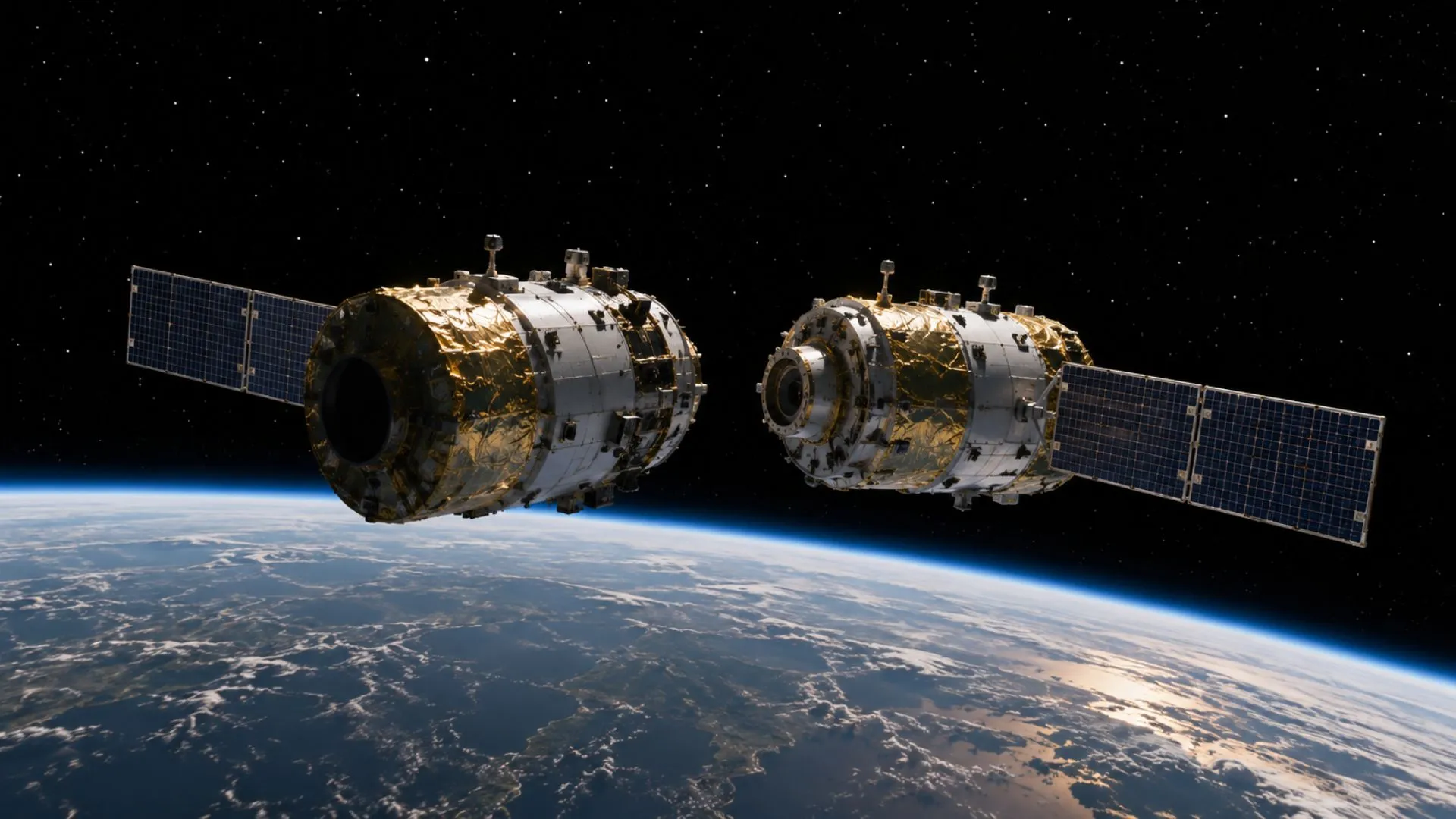
Space trackers recently confirmed that Russian COSMOS satellites are maneuvering within a mere 10 feet of each other at speeds of 17,000 mph. These "inspector" crafts specialize in proximity operations, using advanced autonomous thrusters to "stalk" high-value targets.
Their capabilities include deploying smaller sub-satellites like nesting dolls to intercept radio signals or snap high-res photos. Most concerningly, the Pentagon views them as potential ASAT weapons capable of firing projectiles to disable or destroy critical GPS and communication networks.
On April 28, 2026, the Russian spacecraft COSMOS 2581 and COSMOS 2583 made a startlingly close pass, coming within barely 10 feet (3 meters) of one another.
For perspective, these things are moving at around 17,000 mph. A gap of 10 feet at that speed is almost the equivalent of two fighter planes flying wingtip-to-wingtip in orbit.
What this tells us about their capabilities:
Precision Engineering: This was not some "flyby." Tracking data from companies such as COMSPOC indicated that COSMOS 2583 executed “fine maneuvers” to maintain that precise position. This demands extremely sophisticated propulsion and self-guided devices.
Rendezvous and Proximity Operations (RPO): This course is a masterclass in RPO. It demonstrates Russia’s capacity to approach, shadow and maintain formation with other objects in space.
Dual Use Technology: These talents are theoretically needed for things like “space tugs” (refueling or repairing satellites), but are more often looked at as “inspector satellite” capabilities. This demonstrates that they are able to approach close enough to another country's satellite to take pictures of it, listen in on its signals, or even physically destroy it.
Test Multi-Object Coordination: A third satellite, COSMOS 2582, and a subsatellite, “Object F,” were included in the test. This suggests they are not merely flying one vessel, but are synchronizing a “cluster” of assets concurrently and that is a degree of competence that only a handful of space powers have now.
Aanya Sharma is a science and technology writer with over 5 years of experience and 300+ published articles across leading digital platforms. She holds a Bachelor's degree in Science (Physics) from Delhi University, which grounds her writing in scientific literacy and gives her the ability to evaluate technical claims with accuracy.
Her work has appeared on platforms including The Wire Science, Analytics India Magazine, and Digit.in, where she has covered artificial intelligence, space exploration, consumer technology, environmental science, and emerging tech policy. With a focus on accuracy and clarity, her writing makes complex scientific and technological developments accessible to readers without a technical background.
Aanya has participated in science communication panels at events including the India Science Festival and has been recognised as a contributor to responsible tech journalism in India. She is an active member of the National Association of Science Writers (NASW) and maintains a public portfolio of her published work.
Across all her work, her writing is grounded in verified sources and a commitment to editorial standards — delivering content that readers can rely on in a space where misinformation spreads easily.