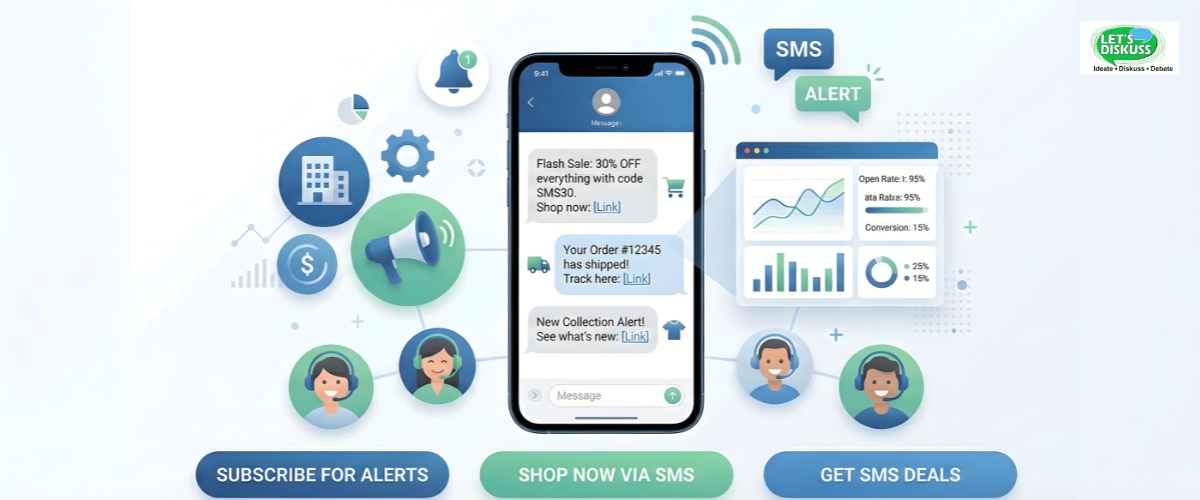
Introduction to SMS Marketing
SMS marketing is a form of marketing practice that involves sending promotional, informational, and transactional messages to customers. SMS marketing continues to make sense even today when customers are mainly using WhatsApp or social media apps or even email for communication. This is because SMS is the most direct digital communication channel.
Earlier text messages were used for basic alerts but now through SMS, marketing communication can be highly personalised, automated and can be used for various campaigns. With the help of SMS, marketing, customers can be reached instantly.
If you compare SMS marketing with WhatsApp, notifications or emails, they stand out because:
No internet connection is required for SMS
Since there are a number of WhatsApp notifications and emails, nowadays, customers can ignore or filter your communication
There is a higher readability when a message is delivered via SMS marketing
That is why even today SMS marketing is a powerful tool to communicate with your customer base.
Understanding the SMS Marketing Landscape
How SMS Marketing Works
SMS marketing works by sending any particular communication to customers via text message. Businesses use SMS marketing in order to:
Inform customers about subscribing or introducing them to website or app
Create schedule messages to be sent on particular day and time
To segment audience
To give tracking details of delivery
To ask them feedback or performance review
Since SMS is delivered directly, even when the phone is not having an active Internet connection, this makes SMS, one of the most instant marketing channels to reach customers.
Key Terms and Concepts
SMS marketing has many key terms and concepts that includes:
Opt-in: Customer consent to receive text messages
Opt-out: Customer request to stop receiving messages
Short code: A code used for high-volume messaging, usually one-way. It is a 5–6 digit number
Long code: A standard business phone number used for two-way communication with the client
Compliance, Consent, and Legal Regulations
SMS marketing is regulated to save and protect customers and save their interest. Businesses must note to comply with certain laws for using SMS as a marketing tool such as:
TCPA (USA) – There should be an explicit consent of the customer before messaging
GDPR (Europe) – It governs data privacy and rights of the users
TRAI (India) – It governs promotional SMS and DND rules
Failure to comply with the rules of the respective country can lead to heavy fines. Anyone blacklisting of numbers. Excessive use of SMS can also lead to loss of customer trust.
Short Codes vs. Long Codes
Short codes are often used by businesses that have a huge customer base. This is the right format to use for mass campaigns and for faster delivery of SMS. It also creates a higher trust and visibility in the minds of the customers.
Long codes on the other hand are suitable when there has to be a two-way communication with the customer. This is usually not considered by businesses because it is an anonymous number and customers can't trust it fully. It is lower in cost as compared to short codes.
Building an SMS Marketing Strategy
For building a successful SMS campaign, there has to be a clear strategy. The following are the steps through which one can build a successful SMS marketing strategy:
Defining Your Goals
The first step is to define your goal. There might be a seasonal sale or a flash offer that is going on that you want to communicate to the client or you want to let your customers know of a particular event that is happening or you want to send order updates. All these count as your goal of communication. SMS marketing should be used for a particular communication and not just for promotional activities. This will improve customer trust and retention.
Identifying Target Audiences
When your goal is that, you should identify your target audience. Before sending out any SMS, you should be aware of your customers, purchase, history, location, engagement levels. A personalized SMS, based on this info can result in better engagement and solution.
Segmenting Subscribers Effectively
To make the most efficient use of SMS marketing, you should segment your subscribers to send relevant messages to different segments of customers. You should consider factors such as new subscribers versus loyal customers, abandon cart users, or you can segment to send any location-based offer.
Choosing the Right Messaging Frequency
Too much use of SMS marketing will act against you. If the frequency of SMS is not right, then customers can go for opt-outs. A balanced approach of sending SMS should be followed, which means sending 2 to 4 messages per month for promotion, messages of transaction whenever required, 8 to 10 triggered based messages that includes communication of offers and festive sales.
Crafting High-Converting SMS Campaigns
Writing Clear and Compelling Messages
Writing a clear copy for your SMS campaigns is the key for getting the desired result. An effective SMS should be short and direct in speech. It should be easy to understand so the language should be flowy and comprehendible. SMS should be action oriented and so towards the end, there should be a CTA i.e., call to action to which the customer can respond to.
A good SMS should also include:
Name of the brand
Offer or purpose of SMS
Call-to-action (CTA)
Personalization Strategies
Personalised messages are better than mass SMS as they perform better in terms of engagement and responding to CTAs. You can personalise SMS by using customers name and their last purchase. You can also send some recommendations to them by suggesting them the products that are there on their WishList.
Time-Sensitive and Triggered Messages
SMS marketing is the right tool to use for campaigns that are urgency driven. You can send SMS to communicate:
Flash sales
Limited-time discounts or offers
Reminders of appointments or classes
Cart nudges or wishlist on offer communication
Tools and Platforms for SMS Marketing
Top SMS Marketing Platforms
There are many SMS marketing platforms that you can use to send across your SMS campaign. The below mentioned order a few popular marketing platforms that modern businesses use:
Campaign automation tools for sending bulk messages
CRM integration to send appointment reminders and details
Analytics dashboards for previewing results
Compliance management tool
Features to Look For
You can opt for any of the above mentioned platforms based upon your needs and preferences. Your need for SMS marketing may be promotional or maybe just to provide appointment communications. So, based on your requirements, you can opt for the platform.
You must also select if you want short codes or long codes considering if you want one way communication or a two-way communication with your customer. For personalisation options and reporting of engagement, there are management tools and dashboards that you can go for.
SMS marketing works best when it is integrated with email, CRM and e-commerce platforms.
Automating SMS Workflows
There are also many tools and platforms that can be used for automating SMS. Automation helps businesses to send across communication. For example, welcoming a new customer or follow up after every purchase. This automation helps in sending reminders and also to establish a re-engagement with active users.
Types of SMS Marketing Campaigns
Promotional SMS
One of the most common uses of SMS marketing is to promote your brand. Promotional SMS can also be used for promoting discounts, product launches, seasonal offers, and festive sales offers.
Transactional Messages
SMS marketing for transactional messages involves sending out order confirmation to customers, sending them shipping updates, sending them OTP's once they make an account at your website and also to send various alerts after the purchase.
Drip Campaigns and Automated Flows
Drip campaigns or not based on instant results, but these are more focused on creating a gradual communication flow with the user. These are used by businesses for products onboarding or loyalty programmes. These can also be used for sending educational messages.
Alerts, Reminders, and Notifications
This type of SMS marketing involves sending alerts, reminders and notification to customers. Businesses who run on an appointment basis can send appointment reminders to customers. Those who hold regular events can send event notifications for the upcoming events. This can also be used for sending subscription or package renewals.
Customer Support via SMS
SMS marketing and also be used for customer support for a quick query resolution. You can also send a follow-up message to the customer after the purchase to collect feedback.
Measuring SMS Marketing Success
So how to measure SMS marketing campaign success? There are key marketing Matrixx through which you can measure the success of any campaign. These are:
Open rate
Click-through rate (CTR)
Response rate
Conversion rate
Opt-out rate
Tracking ROI
Once you measure the success of the campaign, you should also track your ROI.
ROI can be measured by comparing the actual cost of the campaign and the revenue generated through that campaign. An extended ROI can also be measured by observing if you have created a loyal customer base through attaining customers from that campaign.
Analyzing Customer Behavior
And effective SMS marketing should also let you know more about your customer’s behaviour. This involves knowing about the most effective messages in your campaign that resulted in the final purchase, or best sending time which resulted in action, etc.
Improving Campaign Performance
Measuring campaign performance always helps you to form a better campaign the next time. You should know what refinement is needed in your communication and how you can improve targeting by segmenting your customers the right way. You should also know why customers went for opt-outs and how you can reduce it.
Best Practices for Effective SMS Marketing
Getting Proper Customer Opt-In
One of the best practices for effective SMS marketing is getting proper customers often by using a clear language that explains your message well. You should also keep the frequency of your message limited to 2 to 4 times a month. You should also give your customers a proper instruction to opt out so they should not feel offended and form a bad image of the brand.
Avoiding Spammy Messaging
SMS marketing should not look like SPAM. To avoid being marked as Spam, you should always send only the relevant communication and limit your frequency of sending SMS. You should try to understand the preferences of your customer and make your SMS personalised.
Ideal Timing and Frequency
Always remember to send SMS during business hours and never send messages late at night or early in the morning. The frequency should also be in control as customers should not feel bombarded with the communication all at once.
Delivering Value in Every Message
SMS marketing should only be used to deliver valuable messages. It should communicate useful information to the customers. That is why it is said to always have a clear goal before opting for an SMS campaign. The customers should see a reason to engage with the brand.
Common Challenges and How to Overcome Them
Like any marketing campaign, SMS marketing campaigns also face many challenges. The below mentioned are the most common challenges that one can face:
Low Engagement Issues
Businesses can face low engagement issues as many brands are opting for SMS and that is why customers usually ignore it. To tackle the low engagement issue, you should start sending personalized messages with customer names. You can also offer real values in your messages. For example, telling them that you are offering a flat 50% off. Also make sure to give a clear CTA towards the end. For example, giving them a number to reach out to, or giving them the website link to shop from.
High Opt-Out Rates
If you are facing higher opt outs, then you should lower your frequency of sending SMS. It simply means that customers are getting irritated by frequent messages. You can also segment your audience and avoid aggressive sales language in order to get conversions.
Deliverability Problems
Businesses may face delivery problems, which means that SMS not getting delivered to the subscriber list. Make sure that your list of customers have verified numbers. Also, make sure that you are following all the compliance rules and not aggressively using your SMS marketing tool.
Compliance Mistakes
Another challenge that can be faced by businesses opting for SMS marketing is a compliance mistake. Always stay updated on the regulations of SMS sending in the country you are operating in. You should also keep consent records of your customers and honour opt outs requests immediately.
The Future of SMS Marketing
The future of SMS marketing is in amalgamation of other omni channels, search as email, WhatsApp etc. In the coming times SMS marketing can be automated using AI. This will help in smart segmentation of customers and automated personalisation. This can also help in predictive messaging which can solve the problem of opt outs.
With the penetration of smartphones, SMS marketing will see a rise in its enhancement using Rich communication services (RCS). RCS enhances SMS marketing by allowing it to use images and videos with the messages, interactive CTA buttons, and excellent branding elements that will take this form of marketing to another level.
The focus of SMS marketing in the future will evolve to provide a better customer experience.
Conclusion
SMS marketing till date is one of the most powerful marketing tools, mainly because it delivers your communication immediately without an active internet connection. It is simpler and usually has higher engagement rates as compared to emails and push notifications. Businesses can strike a better result and user engagement by using SMS marketing strategically.
All in all, SMS marketing is important to build a stronger customer relationship, and deliver the right communication to customers in real-time.
FAQs
How do I start an SMS marketing campaign?
To start an SMS marketing campaign, you should define your goal and segment your audience. You should draft a clear message you want to communicate.Do customers need to opt in for SMS marketing?
Yes, explicit opt-in is legally required. This is a compliance that every business must follow.What types of messages can be sent through SMS marketing?
Messages like promotional offers, order and shipping updates, reminders and alerts, customer support, etc. can be sent through SMS.How often should I send SMS messages?
2–6 promotional messages per month. Also, updates and order details via messages sent only when required.What is the difference between SMS and MMS?
SMS is only text, while MMS allows to send images, videos, and other multimedia content. MMS costs more than SMS and has lower deliverability.