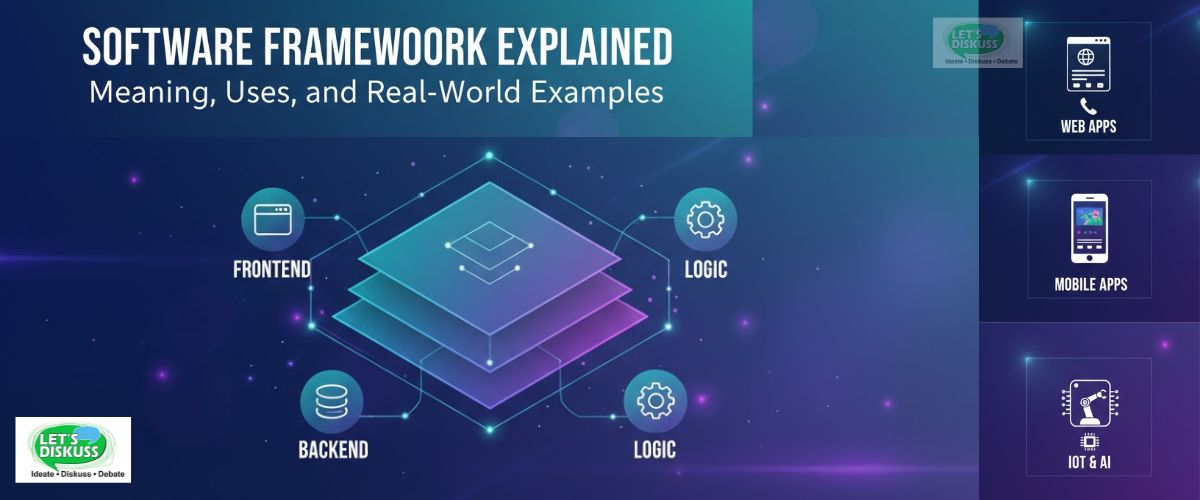
Understanding the Role of Software Frameworks
As I wrote the first few lines of code, I created all that myself, all the functions, all the structures, all the logic. It succeeded, and it was tedious and sloppy. Then I came across software frameworks and then development became seeming structured, productive and orderly.
Software framework provides you with the base that you will develop robust and scalable software without having to re-invent the wheel. It is as though you have a skeleton of a house; you just make up the interiors. Frameworks conserve time, assist in structuring and assist in ensuring uniformity within large projects.
What is a Software Framework?
Software framework is a set of code, libraries and guidelines, which are ready-built, and assist developers in creating applications more quickly. It is a road map that outlines how various components of your application development-making process are to work together.
Also generally in contrast to a library that you call when you need it, a framework frequently calls your code when you need it- a concept referred to as Inversion of Control. This implies that you use the structure of the framework and yet you can still go ahead and customize your application.
When you might have asked yourself "what is a framework in software", it is actually a pre-written environment that does the teddy work such as database connections, routing or authentication to allow you to concentrate on the main logic.
Concisely, "what is a software framework?" It forms the foundation on which every developer bases his/her code to code smarter but not harder.
The operation of a Software Framework: How It Works
Each framework is based on a pre-architecture that influences the manner in which the application acts. It also presents re-useable modules and has code patterns which are used to enforce code consistency.
In a software engineering process framework, they are structures that define workflows, such as the flow of data amongst components, how user inputs are processed or how errors are processed.
As an example, in Django (a Python-based framework) you define models, views and templates independently, and it is a routing framework and a rendering engine. Such an organized structure makes it easy to collaborate and it accelerates the process of software development.
The process framework in software engineering provides guidance to the development team and projects do not go out of control.
Types of Software Frameworks
Frameworks exist in various forms based on the application that is being developed. Let's break them down:
1. Web Frameworks
A web framework assists the developers in developing web sites and web applications. Django, ruby on rails, and Laravel are classical. They control such entities as database communication, routing, and templates.
2. Frontend Frameworks
A frontend framework is used to regulate the content and interfaces of the user. User interfaces are dynamic and engaging with such frameworks as React, Angular, and Vue.js.
3. Backend Frameworks
A backend Frameworks concern itself with all of the stuff that is on the other side of the curtain server-side implementation, APIs, and database management. The best ones are Node.js,Spring Boot, and Express.js.
4. Automated Testing Frameworks
Testing frameworks like Selenium or PyTest automate repetitive testing tasks, ensuring your app runs as expected.
Each of these types of framework plays a unique role in modern software development, reducing manual effort and improving quality.
Software Framework Popular Examples
We shall speak of some of the most popular names:
-
React (Frontend Framework): Adored due to its flexibility and its use in the development of web application frameworks.
-
Django (Backend Framework): Follows the "Don't Repeat Yourself" philosophy and makes application development incredibly fast.
-
Flutter (Mobile Framework): Cross-platform mobile application.
-
Electron Software Framework: Ideal to the development of desktop applications such as Slack or Visual Studio Code in web technologies.
All of these demonstrate how structures can be customized to a particular requirement- be it web, mobile or desktop.
The advantages of a Software Framework
It is not merely a matter of convenience to use a software framework, but will alter your way of thinking as a developer.
This is what I have been observing over the years:
-
Faster Development: Frameworks are equipped with solutions to repetitive code development.
-
Better Security: The majority of frameworks are defended against such threats as SQL injection or cross-site scripting.
-
Scalability: As your project increases, the software process framework makes it constant and maintainable.
-
Easier Testing: A number of them are compatible with automated testing frameworks.
In case you are a full stack web developer, it becomes a bit easier to deal with such frameworks as MERN or MEAN, which bridge the gap between the front and back end.
When you have tried such efficiency, you will never revert to raw coding.
The Difference Between Software Design Patterns and Software Frameworks
Software design patterns are usually mistaken to be software frameworks. They are almost similar but not the same.
Software design pattern is an easy-to-use solution to a common problem, such as the Singleton or Observer pattern. It's a concept or strategy.
The actual implementation, using illegal editor: a working skeleton that consists of those skeletal patterns under the hood, is called a software framework.
Patterns are recipes, rules are hewn cabinets constructed of recipes, frameworks are complete kitchens and make up of hewn cabinets.
They both help to make software development smarter and structured.
How to select the Right Framework in Your Project
Choosing the appropriate software framework is daunting. Something new is always on the free-way. I have been taught to concentrate on three things:
-
Project Needs: A basic web Framework such as Flask is fine with simple websites. In the case of enterprise systems, you might require it to be a bit stronger such as Spring Boot.
-
Team Skillset: A framework can only be as effective as the way you apply it. Select one that your team is at ease.
-
Community Support: Community-based structures are more updated and troubleshooting are better.
In case you want to create APIs, consider the structures designed to create API development such as FastAPI or Express.js.
The proper structure is instinctive in it comes to your project as a glove fits a man.
Challenges and Limitations of Frameworks
I am as fond of frameworks as I can be, but they are not flawless. They are restrictive to some developers since they must work under the rules that are already laid down. You are not always able to customize everything as you would want.
Other software framework challenges are:
-
Time-consuming Learning Curve: There are some frameworks that are difficult to master.
-
Overhead Performance: Heavy structures may slow down lean projects.
-
Dependency Lock-in: If you are committed to a framework it may really hurt to change.
This is why it is important to be informed of the benefits as well as the constraints of the framework limitations before leaping into it.
The Future of Software Frameworks
Frameworks are not disappearing they are being changed. The modern software frameworks reveal the pace at which technology is advancing. New frameworks such as Svelte, Next.js and Remix are putting more emphasis on performance and developer experience than ever.
Software frameworks are going to be even more adaptive in the future, allowing the use of AI-based development, real-time teamwork, and increased speed of automation.
A proper software engineering process framework will remain as an interface between inventiveness and design and ease the lives of developers.
Final Thoughts
A software framework is not a tool to be naively treated but one of your companions that can define your way of coding and thinking. It assists you in being creative as dealing with the drudgery of application development.
When someone poses a question to me, "What is a framework software?" I explain to them: it is the unspoken construct that is holding your project together. It puts your fancy to the blunt. It puts your fancy to the blunt.
Then, be it the frontend framework you are investigating, the new backend framework you are testing, or the automated testing framework you are studying, keep in mind: a framework that is right does not only save you time, it can transform the way you code.
FAQs:
1. What is a software framework in simple terms?
A software framework is an existing structure or platform that assists developers to develop applications quicker by reusing existing pre-written code and adhering to a set structure.
2. What is the main purpose of a software framework?
It is primarily aimed at the one hand to make software development easier offering reusable elements that minimize redundant code and consistency across projects.
3. What are the different types of software frameworks?
They are primarily web frameworks, frontend frameworks, backend frameworks, testing frameworks and mobile app frameworks each designed to fulfill a specific development aspect.
4. How does a software framework differ from a library?
A library is the collection of functions you make calls to when your application requires them, whereas a framework is the overall structure in which you insert your application code in into it.
5. What are some examples of popular software frameworks?
Examples of popular ones are React, Angular, Django, Spring Boot, Laravel, Flutter and the Electron software framework on desktop apps.
6. Why do developers use frameworks?
Frameworks help developers to save time, write cleaner code, enhance security, and develop scalable applications without necessarily having to address everything fresh.
7. What is the difference between a software design pattern and a framework?
A software design pattern refers to a reused concept or strategy whereas a software framework is a concrete real code that refers to a set of patterns to create a program.
8. Is using a software framework necessary?
React and Angular are also popular with frontend. In the case of backend, developers usually tend to use Node.js, Django, or Laravel. You have to pick the best depending on your project objectives and language.
9. Which framework is best for web development?
React and Angular are also popular with frontend. In the case of backend, developers usually tend to use Node.js, Django, or Laravel. You have to pick the best depending on your project objectives and language.
10. Can I create my own software framework?
Yes, you can. Custom frameworks are at times developed by developers whereby the existing ones fail to satisfy them but this is laborious and only those with a deep understanding in the technical aspects can do so.
11. What is a process framework in software engineering?
It consists of a formalized set of practices and tools that inform the process of software development, testing and delivery and make sure each phase of the development process is based on a dependable process.
12. What is the future of software frameworks?
The next generation of structures is most likely to be based on automation, integration of AI, and developer experience- software development will be quicker, smarter, and more cooperative than ever.