Introduction:
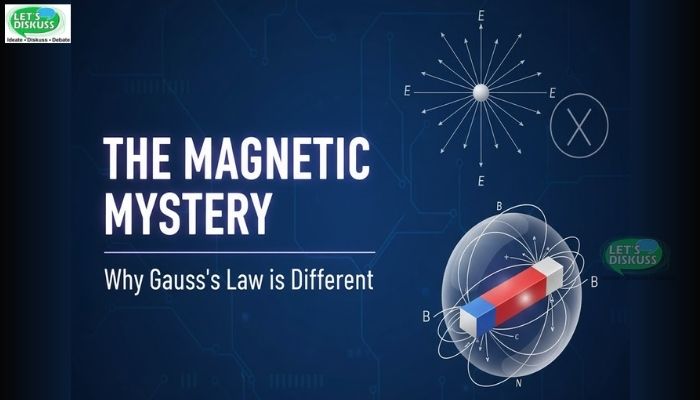
While we are familiar with Gauss's law for electrostatics, which helps us calculate electric fields due to charges, the magnetic version of this law reveals a fundamental and radical difference in the nature of the magnetic field itself. Electrostatics is governed by the presence of discrete electric charges, which act as sources and sinks for electric field lines. Magnetism, however, arises from the motion of these charges, leading to a field with a fundamentally different topology—one of continuous, closed loops. This blog post will explore Gauss's Law for Magnetism, the profound implications of the absence of magnetic monopoles, and how to correctly visualize magnetic fields through illustrative examples and common pitfalls.
Recapping Gauss’s Law for Electrostatics
In electrostatics, Gauss's law states that the net electric flux through a closed surface is proportional to the net electric charge enclosed within that surface. Mathematically, it is expressed as:
∮SE⋅dS=qenc/ϵ0
where E is the electric field, dS is an infinitesimal vector area element normal to the closed surface S, and qenc is the total charge enclosed.
1. The Visual of Electric Field Lines
Pictorially, if a closed surface encloses a positive net charge, there is a net outward flux of electric field lines, meaning more lines leave the surface than enter it. Conversely, if it encloses a negative charge, there is a net inward flux. If the net enclosed charge is zero, as in the case of a closed surface represented by Q in your textbook's figures, the number of lines leaving the surface is equal to the number of lines entering it. This visual intuition is perfectly consistent with the mathematical formulation of Gauss's law for electrostatics.
The Magnetic Field: A World of Closed Loops
The situation is radically different for magnetic fields, which are continuous and form closed loops. This is not just a curious observation but a foundational property. Examine the Gaussian surfaces represented by Q or U^ in Fig 5.3(a) or Fig. 5.3(b). Both cases visually demonstrate that the number of magnetic field lines leaving the surface is balanced by the number of lines entering it. The net magnetic flux is zero for both surfaces. This is true for any closed surface, regardless of its shape or size, or where it is placed in a magnetic field.
1. The Mathematical Statement
Consider a small vector area element ΔS of a closed surface S as shown in Fig. 5.6. The magnetic flux through this element is defined as ΔϕB=B⋅ΔS, where B is the field at ΔS. We divide S into many small area elements and calculate the individual flux through each. Then, the net flux ϕB through the entire closed surface is:

In the limit of infinitesimally small elements, this sum becomes a surface integral, giving us the formal integral form of the law:

Compare this with the Gauss's law of electrostatics. The stark difference is a direct reflection of a fundamental physical reality.

The Fundamental Reason: The Non-Existence of Magnetic Monopoles
The stark difference between the two Gauss's laws is a direct reflection of the fact that isolated magnetic poles, or monopoles, are not known to exist. In electrostatics, an electric monopole (a positive or negative charge) is the source of the electric field. Lines of E begin on positive charges and end on negative charges.
1. The Simplest Magnetic Element is a Dipole
Sources or sinks of the B magnetic field do not exist; the simplest magnetic element is a dipole or a current loop. If a bar magnet is cut halfway, no north and south poles are found, but two smaller magnets form, each having its north and south pole. The magnetic phenomenon, ranging from the field of a simple bar magnet to the complex fields found in the cores of planets, can be explained by a combination of dipoles and/or current loops. All magnetic field lines that start somewhere must end somewhere, and in the case of a magnetic field that has no net source or sink, they must end in a continuous, closed loop. Therefore, the total magnetic flux across any enclosed surface is zero; all the field lines entering must leave.
The Formal Statement of Gauss’s Law for Magnetism
Therefore, we can formally state Gauss's law for magnetism as follows: The net magnetic flux through any closed surface is zero.
This is one of the four cornerstones of Maxwell's equations that unified the theory of electromagnetism. It is a powerful constraint that any physically realizable magnetic field must obey.
Case Studies: Identifying Incorrect Magnetic Field Lines
A great way to solidify this concept is to examine diagrams from Fig. 5.7 and point out why certain depictions of magnetic field lines are wrong. This exercise sharpens our understanding of what magnetic fields can and cannot do.
1. Field Lines Emanating from a Point (Wrong) - Fig. 5.7(a)
With magnetic systems, the field lines cannot be generated at a single point, since this would mean that the net outward flux will not be zero, and hence violates the law of Gauss in the case of magnetism. Ideally, the number of field lines entering and exiting the surface should be equal as occurs in the conceptual setting shown below. The diagram used in the inaccurate figure will in fact, illustrate the electric field due to infinitely long and uniformly charged positively charged wire. The correct illustration of magnetic field lines around a straight, current-carrying conductor, on the contrary, would be in the form of concentric circles around the wire.

2. Crossing Field Lines and Loops in Empty Space (Wrong) - Fig. 5.7(b)
Field lines can never cross each other, because otherwise the direction of the field at the point of intersection is ambiguous. There is a further error in this figure. Magnetostatic field lines can never form closed loops around completely empty space. A closed loop of a static magnetic field must enclose a region across which a current is passing (as in a solenoid or a loop of wire). By contrast, electrostatic field lines can never form closed loops.

3. Correct Confinement in a Toroid (Right) - Fig. 5.7(c)
A toroid correctly demonstrates field lines forming closed loops entirely within its core, as each loop encloses the current in the windings. Nothing is wrong here. For clarity, only a few field lines are shown, but the entire region enclosed by the windings contains a magnetic field. This is a perfect example of a field that is entirely confined within a structure without any "leakage" that would violate Gauss's law.

4. The Fringing Field of a Solenoid and Bar Magnet - Fig. 5.7(d), (e), (g)
-
Fig. 5.7(d) (Wrong): Field lines due to a solenoid at its ends and outside cannot be completely straight and confined; such a thing violates Ampere's law. The lines should curve out at both ends and meet eventually to form closed loops. A closed surface placed over one end of this solenoid would show a non-zero net flux, which is impossible.
-
Fig. 5.7(e) (Right): These are correct field lines outside and inside a bar magnet. Note carefully the direction of field lines inside (from south to north). Not all field lines emanate out of a north pole; they form continuous loops. The net flux through a surface surrounding either pole is zero.
-
Fig. 5.7(f) (Wrong): These field lines cannot represent a magnetic field. In the upper region, all the field lines seem to emanate out of the shaded plate, implying a net non-zero flux through a surface surrounding it. This is impossible for a magnetic field. The figure actually shows the electrostatic field between two parallel charged plates.
-
Fig. 5.7(g) (Wrong): Magnetic field lines between two pole pieces cannot be precisely straight at the ends. Some "fringing" of lines is inevitable as the field lines curve to form closed loops. Confining them perfectly would, again, violate Ampere's law and Gauss's law. This fringing effect is also true for electric field lines in capacitors.

Frequently Asked Questions on Magnetic Fields
Let's address some common conceptual questions that arise when studying magnetism and Gauss's law.
1. Are Magnetic Field Lines "Lines of Force"?
No. The magnetic force on a moving charged particle is always normal to B, given by F=qv×B. This means the force is perpendicular to both the velocity and the field direction. Therefore, it is misleading to call magnetic field lines as lines of force. They indicate the direction a small magnetic compass needle would align, not the path a moving charge would follow.
2. Confinement in a Toroid vs. a Straight Solenoid
Magnetic field lines can be entirely confined within the core of a toroid but not within a straight solenoid because a toroid has no 'ends'. If field lines were entirely confined between the two ends of a straight solenoid, the flux through a cross-sectional surface cap closing one end would be non-zero. But the flux of field B through any closed surface (like a pillbox covering the end) must always be zero. The toroid's donut shape elegantly avoids this problem, as every field line remains inside the core without any ends from which flux could escape.
3. What If Magnetic Monopoles Existed?
Gauss's law of magnetism states that the flux of B through any closed surface is always zero: ∮B⋅dS=0. If magnetic monopoles existed, the right-hand side would be equal to the net magnetic charge qm enclosed by S, analogous to Gauss's law for electrostatics. The modified law would be:
∮SB⋅dS=μ0qm
where qm is the (monopole) magnetic charge enclosed by S. The search for magnetic monopoles remains an active area in fundamental physics.
4. Self-Force and Torque in Magnets and Wires
No, a bar magnet does not exert a torque on itself due to its own field, and a current element does not exert a force on itself. The field generated by an element cannot act upon that same element. However, one element of a current-carrying wire can exert a force on another element of the same wire. For the special case of an infinitely long, straight wire, the net force on any segment due to the rest of the wire is zero because the forces cancel out symmetrically, but for wires of other shapes, this self-force can be significant and leads to phenomena like the pinch effect in plasma physics.
5. Can a Neutral System Have a Magnetic Moment?
Yes. The magnetic moment arises due to charges in motion, not from a net static charge. The average of the charge in the system may be zero, yet the mean of the magnetic moments due to various internal current loops may not be zero. A prime example is found in paramagnetic materials. The atoms or molecules of these materials, like those in aluminum or oxygen, have a net magnetic dipole moment due to the orbital and spin motions of their electrons, even though the atom itself is electrically neutral.
Conclusion: A Cornerstone of Electromagnetism
The law of magnetism formulated by Gauss in the succinct statement of zero net magnetic flux is an effective and fundamental principle that stresses the dipolar nature of magnetism and the absence of magnetic monopoles in the modern theory of physics. The arrangement of the magnetic field is not an accident of mathematical interest but rather a substantial physical law which forces the magnetic field to take the form of smooth, continuous closed loops, visible everywhere, both in toroidal cores and in the great magnetic fields of the stars and the galaxies. Skillful understanding of this principle is necessary with regard to correct interpretation of magnetic phenomena as well as with regard to distinguishing between them and their electric counterparts.