There’s no one-size-fits-all answer here. It depends on your professional objectives, your budget, and where you anticipate yourself working after graduation.
If you want to work in India, get a good ROI and be connected to one of the strongest alumni networks in India, then a top IIM is a great option.
If you want to develop an international career, encounter other cultures, learn alongside peers from around the globe, and enhance your global perspective, then an MBA abroad can be the best choice. Well-known MBA programs also provide worldwide networking and exposure to varied corporate contexts.
If I didn't care too much about the money, I'd do an MBA abroad myself. Not because I believe it is automatically better than an IIM, but because I believe education is a lot more than classrooms. Living abroad teaches you independence, exposes you to new cultures, helps you establish a worldwide network, and transforms the way you think. Those experiences stick with you for a long time after you’ve got your degree.
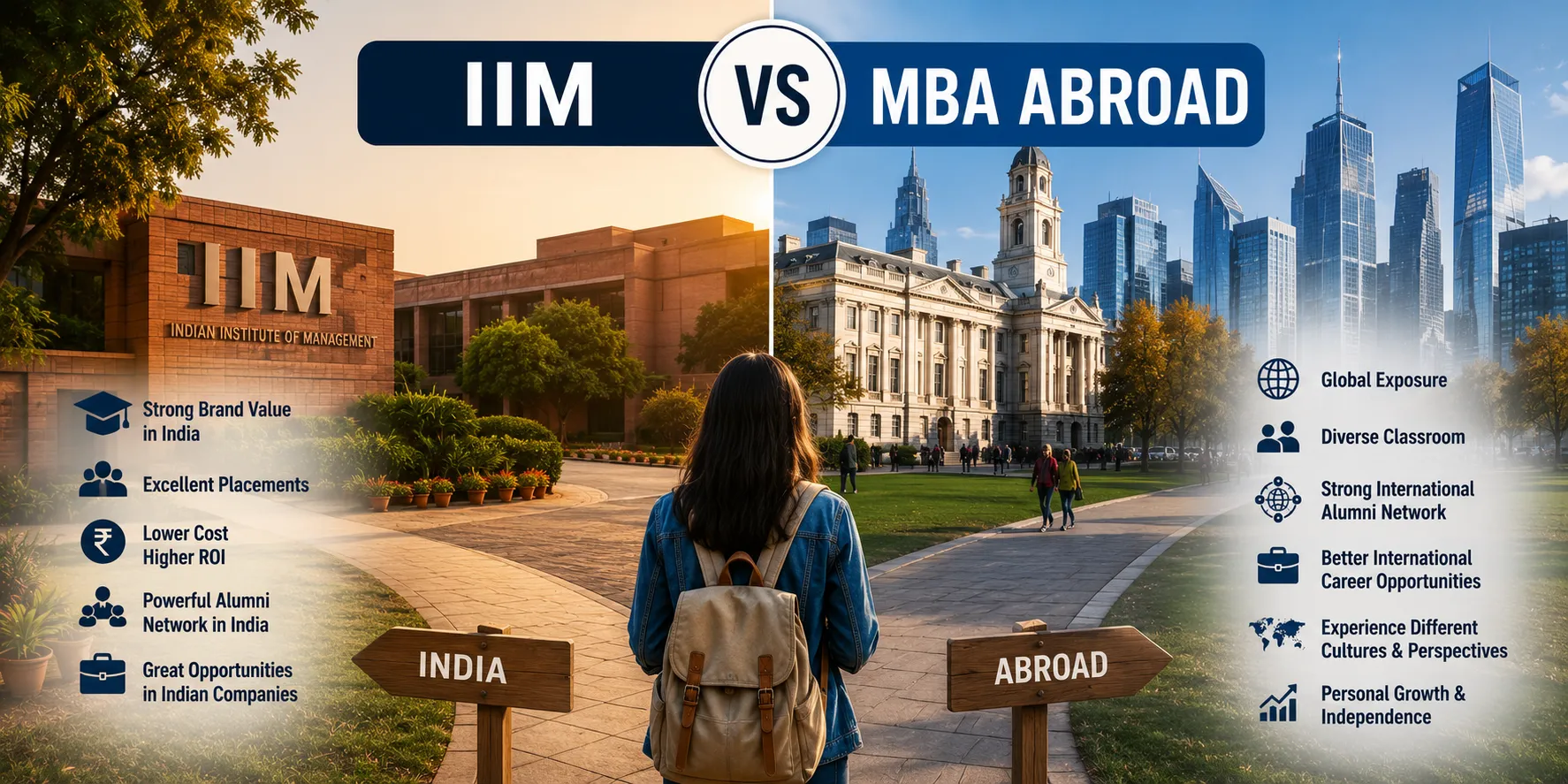
Quick Comparison
An MBA from an IIM and an MBA from overseas both provide great chances but prepare you for various kinds of professions.
Generally, an IIM has higher recognition in India, spends less overall, and recovers money faster through placements. Top IIMs do well on employability and value-for-money rankings continuously.
Usually, an MBA abroad leads to more international exposure, diverse classrooms, strong global alumni networks, and better opportunities for careers outside India. But it also implies a much higher cost and visa-related considerations.
Advantages of an IIM
If you are planning to build your career mostly in India, then it can be a fantastic idea to go for an IIM.
Some of the main advantages are:
• Good brand value in the Indian industry.
• Good campus placements.
• Strong alumni network in India.
• Lower fees than other overseas MBA programs.
• ROI, Faster.
• Direct connection to top Indian companies.
• Strong reputation in consulting, finance, marketing, operations, and general management.
For many students, particularly those who want to become leaders of Indian companies, an IIM offers one of the best value-for-money management degrees available.
Advantages of an MBA abroad
An international MBA is good for more than just the academics.
Here are some of the largest advantages:
• Exposure to other cultures and business practices.
• Classrooms filled with students from numerous nations and diverse backgrounds.
• Worldwide alumni network.
• Career opportunities in international.
• Industry projects and case studies for hands-on learning.
• Better understanding of the world market.
• Personal development through independent living.
In fact, this is the biggest reason I would choose to do an MBA abroad personally.
“Moving to another country is not just about getting a degree; it’s about learning how people think differently, how they work, negotiate, communicate, and solve problems. You become more flexible, more self-confident, and often more open-minded. It’s hard to learn those concepts from books.
The cultural immersion is just as important to me as the MBA itself.
Price Comparison
One of the greatest distinctions between the two is expense.
In general:
• A top IIM MBA requires a considerably cheaper investment than a top MBA abroad.
• An MBA abroad is far more expensive as it involves tuition, lodging, insurance, travel, and living expenses.
However, the actual ROI in real life is influenced by factors such as the location, university, industry, and post-study work options, but graduates from globally renowned business schools are likely to have access to higher international incomes and more career mobility.
It’s why you can’t just make a decision based on fees. It should also be in line with your long-term career goals.
Jobs Availability
A big part of your decision should be where you wish to work following your MBA.
If you wish to:
• Make a career in India.
• Work for Indian consulting firms.
• Work for Indian startups.
• Lead businesses in India.
A top IIM could be the stronger pathway.
If you wish to:
• Work from around the world.
• Work with global companies abroad.
• Create a worldwide network.
• Go to different countries during your career.
An MBA outside the country typically provides more international exposure and mobility.
Neither option is guaranteed to succeed. Your skills, experience, networking, and performance are just as important as the institution.
Eligibility & Admission
The admission process is also quite different.
In the case of IIMs, admission usually comprises of:
• CAT marks.
• Academic background.
• Face-to-face interview.
• Written Ability Test (if applicable).
• Work experience (based on the institute)
For overseas MBA programs, colleges generally consider:
• Bachelor's degree.
• Work experience (particularly for top global MBA schools).
• GMAT or GRE (specific to school).
• English Language skills if necessary.
• Essays.
• Letters of Reference.
• Interviews
One of the major differences is that many of the best MBA programs in the world want 2-5 years of professional work experience. Many Indian MBA programs admit candidates earlier in their careers.
Decision Criteria
Before you judge, ask yourself these questions:
• Where do I want to work post-graduation?
• Can I comfortably afford an MBA abroad or get scholarships?
• Do I value global exposure more than a faster ROI?
• “Do I want to go and assimilate into a new country?”
• Is my long-term objective international leadership, or is my main goal to have an Indian career?
"What would you choose?" is a question I've been asked.
I would go for an MBA overseas.
Not that IIMs are not prestigious; they are the best business schools in India, but I value experiences as much as education. For me, living overseas would be worth it: meeting people with other cultures, understanding global business processes, and being more independent.
That said, if you want to create a career in India and want a great ROI, I’d still suggest you choose a top IIM.
Myths Busted
“Doing an MBA abroad is always better than an IIM.
No.
It depends on what you want to do with your job. For someone who wants to work in India, a top IIM may offer greater value for money and more domestic opportunities.
An IIM degree only has value in India.
Wrong.
Top IIMs are among the best business schools in the world and continue to figure high in worldwide rankings of business schools.
“An MBA from abroad guarantees an international job.
No.
The availability of jobs depends on a variety of factors, including work experience, visa rules, networking, economic conditions, and individual performance.
"More expensive = better MBA.
Not really.
Not all pricey MBAs are a better investment. The best option is the one that suits your career goals, financial situation, and long-term objectives.
Frequently Asked Questions
1. Is an MBA abroad better than an IIM?
Not everywhere. While an MBA abroad gives you global exposure, a top IIM has better ROI and good opportunities for careers back home in India.
2. Which option offers more ROI?
The top IIMs usually have a faster financial payback for students who plan to work in India, because of the lower cost of tuition and good placement records.
3. Is work experience necessary to study an MBA abroad?
Most of the top international MBA programs prefer candidates having about 2-5 years of work experience (the exact amount of experience required depends on the university).
4. Which is better for international careers?
Usually, an MBA abroad provides an opportunity to connect with global employers, multi-cultural classrooms, and international alumni networks.
Must Read: How is the MBA in Singapore? Is it Worth It?