Introduction
The relationship between magnetism and electricity is one of the most radical things ever made in the field of physics. It is in relation to this that modern electrical engineering, transformers and generators were born through this beautiful connection of Faraday in his Law of Electromagnetic Induction. The experiments by Michael Faraday in the 19th century have shown that an electric current could be generated by a varying magnetic field, thereby bridging two formerly distinct fields of knowledge.
This discussion examines concept, experiment and mathematics behind the Law of Induction as developed by Faraday and its real world application and examples that persist in defining modern technology.
The Birth of Electromagnetic Induction
1. Michael Faraday's Curiosity
Michael Faraday (1791-1867) was an independent physicist in Britain who performed his works without major assistance and contributed a lot to the world of physics. Experimental research led to the discovery of electromagnetic induction which is the phenomenon where a change in an elliptical field of magnetism results in the creation of an electromotive force (EMF) inside a conducting medium.
In addition to this, Faraday also worked revolutionarily in organic chemistry and electrochemistry, discovering benzene, the laws of electrolysis and the electric motor and transformer. His work is often mentioned as having put the paradigm of experimental physics in place during the nineteenth century (see sidebar in Fig. 2).
2. The Question That Started It All
In the early 1830s, scientists knew that an electric current produced a magnetic field, as demonstrated by Oersted and Ampere. However, the reverse question remained:
"Can a magnetic field produce an electric current?"
Faraday devoted years to answering this question, and his experiments led to a definitive "Yes."
Faraday's Experiments on Induction
1. The Magnet and Coil Experiment (Fig. 1)
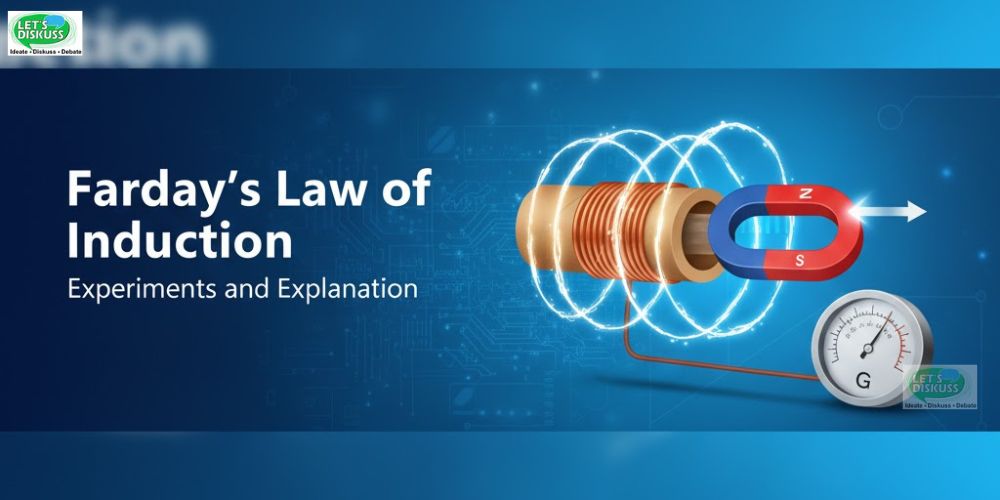
The first experiment by Faraday was a simple set up, consisting of a coil of wire, which was tapped to a galvanometer and one bar magnet. He observed that:
- A deflection of the galvanometer needle was not observed when the magnet was at rest.
- The galvanometer deflected briefly when the magnet was moved either in the direction of or away out of the coil.
- On counteraction of a direction of motion, there was a reversal of direction of deflection.
This meant that it was only on change in magnetic field linkage with the coil that electric current was induced.
Observation:
The magnetic flux passing through the coil as the magnet and coil moved together relative to each other changed and thus created an induced electromotive force and a resulting current.

2. The Two-Coil Experiment (Fig. 2)
In a different setup, Faraday set up two coaxial coils around a common iron core - coil C1, to which a galvanometer was connected thus acting as the secondary and coil C2, to which a battery was connected thus acting as the primary.
He observed that:
- As the switch in the primary circuit was opened or closed a transient deflection was recorded on the galvanometer in the secondary circuit.
- When the switch was left in the closed position it did not cause any continuous current in the secondary circuit.
Explanation:
Pressing the key caused a sudden change in current in the primary coil C2, thereby changing the magnetic field. This changing magnetic flux linked with the secondary coil C1 induced an emf in it.
Conclusion:
The induced emf arises only when the magnetic flux through a circuit changes with time—not when the magnetic field is constant.

3. The Mutual Induction Demonstration (Fig. 3)
To explain the observation in Experiment 6.3, it is necessary to investigate the phenomena that are manifested when the tapping key K in the circuit of coil C2 is switched. The current in coil C2 rises to its peak value, that translates to an increase in the magnetic flux connecting the other coil C1. This change in turn causes an electromotive force in coil C1.
In this case as long as the key is still in the on position; the current in coil C2 is fixed and the magnetic flux passing through coil C1 is fixed, thus preventing the induction of an electromotive force. The current reaches zero again, when the key is released, and the magnetic flux is again changed, producing an oppositely directed electromotive force.
General Observation:
A current, and hence an electromotive force, can only occur when the magnetic flux changes with time.

Understanding Magnetic Flux
A quantitative measure of the number of magnetic field lines passing through an area is known as magnetic flux (ΦB). Mathematically, it is defined as:
ΦB = B·A·cosθ
Where:
- B = magnetic field strength
- A = area of the coil
- θ = angle between the magnetic field and the normal (area vector) to the coil
The SI unit of magnetic flux is the weber (Wb).
Interpretation:
- If B, A, or θ changes with time, the magnetic flux changes.
- An induced electromotive force (emf) is produced in a temporally varying magnetic flux in accordance with the Law of Faraday.
In Figure 4, every element of the difference area of the object, dAi, is linked to a local magnetic field, Bi. By adding together all such elements the total flux is obtained.

Faraday's Law of Electromagnetic Induction
1. Statement of the Law
Faraday's Law of Induction: The emf induced in a closed circuit is the rate of change of magnetic flux through the circuit which is negative.
Mathematically,
ε = −dΦB/dt
For a coil with N turns,
ε = −N × dΦB/dt
The negative sign (as per Lenz's Law) indicates that the induced emf opposes the change in magnetic flux producing it.
2. Physical Meaning
Faraday's Law tells us that electricity can be generated from magnetism—but only if the magnetic environment changes. This change can occur by:
- Moving a magnet relative to a coil (changing B)
- Changing the area of the coil (A)
- Rotating the coil to alter the angle θ between B and A
Thus, electromagnetic induction depends on motion, field variation, or geometry of the coil.
Experimental Illustrations and Examples
1. Example 1 – Enhancing Deflection
Question:
What can be done to obtain a large deflection of the galvanometer in Experiment 2?
Solution:
To increase the induced emf:
- Use a soft iron rod inside the coil C2.
- Connect the coil to a powerful battery.
- Move the arrangement rapidly towards the test coil C1.
The faster the change of flux of magnet, the higher the induced emf.
When the galvanometer is substituted by a small bulb, the bulb will glow briefly each time one presses the key- which proves that the current induced will exist without the galvanometer.
2. Example 2 – Induced emf in a Square Loop
A square loop of side 10 cm and resistance 0.5 Ω is placed in a uniform magnetic field of 0.10 T, which is reduced to zero in 0.70 s.
Calculation:
Initial flux,
Φ = BAcosθ = 0.1×(0.1)2×cos45° = 7.07×10⁻⁴ Wb
Final flux, Φmin = 0
ε = ΔΦ/Δt = 7.07×10⁻⁴/0.7 = 1.0×10⁻³ V
I = ε/R = 10−3/0.5 = 2 mA
Result:
An emf of 1.0 mV and a current of 2 mA are induced.
Note: The steady magnetic field of Earth also passes through the loop but does not induce emf because it does not change with time.
3. Example 3 – Rotating Coil in Earth's Magnetic Field
A circular coil of radius 10 cm with 500 turns and resistance 2 Ω is rotated through 180° in 0.25 s in the horizontal component of Earth's magnetic field (3.0×10⁻⁵ T).
Solution:
ΦB(initial) = BAcos0° = 3.0×10⁻⁵×π(0.1)2 = 3π×10−7 Wb
ΦB(final) = BAcos180° = −3π×10−7 Wb
ε = N × ΔΦB/Δt = 500×6π×10−7/0.25 = 3.8×10⁻³ V
I = ε/R = 1.9×10⁻³ A
Conclusion:
The estimated emf and current depend on the rate of rotation—faster motion means greater induction.
Lenz's Law: The Direction of Induced emf
Heinrich Lenz optimized the Law of Faraday by coming up with one of the key principles of directionality. The Law of Lenz is succinctly brought forth as:
"The cause of the current generated is the opposite to the direction of current generated."
Here, this hostile situation is represented by the negative sign incorporated in the equation of Faraday. As an illustration, as the magnetic flux passing through a coil increases, the induced current is forced to flow to the effect of creating a magnetic field that opposes this increase.
Physical Significance:
The Law by Lenz protects the concept of energy conservation in the electromagnetic processes.
Factors Affecting Induced emf
The magnitude of the induced emf depends on:
- Rate of Change of Magnetic Flux: Faster changes produce higher emf.
- Number of Turns (N): More turns mean greater emf.
- Area (A): Larger coils capture more flux lines.
- Angle (θ): The emf is maximum when the magnetic field is perpendicular to the coil.
Applications of Faraday's Law
The Law of Faraday is the conceptual groundwork of many of the modern electrical appliances and technologies:
- Electric Generators: Due to the Law of Faraday, they transform mechanical kinetic energy to electrical energy, thus providing opportunities to produce alternating and direct currents on the small and large scale.
- Transformers: These devices accomplish the electrification and de-electrification of different circuits, by varying the intensity of a magnetic field, and this process is exactly regulated by the inductive laws of Faraday.
- Induction Cooktops: Induction cooktops work by using the fast-changing magnetic fields to induce eddy currents in metallic cookware, resulting in efficient and localized heating at very low energy dissipation.
- Electric Guitars & Microphones: In these instruments, electrical signals are induced using electromagnetic induction to convert mechanical vibrations into electrical signals, which directly implements the Law of Faraday on a small scale.
- Magnetic Braking Systems: In magnetic braking systems, induced currents generate magnetic fields that act against movement in line with the Law of Lenz, generating both controllable and amplified braking forces and is an effective example of how the Law of Faraday can be used in the management of kinetic energy.
Summary
Through practical experiments conducted by Michael Faraday, it was proved beyond doubt that temporal change in magnetic flux has the ability to produce an electromotive force. His electromagnetic induction principle, in its mathematically enabled formulation,
ε = −dΦB/dt
—became a cornerstone of modern physics and engineering.
Between the experiment of Figure 1, of a moving magnet, and the arrangement of Figure 3, of interacting coils, all the empirical observations emphasized one principle, the need to have variation of magnetic flux in order to produce electrical current due to magnetic effects.
Not only did Faraday provide the field of study of electricity and magnetism with a sense of unity but also provided the theoretical framework of what today is known as the power generation industry, thus making him one of the most impactful scientists in human history.