Table of Content
- Introduction
- Understand the CBSE Exam Pattern and Syllabus
- Create a 30-Day Study Plan
- Focus on High-Scoring Chapters
- Revision Strategy for the Last 30 Days
- Solving Previous Year Question Papers
- Sample Papers and Mock Tests
- Subject-Wise Preparation Tips
- Time Management During Exams
- Health, Sleep, and Stress Management
- Common Mistakes to Avoid in the Last 30 Days
- Final 7-Day Revision Plan
- Conclusion
- FAQs
Introduction
Let's be honest: you can't read every page of your textbooks right now. Planning well requires seeing what is actually on the test. It's about choosing your battles and putting 80% of your energy on the 20% of the syllabus that is most important.
Stop saying you're late. That guilt only makes things take longer. Change your thoughts to a rescue mission way of thinking. Every hour you spend now goes directly into your final percentage. Keep your cool, stay focused, and think of this as a 30-day race to the finish line.
Understand the CBSE Exam Pattern and Syllabus
CBSE has substantially raised the bar for 2026 with competency-based questions. Half of the paper will be case studies or questions based on sources. It's less about memorizing things and more about whether you really understand the idea.
Marking scheme and weightage
|
Stream |
Subject |
Theory Marks |
Internal/Practical |
Key Focus Units (Weightage) |
|
Science |
Physics |
70 |
30 |
Optics (18), Electrostatics & Current (16) |
|
Chemistry |
70 |
30 |
Organic Chemistry (33), Electrochemistry (9) | |
|
Biology |
70 |
30 |
Genetics & Evolution (20), Reproduction (16) | |
|
Commerce |
Accountancy |
80 |
20 |
Partnership (36), Companies (24) |
|
Economics |
80 |
20 |
Indian Eco Challenges (22), Macro (40 total) | |
|
Business Studies |
80 |
20 |
Staffing/Directing (20), Marketing (15) | |
|
Common |
Mathematics |
80 |
20 |
Calculus (35), Vectors/3D Geometry (14) |
|
Humanities |
History |
80 |
20 |
Modern India (Themes III - 35 Marks approx) |
|
Pol. Science |
80 |
20 |
World Politics (40), Indian Politics (40) |
Subject-wise syllabus focus
|
Stream |
Subject |
The Monster Units (Focus Here) |
Weightage |
|
Science |
Maths |
Calculus (Integrals, Derivatives) |
35 Marks |
|
Physics |
Optics & Electrostatics + Current |
18 + 16 Marks | |
|
Biology |
Genetics & Evolution |
20 Marks | |
|
Commerce |
Accountancy |
Partnership & Company Accounts |
36 + 24 Marks |
|
Economics |
Macro: Income/Employment & Indian Eco Challenges |
12 + 20 Marks | |
|
Humanities |
History |
Modern India (Themes Part III) |
~30-35 Marks |
|
Pol. Sci |
Contemporary World Politics |
40 Marks |
Create a 30-Day Study Plan
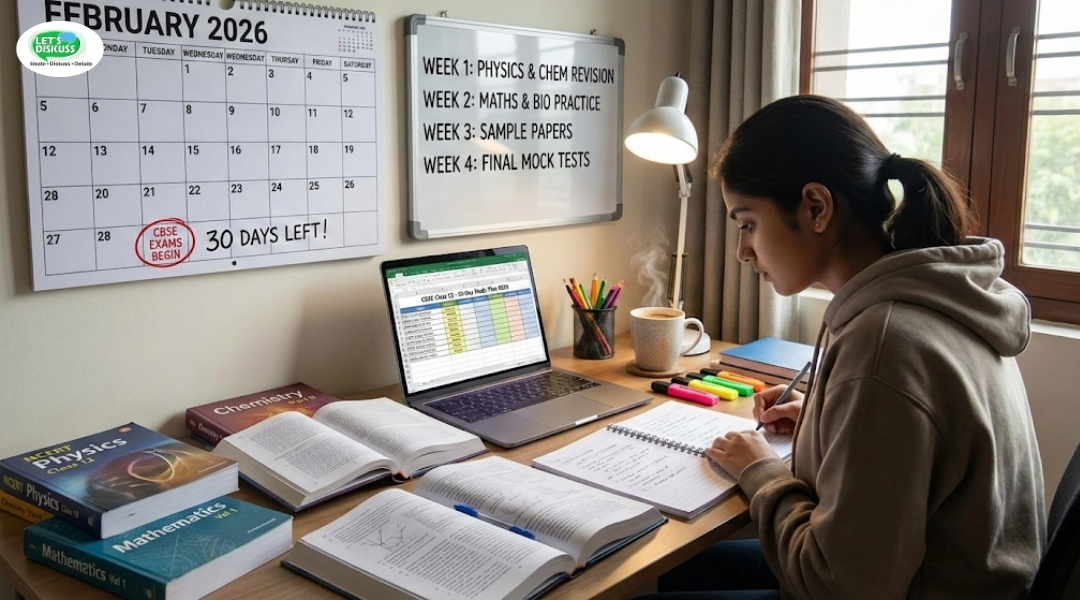
Split your month into four weeks. Use the first two weeks to review a lot for the last 30-day study plan class 12. You should spend the third week working on papers and the last week on small touch-ups. You won't get anything done if you don't have a to-do list every day.
Don't spend the whole day on your favorite subject. Use the Sandwich Method: start with a hard topic (like Physics), then go on to an easier one (like English) in the afternoon when you're tired, and end with a medium-difficulty one (like Chemistry) in the evening.
If you haven't read a chapter yet, just glance at its synopsis and the questions that are most important to you. If you spend three days on a new topic and ignore five chapters you already know, you'll get into trouble. Make what you already have in your bag stronger.
Focus on High-Scoring Chapters
Identifying important chapters
Check out the plans. In chemistry, organic frequently make up a big part of it. In accounting, partnership and company accounts are where the money is. Put these big fish chapters at the front of your list so that you can get most of the points even if you run out of time.
Previous year question trends
CBSE loves patterns. Every two years, a certain type of derivation or a specific poet's work will probably come back. If you look at papers from the last 5 to 10 years, you'll discover that the board often uses the same logic for the problems, even though the numbers change.
Smart topic selection
Be tough. If it takes you five hours to understand a 2-mark topic, don't worry about it right now. Pay attention to the 5-mark and 4-mark (case study) parts. This ROI-based research is what makes the best students stand out during cbse board test preparation.
Revision Strategy for the Last 30 Days
First, second, and final revision
Your initial rewrite should be very thorough. Your highlighted notes should be the only thing you change in the second revision (about Day 20). The last review is just going over titles, formulas, and illustrations. Every round should take half as long as the one before it.
Notes and short formulas
Don't start taking notes now if you haven't already. Instead, ask a buddy for theirs or download one-pagers off the internet. For Science, keep a separate Formula Sheet or Reaction Map, and for Business Studies or History, keep a Keyword List. Every night before bed, read these.
Active recall techniques
Don't just read; put yourself to the test. Cover the paper and try to convey the idea out loud as if you were teaching a friend. You know you've mastered something if you can express it in simple terms. This works much better than marking up the whole book.
Solving Previous Year Question Papers
The best way to see the future is to work on previous year question papers. It helps you get used to how the examiners talk. The identical question from five years ago can come up again, but with a different name or value.
Try to do at least 5 to 7 sets for each subject. Don't just read them. Write them down. There is a big difference between seeing the answer and actually writing it down under pressure. It helps you remember what you need to do for the real test.
Set a timer for three hours and sit in a quiet place while you work on your paper. No munchies or phone. This keeps your brain sharp for the whole time. You will know if you are spending too much time on 1-mark MCQs.
Sample Papers and Mock Tests
CBSE sample paper usage
The official CBSE sample paper for the 2025-26 session is like your Bible. It tells you exactly how many questions, based on your skills, to expect and how the parts are split up. You're on the right track if you can solve this easily.
Self-evaluation methods
Don't only look at the total marks once you finish a practice test. Check the marking scheme to find out why you lost a mark. Was there a unit that was missing? A diagram that looks bad? Not enough keywords? Now is the time to fix those little leaks.
Improving speed and accuracy
If you're slow, use a stopwatch for each part. Set aside 45 minutes for Section A and so on. Practice makes you more accurate, but understanding which questions to skip and which to answer first makes you faster.
Subject-Wise Preparation Tips
Science subjects strategy
For Physics, concentrate on derivations and numbers. Organic reactions and inorganic trends are very important for chemistry. For Biology, practice drawing each diagram until you can do it in your sleep. Don't forget about the back-exercise questions in NCERT, as they are your main source.
Commerce subjects strategy
You need to practice accounting every day. To keep the formats fresh, tackle one full-length issue per day. Graphs and logical thinking are a big part of economics. In Business Studies, pay attention to case studies and seek the clues in the paragraphs to figure out the idea.
Humanities subjects strategy
The structure and keywords are what matter here. Use bullet points instead of big, terrifying paragraphs in History or Political Science. Use flowcharts to show what happens and why. It makes the examiner's job easier, and they will give you points for it.
Time Management During Exams
Question paper reading strategy
You have 15 minutes to read. Use this time to choose which optional questions you will answer. Don't just read the questions, but plan out the responses in your head. You should have a plan for the first hour by the time the bell rings to start writing.
Section-wise time division
Don't allow the 1-mark questions take up too much of your time. Get going. At the conclusion, set aside at least 15 to 20 minutes for revision. You'll be astonished at how many dumb mistakes (like wrong question numbers) you find in the last few minutes.
Avoiding panic
If you see a question you don't know, take a deep breath and keep going. Don't allow one hard question to ruin the following 10 that you do know the answer to. Come back to it at the end; your subconscious mind will typically figure it out while you write other replies.
Health, Sleep, and Stress Management
Sleep schedule importance
Staying up all night is the worst thing you can do to get ready for the cbse exam. To save what you learnt during the day, your brain requires sleep. Try to get at least six or seven hours. Even the simplest formulas will be forgotten by a fatigued brain.
Diet during exam time
Stay away from heavy, greasy comfort foods that make you sleepy. Choose fruits, nuts, and a lot of water. Don't drink too much coffee, or you'll get exam jitters and not be able to focus.
Stress control techniques
- When you feel stuck, take a break for 10 minutes. Play your favorite song, do some brief stretches, or talk to your parents about anything outside the curriculum.
- Stop comparing yourself to others. Just because your friend finished three sample papers doesn't mean you're behind. Everyone goes at their own speed, so stick to your own plan and stay in your lane.
- Sleep is a cheat code: staying up all night makes you slow and grumpy. Sleep for 7 to 8 hours. Your brain needs that save button to remember all you learned.
- Oxygen over caffeine: If you start to panic, take five deep breaths. The 4-7-8 technique (inhale 4s, hold 7s, exhale 8s) really works to tell your brain to cease the fight-or-flight phase so you can concentrate again.
Common Mistakes to Avoid in the Last 30 Days
Again, don't add more chapters unless they are very important. Being 100% ready for 80% of the syllabus is better than being 50% ready for 100% of it. Right now, your biggest opponent is confusion.
A lot of students keep completing the curriculum, but never go back to see what they completed two weeks earlier. If you don't review, you'll go to the exam hall and find you know the material but can't exactly remember all the intricacies.
Overusing social media
Uninstall the apps for 30 days. That quick 5-minute reel break is a deception; before you know it, it's an hour long. Do something offline if you need a break. Your future self will be grateful for your self-control.
Final 7-Day Revision Plan
Day-wise revision checklist
- Day 1-2: Hit the Monsters. Don't re-read chapters. Only solve the Red Alert questions: the ones that killed you in pre-boards (Calculus, Accounts, or Physics derivations).
- Day 3: The Data Dump. Spend the day on your Cheat Sheets. Memorise the exact formulas, chemical reactions, and case study formats. If it’s not on your sheet, don't look at it.
- Day 4: The 50% Rule. Practice only Competency-Based Questions. Since half the paper is application-based now, make sure you aren't just a ratta-mar robot.
- Day 5-7: First Exam Lockdown. Forget other subjects. If you have Biotech/Entrepreneurship or Physics, dive deep. Solve one full sample paper with a timer to fix your speed.
Light study + confidence boost
On the last day, don't do anything heavy. Just look through your notes and reassure yourself that you did the work. Get to bed early. If you walk into the hall feeling confident, you'll do 20% better.
Conclusion
Even though it doesn't seem like it, you've been studying for this all year. You only need to stay calm to get the facts out. Have faith in the process and the hard work you're doing this month.
The trip to get ready for the class 12 exam is a long one, not a short one. Do it one day at a time. Don't worry about what other people are doing; just keep working on your own. You can do this!
FAQs
Can I score well in Class 12 CBSE exams in 30 days?
Yes, it is. If you focus on the chapters that are worth the most points, do sample papers, and make NCERT your top priority, you can easily get an 80-90% score, even if you just started.
What is the best study plan for the last 30 days?
The 20-10 rule says to spend 20 days going over everything and solving past questions, then 10 days taking full-length practice examinations and making any last-minute changes to formulas and diagrams.
Should I study new topics in the final month?
Only if they are very important and you can learn them in a few hours. If not, it's better to master what you already know.
How many hours should I study daily in the last 30 days?
Aim for 8 to 10 hours, but remember that quality is more important than quantity. Split it up into two-hour blocks with 15-minute breaks to keep your mind fresh.
Are previous year papers enough for CBSE preparation?
They are important, but for 2026, you also need to solve the latest CBSE sample papers because the exam now has more questions that test your skills.