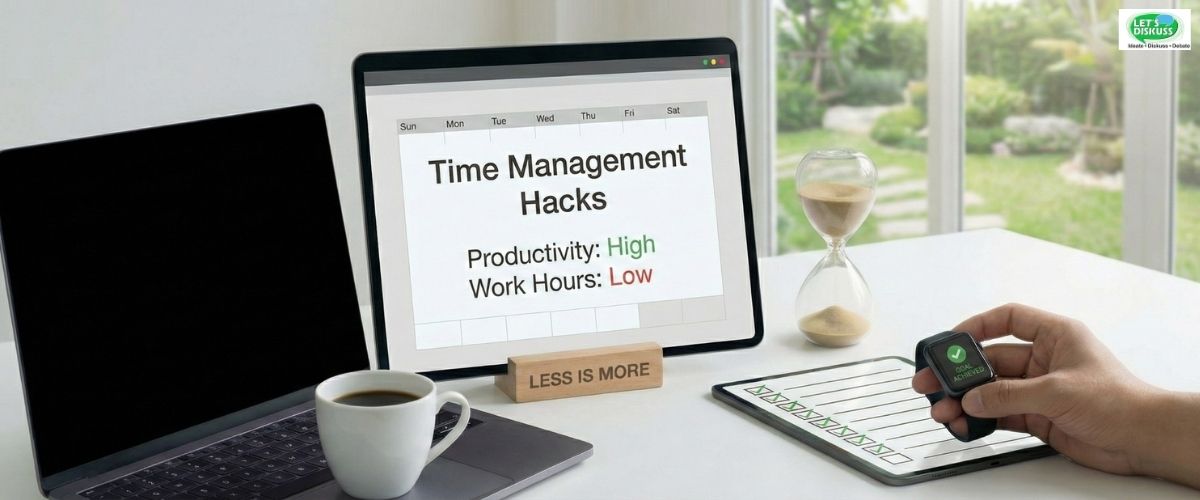
1. Introduction: The Myth of Busyness
We are living in a world driven by hustle-culture. People are ‘always busy’ but rarely being productive. People think that stress is something to be proud of as this means they are driven and chasing their life goals. Longer the working hours, better the performance.
But here's the truth bomb: working overtime does not mean you are achieving more. In fact, research shows the opposite! It is suggested in many studies across the world that overworking often leads to burnout resulting in dissatisfaction, low creativity, fatigue related to decision making, and lack of motivation over time.
Why working longer doesn't equate to working efficient
Suppose you work for 10–12 hours a day. Think and conclude- Did you actually work 12 hours' worth of productivity? Does each task performed during this 12 hour long period give you high-quality output? Or did half your time go into passing the ball, small/big distractions, resolving unimportant matters, and mental fatigue after 7 hours?
Productivity isn’t measured by hours. It’s actually measured by end-results. If you can focus and work in complete concentration for even 5 hours, you can finish 12 hours worth of work!
The secret goal: achieving true work-life balance
In this hustle-culture, everyone aims for a “work-life balance,” but only a few actually achieve it. Most people assume that working overtime will allow you to earn time for your personal life. If you don't work on something important today, there is no right to have special personal time for your family/friends as well!
The real secret to work-life balance is learning the art of how to be more productive by working less. This requires a complete mindset shift!
The mindset shift required
If you want to free yourself from this cycle of working non-stop, you need to change the way you think about work, time, and priorities. The goal is simple:
Take up fewer things today (prioritization), but perform them exceptionally well (focus).
2. The Mindset Shift: Focus & Prioritization
Shifting your mindset is not easy. It requires complete rewiring of how your brain works when work is in front of you. Here are a few methods and principles that will actually help you make the shift!
The 80/20 Rule (Pareto Principle)
The 80/20 rule is one of the most talked about methods as it makes things really easy to comprehend! This method says that 20% of your efforts create 80% of your results.
This means:
Take up and try finishing up only a small number of tasks that are of high-impact.
Ignore and keep aside all that extra work that keeps you “busy” but actually has very little payoff.
You can practice this by asking yourself the following:
Which tasks will give the most progress?
Which tasks should I eliminate that will have little to no consequence?
By simply doing the important tasks first, you’ll be able to double your productivity!
Eat the Frog: Do the hardest task first
Another famous method as suggested by Brian Tracy’s in his popular book is an interesting concept. He states that : If you eat a frog first thing in the morning, the rest of the day becomes easier.
Here frog does not mean actual frog! Here, “frog” = the most important, and actually the hardest task of the day. You’ll get immense relief if you do the hardest task of the day, first thing at work. The rest of the day will then feel like a breeze!
Why this method actually works:
Your brain is said to be sharpest in the morning
When you complete a big task first thing in the morning, it gives you momentum
It won’t allow you to procrastinate for hours to complete that one hard task
You’ll not feel burnout later in the day for not completing the relevant tasks
The 3-Item Daily List
Do you also make a long list of do-tos and end up not completing them? Most of the people do so and hence, they feel dissatisfied towards the end of the day. Most to-do lists fail because they’re overwhelming and overcalculative of your time. Here is a better method:
List only the 3 biggest priorities for the day.
These 3 things should be written keeping in mind:
What is the most important task that cannot be postponed to tomorrow?
What tasks will make me feel relieved of the upcoming obligations?
What tasks can be delegated or done even in the coming week?
A 3-item list is a powerful way to direct all your mental bandwidth to 3 important tasks in a day and eliminates fatigue that is caused by not-so-important tasks.
3. Workflow Hacks: How to Be More Efficient at Work
Now that you have understood the ways to set your priorities for the day, the next step is creating a workflow.
Workflow means how to take ahead the tasks on priority in an efficient and time -saving way. Working in efficiency rather than chaos, will save you from unnecessary stress. Let’s look at the number of options for maintaining workflow:
Task Batching
As the name suggests, Task Batching is grouping the task in bunches and completing one bunch in one go. This way, your brain can focus more as it doesn't have to switch between different types of tasks.
A few examples of task batching are:
Answering all emails in one go
Making all calls at one go
Doing outside work in one go and then sit to do the screen work in one go
This saves your mental energy and prevents distractions. Try batching your tasks if you do not want to break your workflow.
Time Blocking vs. Timeboxing
These are two different techniques, yet both are powerful.
Time Blocking means assigning a chunk of time to one category of work.
Example:
10–12 PM: Meetings
2–3 PM: Lunch
4–4:30 PM: Calls and emails
Timeboxing means giving as little time as you can give to one category of task. So instead of grouping the task in a single time window, you try to wind up asap. For example, 10-12 PM time window is for meetings. But what if the meeting takes only 45 minutes? Then you can skip to the next task immediately instead of sitting idly till 12 PM! This method prevents forced efficiency.
The Two-Minute Rule
This rule is a basic thumbrule if you want to be an efficient worker. This simply states- If something takes less than two minutes:Do it immediately.
This rule helps clear unnecessary mental clutter and prevents tiny tasks from piling up. A few examples are :
Giving a quick reply to an important message
Scheduling a meeting or drafting a mail for the upcoming meeting
Updating a file, etc.
4. Technology and Environment Hacks
Being productive at work and to improve your efficiency, certain technological tools and your surroundings in which you work, also play a huge role. Even the best time management techniques fail if you are not up-to-date with the technology or if your work environment is chaotic.
Here are the three hacks that will surely help you in your efficiency at work :
Digital Detox Blocks
Pop up notifications are productivity eaters. Every ping on your phone that forces your brain to peep, actually disrupts your work flow. How many times do you pick up your phone to check something that results in the next 20 minutes being lost to scrolling reels?
Make sure to turn on your DND mode while you work on a single batch of tasks. You can take 10 minutes to check your notifications before moving to the next batch of work.
Automation for Repetitive Tasks
Repetitive tasks are not only exhausting but also drain your time that you could utilize on some high-value work.
You can employ technology to do simple tasks in automation. For example,
Automated response to emails/messages
Calendar scheduling of meetings
Pre-scheduled social media posting
The End-of-Day Ritual
The final 15 minutes of your workday should follow a ritual:
Clear your desk
Close tabs
Review today’s accomplishments
Write tomorrow’s 3-item list
Shut down your devices
This ritual signals your brain to disconnect, helping you actually enjoy your evenings and avoid burnout.
5. The Ultimate Goal: Achieving Work-Life Balance
Employing all the above mentioned techniques primarily focus on one thing- Time management. Time management teaches us a balance and not just being efficient at work. It’s about working in forms to have a life where work doesn’t swallow everything else. Once you make a productive end to your work, make sure to pay time for certain personal commitments such as going to the gym, attending family dinners, self-care, or even rest. Depending upon your priorities, make these personal agendas a part of your calendar and give them equal share of importance.
Once you achieve a work-life balance, you’ll see a lot of improvement in both your work and life scenarios.
To balance your life, make sure:
You finish your work within scheduled time frame
You carry no or fewer things to do at home
You stress less about your work for the next day
You sleep better at night
To balance your work, make sure :
Better focus on personal agendas
Better relationships with friends and families outside of work
Better your personal growth by investing in fitness or any hobby
6. Conclusion: Start Working Smarter, Not Harder
Long working hours often result in lag. Productivity isn’t about squeezing more hours into your work schedule. It means working in a result-oriented manner, even if you work less than required. Learn to employ smarter strategies that we have mentioned above so you can get better results, more freedom to choose your life, and strike a balance between personal growth and work goals.
The most impactful hacks to start with are:
Identify your top 20% tasks
Eat the frog every morning
Create a 3-item daily priority list
Batch similar tasks
Block time for deep work
Set end-of-day rituals
Protect your personal hours
Frequently Asked Questions (FAQ)
Q1: What is the single most important habit for knowing how to be more productive?
The most powerful habit is prioritization. You need to identify and work on the most important and the hardest task first that actually moves the needle. This will help you declutter and eliminate the noise.
Q2: How can I achieve better work-life balance using time management hacks?
You can use different methods to be more efficient at work such as batching, deep work blocks, and a 3-item priority list. This will help you reduce spillover into personal time by contributing to your productivity and hence creating a work-life balance.
Q3: Is 'working less' really possible if I have a demanding job?
Yes. Even in demanding roles, you can be a high-performer by focusing on time-management using proven methods, make the right use of automation, and learn the art of prioritization. Remember that productivity is about quality, not quantity.
Q4: What are the biggest mistakes people make when trying to be more efficient at work?
Biggest mistakes are : Doing too many low-value tasks instead of a few high-value tasks, not planning their day, constantly indulging in multitasking, and letting notifications interrupt workflow.