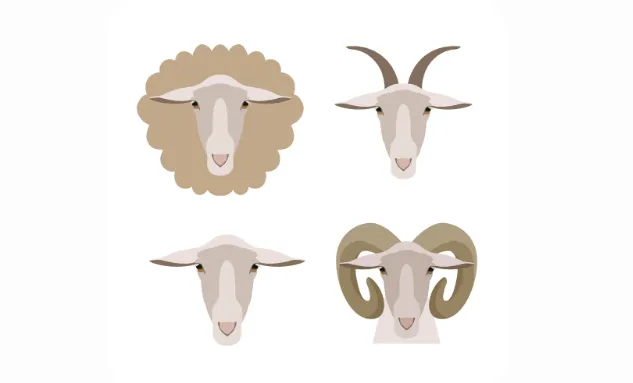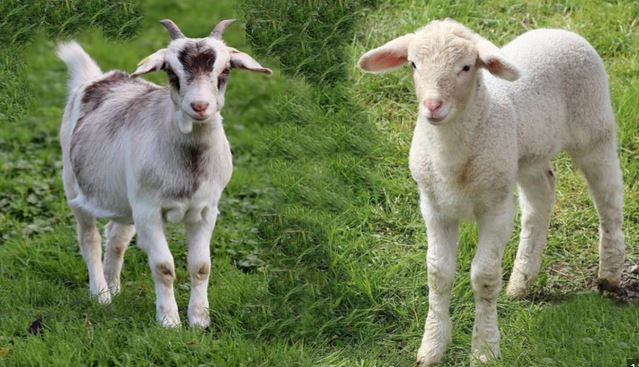
A goat is a type of livestock as well as a sheep; however, there are many differences between the two types of livestock. For example, goats typically have shorter hair on their bodies than sheep, longer narrower heads and either straight or curved horns. Many goats have a beard on the bottom of their chin, particularly male goats. Goats are very active and curious animals that can easily climb rocky areas. Goats are primarily raised for their milk, meat and skin. Most goats do not produce the same amount of wool as sheep do. Rather than producing wool, most goats produce hair or specific types of fiber. While goats and sheep appear to be similar in appearance, they are classified as being part of two separate animal families.
The ram is a fully grown male sheep. Generally, the ram is stronger and bigger than the ewe, or the female sheep. The ram usually has large, curved horns, however; there are some types of rams that do not have any horns. The ram plays a very important part in reproducing with the ewe to create lambs. Many times the ram is kept by farmers to breed with the ewes and occasionally for its meat. Therefore, when you hear the word "ram", you will know that it refers to a male sheep, not a different type of animal.
Mutton is the flesh of sheep (especially adults). Many cultures eat mutton, particularly India; there, it is often used as an additive to curries, biryanis, etc. Compared to lamb, mutton typically has a stronger taste and firmer consistency. Although it requires more time to cook than lamb, once cooked correctly, mutton is both tasty and soft. Some regions use the term "mutton" to describe goat meat as well. This may cause confusion depending upon regional culinary practices.
A lamb is a baby sheep, usually less than 1 year old. Lambs have short legs, big eyes and a body full of soft wool. When lambs are born they need their mother's milk to eat. After some time, lambs will start to eat grass and other plant matter. People raise lambs to use them for their meat, which we call "lamb meat." Lamb meat is typically softer and more tender than meat from older sheep. To put it simply, all lambs are sheep, however not all sheep are lambs.
The domestic sheep (Ovis aries) is a four-legged ruminant mammal that has been domesticated around the world for use in livestock production. The domestic sheep evolved from the wild mouflon of Central and Southwest Asia and were one of the first species to be domesticated by humans during the Agricultural Revolution approximately 11,000 to 9,000 BCE. Domestic sheep display strong gregarious behavior, exhibiting high levels of flocking for defense from predators. They also have a very good spatial memory, are able to identify individual sheep and human faces for years, and develop a complex social hierarchy within each herd.
In summary, sheep, lamb, goat, ram and mutton relate to farming and food; however, they have distinct definitions. A sheep and a goat are two different species of animals. A lamb is a juvenile sheep. A ram is an uncastrated male sheep. Mutton is the flesh of a mature sheep. Understanding the differences among the various forms of livestock can help in understanding animal agriculture, meat products available for purchase and the use of the English language when discussing food.