Quick Answer
The Ramayana is one of the most significant and deeply revered epics in human history, shaping the culture, religion, and morality of South Asia for millennia. Because the story has been told and retold across countless generations and regions, a very common question arises: "Who wrote Ramayan?" The original, ancient Sanskrit text was composed by the great sage Maharishi Valmiki. His version, known as the Valmiki Ramayana, is considered the foundational text. However, centuries later, the poet-saint Goswami Tulsidas wrote a highly accessible and deeply devotional version in the Awadhi language (a dialect of Hindi) called the Ramcharitmanas, which is the version most widely read and recited in Northern India today.
The Original Creator: Maharishi Valmiki
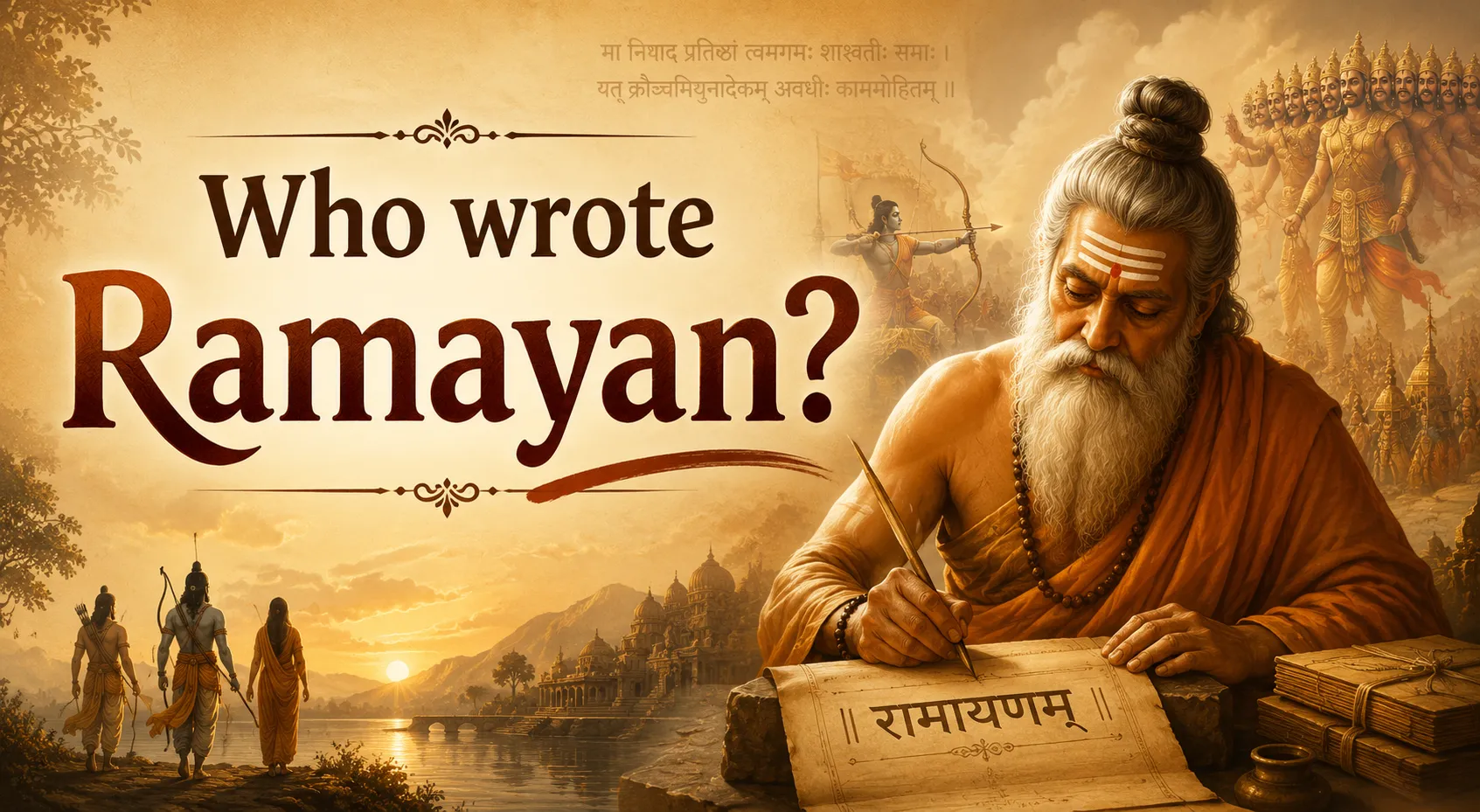
To truly answer Who wrote Ramayan?, we must journey back to ancient India. Maharishi Valmiki is revered as the Adi Kavi, or the "First Poet" of the Sanskrit language. According to tradition, Valmiki was inspired to invent the shloka (a specific Sanskrit poetic meter) after witnessing the tragic death of a bird separated from its mate.
Using this new, rhythmic poetic structure, Valmiki composed the epic of Lord Rama. The Valmiki Ramayana is a massive literary undertaking, consisting of approximately 24,000 verses divided into seven Kandas (books). Valmiki's text is not just a religious document; it is a masterclass in ancient poetry, ethics, statecraft, and human psychology. It portrays Lord Rama as Maryada Purushottam—the ultimate embodiment of righteousness, duty, and ideal human conduct.
The People’s Epic: Tulsidas and the Ramcharitmanas
While Valmiki wrote the original epic, the Sanskrit language was primarily accessible only to scholars and priests. In the 16th century, a devoted saint named Goswami Tulsidas set out to bring the story of Lord Rama to the common people.
Tulsidas authored the Ramcharitmanas in Awadhi, a local dialect of Hindi. While the core storyline remains the same, the Ramcharitmanas is heavily infused with the Bhakti (devotional) movement. Unlike Valmiki, who often portrayed Rama as a noble human king who achieves divinity through righteous action, Tulsidas portrays Rama explicitly as the supreme incarnation of Lord Vishnu from the very first verse. When modern people in Northern India ask, "Who wrote Ramayan?", they are often referring to Tulsidas, as his version is the one recited in homes and performed in the annual Ramlila plays.
Famous Versions of the Ramayana at a Glance
Because the epic spread across all of Asia, it was translated and adapted by many different cultures. Here is a summary of the most prominent versions of the text and their brilliant authors:
Version Name | Author / Poet | Language / Region | Key Focus or Style |
|---|---|---|---|
Valmiki Ramayana | Maharishi Valmiki | Sanskrit (Ancient India) | The foundational text; focuses on duty (Dharma) and human ideals. |
Ramcharitmanas | Goswami Tulsidas | Awadhi (North India) | Highly devotional; portrays Lord Rama as the supreme deity. |
Kamba Ramayanam | Kamban | Tamil (South India) | Known for its exquisite Tamil poetic beauty and slight regional variations. |
Krittivasi Ramayan | Krittibas Ojha | Bengali (East India) | Blends the epic with local Bengal folklore and social customs. |
Ramakien | Various Kings | Thai (Thailand) | The national epic of Thailand, adapting the story to Southeast Asian culture. |
Top Reasons to Study the Ramayana Today
The story of Lord Rama is far more than just ancient history. Here is why reading the Ramayana—regardless of which author's version you choose—remains incredibly beneficial today:
Understanding Dharma (Duty): The epic provides a complex, nuanced exploration of duty. It teaches the importance of fulfilling one's responsibilities as a child, a spouse, a leader, and a friend, even when it requires immense personal sacrifice.
Conflict Resolution: The story offers profound lessons in diplomacy, alliance-building (such as Rama's alliance with Sugriva), and dealing with adversaries.
Cultural Literacy: The Ramayana is the bedrock of South Asian art, classical dance, music, and literature. Understanding the text unlocks a deeper appreciation for the entire region's cultural heritage.
Mental Resilience: Observing how characters like Lord Rama and Devi Sita handle exile, loss, and hardship provides timeless psychological tools for overcoming modern adversity.
Frequently Asked Questions (FAQs)
Did Maharishi Valmiki actually meet Lord Rama?
According to the epic itself, yes. In the Uttara Kanda (the final book), Valmiki plays an active role in the story. He provides shelter to Devi Sita in his ashram during her exile, and he is the one who teaches the epic song to Luv and Kush, the twin sons of Lord Rama.
Which is older: the Ramayana or the Mahabharata?
According to Hindu chronology (Yuga cycle), the events of the Ramayana took place in the Treta Yuga, which predates the events of the Mahabharata, which occurred at the end of the Dvapara Yuga. Therefore, the core story of the Ramayana is considered much older.
Is the Ramcharitmanas an exact translation of the Valmiki Ramayana?
No. While it follows the same chronological events, Tulsidas took creative and theological liberties. The Ramcharitmanas is a retelling designed to evoke deep emotional devotion (Bhakti), whereas Valmiki's text is older, highly detailed, and often more grounded in political and ethical philosophy.
Conclusion
Whenever a curious reader asks, "Who wrote Ramayan?", the simplest answer is Maharishi Valmiki, the creator of the original Sanskrit masterpiece. However, the true beauty of this epic lies in its evolution. From Valmiki's ancient verses to Tulsidas's devotional poetry, and Kamban's Tamil literary genius, the story of Lord Rama was too immense to be contained by a single author. It was written and rewritten by the greatest minds of different eras, ensuring that its profound lessons of righteousness, love, and duty continue to inspire humanity generation after generation.
Sources & References: Bhandarkar Oriental Research Institute
Also Read: Who wrote Mahabharata?