
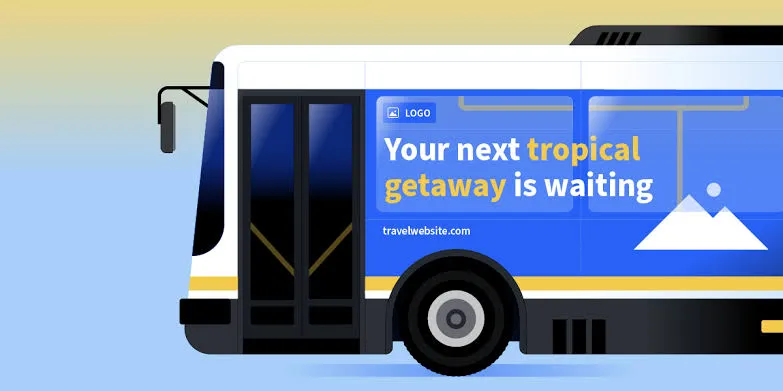
A bus advertising agency promotes your business by turning buses into moving outdoor advertisements. Instead of your ad staying in one fixed location, it travels through selected routes, neighborhoods, shopping areas, business districts, and other busy parts of a city.
But the agency's real job is not simply to print your logo on a bus. A good agency figures out where your audience is likely to be, chooses suitable routes and ad formats, handles the creative and installation, and then measures whether the campaign delivered useful exposure.
Bus advertising falls under out-of-home (OOH) advertising. Interestingly, transit was the fastest-growing U.S. OOH segment in 2025, growing 9.2% year over year, according to OAAA.
From my perspective, bus advertising works best when you stop treating it like a giant poster and start treating the bus route itself as part of your targeting.
How Bus Advertising Works
The process normally starts with a business goal. Maybe you want more local awareness, promote a new store, advertise an event, or simply get your brand name repeatedly seen.
The agency then looks at things like:
Target audience
Geographic market
Bus routes and coverage
Campaign duration
Available budget
Creative format
For example, Geopath notes that bus audiences can be targeted through garages because different garages serve particular groups of routes.
That means a local restaurant doesn't necessarily need buses traveling everywhere. I'd rather have its ads repeatedly moving through areas where potential customers actually live, work, or eat.
Business Benefits
What I like about bus advertising is the physical presence.
People can scroll past a social media ad in half a second. A large bus moving through traffic is harder to miss.
It can help with:
Local brand awareness
Repeated exposure
Geographic reach
Store or event promotion
Supporting digital campaigns
Reaching commuters, drivers, and pedestrians
OOH is also becoming much more measurable. OAAA says modern OOH campaigns can be connected with outcomes such as website visits, app downloads, and store visits.
Still, I wouldn't pretend every person who passes a bus has carefully read the ad. Exposure and attention aren't the same thing.
Advertising Formats
Bus campaigns aren't limited to one giant wrap.
Format | What it looks like | Best suited for |
|---|---|---|
Full wrap | Covers most/all of the bus | Big brand impact |
Side panel | Large ad along the side | Visibility in traffic |
Rear ad | Display on bus rear | Drivers following buses |
Interior card | Ads inside the bus | Reaching passengers |
Digital display | Screen-based creative | Flexible messaging |
Geopath's audited transit formats include full wraps, full sides, half sides, backs, and interior bus cards, among others.
Full wraps are particularly noticeable because they combine billboard-like scale with the movement of a bus.
Agency Services
A bus advertising agency may handle the campaign from planning to removal.
That can include researching routes, buying media space, designing or adapting artwork, printing, installation, campaign scheduling, compliance coordination, maintenance, and reporting.
The creative part deserves more attention than it usually gets. Someone might only see the bus for a few seconds. If the ad has a tiny headline, six offers, three phone numbers, and a paragraph explaining the company, you've probably lost them.
Personally, I'd keep the message painfully simple: one idea, strong branding, readable text, and one obvious action.
Performance Measurement
Bus advertising isn't measured exactly like paid search, where every click is sitting neatly in a dashboard.
Agencies can use OOH audience measurements such as estimated impressions, reach, and frequency. OAAA's measurement guidance also covers attribution, mobile location data, brand studies, foot traffic, web activity, and other approaches.
For an actual business campaign, I would also track things I can connect more directly:
Unique QR codes
Campaign-specific URLs
Promo codes
Website traffic changes
Store visits
Search volume for the brand
Sales or enquiries in targeted locations
The mistake would be measuring only how many buses carried the ad. That's distribution, not necessarily business impact.
Frequently Asked Questions (FAQs)
1. Is bus advertising only useful for big brands?
No. Local restaurants, colleges, healthcare providers, retailers, events, and service businesses can use it when bus routes overlap with their target market.
2. How long does a bus advertising campaign run?
It varies by market and media owner. OAAA's guidance for full bus wraps notes that they have traditionally been purchased in four-week periods, often for several months.
3. Can you target specific locations with bus ads?
Yes, to an extent. Agencies can plan around routes, garages, stations, and geographic coverage rather than buying completely random exposure.
4. Can bus advertising generate sales?
It can contribute to sales, visits, searches, and other actions, but results depend on the offer, creative, location, frequency, and how well the campaign fits the audience.
 Answered by