For most years, the answer is straightforward:
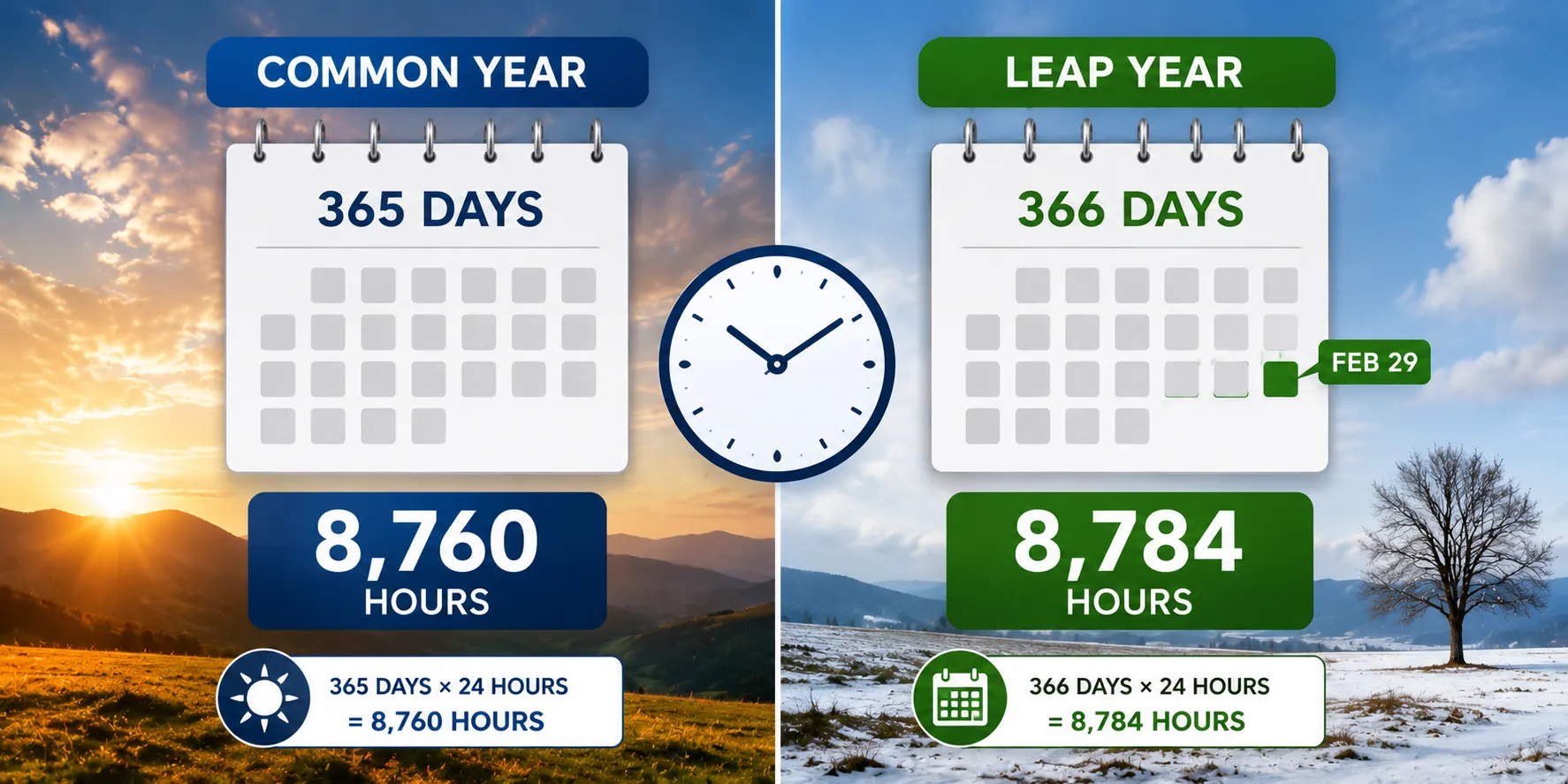
1 common year = 8,760 hours
This comes from:
365 days × 24 hours = 8,760 hours
However, if it's a leap year, the answer changes slightly:
1 leap year = 8,784 hours
because a leap year has 366 days instead of 365.
So, the correct answer depends on the type of year you're referring to.
Calculation
The calculation is simple once you know the number of days in the year.
Common Year
365 days × 24 hours
= 8,760 hours
Leap Year
366 days × 24 hours
= 8,784 hours
The extra 24 hours come from February 29, which is added during leap years to keep our calendar aligned with Earth's orbit around the Sun. Without leap years, our calendar would slowly drift away from the seasons.
Conversion Table
| Time Period | Days | Hours |
|---|---|---|
| 1 Day | 1 | 24 |
| 1 Week | 7 | 168 |
| 1 Month (Average) | 30.44 | ~730.5 |
| 1 Common Year | 365 | 8,760 |
| 1 Leap Year | 366 | 8,784 |
A simple way to remember it is:
- Common year → 8,760 hours
- Leap year → 8,784 hours
Common Year vs Leap Year
Many people know that leap years happen every four years, but there's a little more to the rule.
A year is generally a leap year if it's divisible by 4, except century years (like 1900 or 2100), which are not leap years unless they're also divisible by 400.
For example:
- 2026 ❌ Common year
- 2024 ✅ Leap year
- 2000 ✅ Leap year
- 1900 ❌ Common year
This system keeps our calendar closely aligned with Earth's actual orbital period of about 365.2422 days.
Practical Examples
Knowing how many hours are in a year is more useful than it first appears.
Salary Calculations
Companies often calculate hourly wages from annual salaries using 2,080 working hours, while broader time calculations use 8,760 hours in a full year.
Electricity Usage
Electricity consumption is frequently measured over a year.
For example:
A 100-watt bulb running continuously for one year consumes:
100 W × 8,760 hours
= 876 kWh
Astronomy and Science
Scientists use annual hours when estimating:
- Satellite operation time
- Climate data
- Solar energy production
- Equipment lifespan
Competitive Exams & Aptitude Tests
Many people think questions like "How many hours are in a year?" are too basic to matter.
In reality, they appear surprisingly often in:
- Government examinations
- Banking exams
- SSC and UPSC aptitude sections
- Campus placement tests
- Interview aptitude rounds
These questions aren't always testing memorization. They're often checking whether a candidate has strong numerical awareness and can quickly perform simple mental calculations under time pressure. Candidates who are comfortable with everyday conversions usually solve these questions in seconds, saving valuable time for more complex problems.
Common Mistakes
Forgetting Leap Years
Many people immediately answer:
8,760 hours
That's correct for a common year, but not for a leap year.
Assuming Every Year Has 365 Days
Every leap year contains 366 days, increasing the total hours to 8,784.
Confusing Calendar Hours with Working Hours
A calendar year has 8,760 hours.
A standard full-time employee typically works around 2,080 hours annually.
These are completely different measurements.
FAQs
1. How many hours are in a normal year?
A common year has 8,760 hours because it contains 365 days.
2. How many hours are in a leap year?
A leap year has 8,784 hours because it contains 366 days.
3. Why do leap years have an extra day?
Earth takes about 365.2422 days to orbit the Sun, so an extra day is added periodically to keep the calendar synchronized with the seasons.
4. Why do aptitude tests ask questions like this?
They're designed to assess numerical reasoning, mental calculation speed, and familiarity with common measurements rather than advanced mathematics.
5. Is 8,760 hours always the correct answer?
No. It's correct only for a common year. If the year is a leap year, the correct answer is 8,784 hours.
A common year contains 8,760 hours, while a leap year contains 8,784 hours. The calculation itself is simple, but knowing when each value applies is what really matters. Although this question may seem basic, it's surprisingly practical. It appears in competitive exams, aptitude tests, interviews, scientific calculations, and everyday planning. Understanding the reasoning behind the answer, rather than simply memorizing the number, makes it much easier to recall and apply whenever you need it.
Must Read: How Many Weeks in a Year? 52 or 53 Weeks Explained