A few years ago, data was just numbers sitting quietly in spreadsheets. Today, it decides who gets a loan, which movie you see next, how hospitals prioritize patients, and even how businesses survive in markets. Data has quietly become the brain behind modern decision-making.
And behind that brain?
Data scientists.
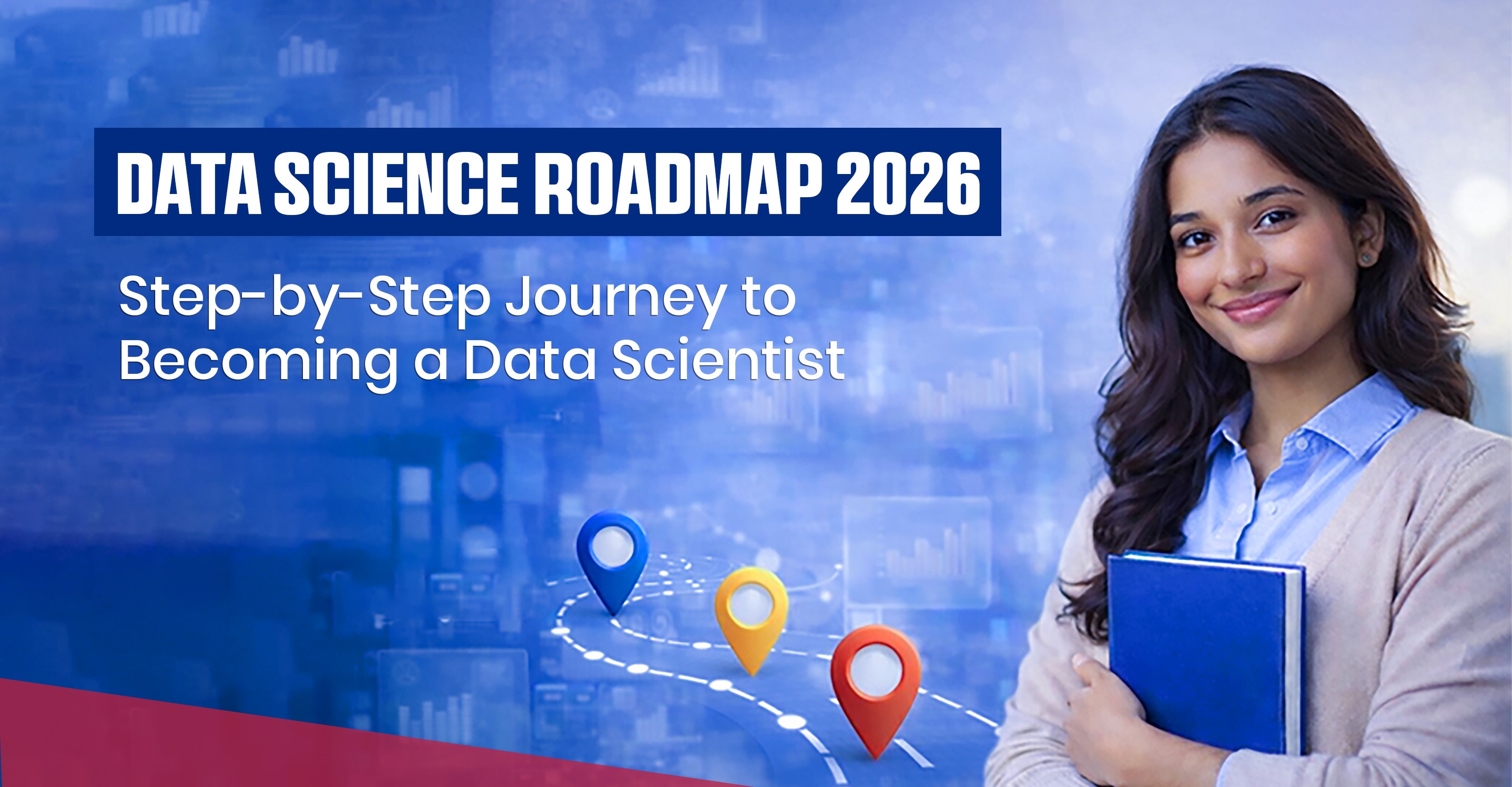
You'll probably get interested in data science if you're reading this... Maybe you’re excited. Maybe you’re confused. Maybe you’ve seen so many "roadmaps." Everything feels overwhelming. Python here, machine learning there, dashboards, AI, cloud… it can feel like everyone is shouting instructions at once. So instead of throwing another checklist at you, let’s walk through this journey the way it actually unfolds. Step by step, like how people will really grow into data scientists by 2026.
What Does a Data Scientist Really Do?
Before touching any code or formulas, it helps to understand the heart of the role. A data scientist is not just someone who writes Python or builds models. They are fundamentally problem solvers.
In a normal workday, a data scientist might:
● Clean, messy data that came from different systems.
● Look for patterns hidden inside thousands or millions of rows.
● Build models that predict future outcomes
● Translate all of that into insights business teams can actually use.
Imagine a retail company noticing customers slowly disappearing. Sales reports show what, but not why. A data scientist steps in, studies customer behavior, spots early warning signs, builds a prediction model, and helps the business act before customers leave.
That’s the job role which is part of technical, analytical, and storytelling.
The First Turning Point: Learning to Think in Numbers
Every data scientist’s journey starts here not with coding, but with thinking logically about data. You don’t need to love math. But you do need to understand it well enough to ask the right questions.
So, you begin with:
● Probability, to understand uncertainty
● Statistics, to know what numbers actually mean
● Linear algebra, which quietly powers machine learning models
● A bit of calculus, mainly to understand optimization
At first, these topics feel abstract. But then something clicks. You realize statistics helps you answer real questions like, "Did this marketing campaign truly increase sales, or was it just luck?” That’s when math stops being a theory and starts becoming a tool.
Learning to Speak the Language of Data
Once you can think in numbers, the next step is learning how to work with them. This is where programming comes into action. By 2026, Python continues to be the main language of Data Science with AI not because it’s fancy, but because it’s practical.
You start small:
● Variables, loops, and functions
● Working with data using Pandas
● Handling numbers using NumPy
● Visualizing insights with Matplotlib or Seaborn
Soon, you’re cleaning datasets, fixing missing values, and transforming raw data into something usable.
Picture this: you’re handed a dataset with one million financial transactions. It’s messy, inconsistent, and full of gaps. Before any “analysis” happens, someone has to make sense of it. That someone is you. SQL joins, filtering queries, and basic version control with Git become part of your everyday toolkit.
When Data Finally Starts Talking
Here's a truth many beginners miss:
Data doesn’t convince people. Stories do. At some point, you realize your analysis only matters if others understand it. This is where data visualization and storytelling change everything.
You learn how:
● A single chart can reveal trends hidden in tables.
● The wrong visualization can mislead decisions.
● Clear dashboards guide leaders faster than long reports.
Think of a hospital administrator. A clean dashboard answers that in seconds. "Why are readmissions increasing this month?" This is what they want to know. This skill translating complexity into clarity is what separates good data scientists from great ones.
Stepping Into Machine Learning (ML)
Now comes the part everyone talks about. Machine learning. This is where data starts predicting outcomes instead of just explaining the past.
You learn:
● How do models learn from labeled data?
● How clustering groups similar patterns
● Why does overfitting break real-world performance?
● How to evaluate models properly?
Suddenly, problems like fraud detection, recommendation systems, and demand forecasting feel approachable. You realize machine learning isn’t magic it's logic, patterns, and experimentation. This is often where structured learning helps, especially when guided projects show how models behave in real scenarios.
The Moment Everything Becomes Real: Projects
There’s a moment in every data scientist’s journey when theory stops feeling enough. That's when projects begin.
You build things like
● A house price prediction model
● A sentiment analysis tool for social media
● A simple recommendation engine
● A sales forecasting system
These projects don’t need to be perfect. They need to be honest. You define the problem. You explain your thoughts. You show results and limitations. That’s exactly how real data science certification course works.
Understanding How Data Flows Behind the Scenes
As you grow deeper into the field, you begin to see the bigger picture.
Where does data come from? How does it move? Who prepares it before you analyze it?
Learning the basics of data engineering ETL pipelines, cloud platforms, and warehouses makes you more effective in teams. You don’t become a data engineer, but you learn to speak their language. And people don't realize how important that is.
The Business Side Most People Ignore
Here's a quiet truth:
A technically perfect model is useless if it doesn’t solve a business problem. Great data scientists understand context.
● A churn model means nothing unless marketing can act on it.
● Healthcare prediction means nothing unless doctors trust it.
That's why you start reading industry reports, following real case studies, and asking better questions: "How can this realization help in decision-making?" This mindset is what employers truly value.
Credentials, Portfolios, and Proof
By now, you’ve learned something important skills matter more than certificates. But credentials still help open doors. A good certification supports your learning, but your portfolio proves it.
Your GitHub becomes your story:
● Real projects
● Clean code
● Clear explanations
● Business-focused thinking
Many recruiters look here before even reading resumes.
Preparing for the Final Test: Interviews
Interviews aren’t just about answers. They’re about clarity.
You practice explaining:
● Statistics in simple terms
● Why models fail
● How you approached real problems
You learn to speak like a data scientist, not just code like one.
And that confidence shows.
Looking Ahead to 2026
The field keeps evolving. Automated tools, generative AI, real-time analytics, and ethical data practices are becoming standard. The best data scientists don’t chase trends. They build strong foundations and adapt naturally.
Final Thoughts
Becoming a data scientist by 2026 isn’t about rushing. It’s about moving step by step, learning deeply, and applying consistently. And if you stay curious, patient, and practical this journey can genuinely change your future.