Introduction
Georg Simon Ohm, a German physicist, donated much of the modern knowledge of electricity, and his work pre-empted all we learn in our physics classes. And when you've ever questioned yourself why the lights in your dorm are still on, or why your cell phone charger is not reducing your phone to a smoldering ruin, you are, in fact, utilizing the legacy of Ohm on a day-to-day basis. The law was coined back in 1828, and it was the tumult of noise of current that he took and transformed it into something that could be measured and predicted. It is a very easy but strong concept, which can connect voltage, current, and resistance, which may sound daunting, but in fact comprises the fundamental building blocks of the movement of electricity. Here, we are going to examine who Ohm was, deconstruct his law, discuss what affects resistance, address the limitations of resistance, and go through some of the practical examples. You are either a new student or just clearing up; either way, we will unpack this together.
Who Was Georg Simon Ohm?
Have you ever heard of Georg Simon Ohm? He was born in 1784 and died in 1854, and was a professor in Munich. His work fundamentally rewrote our conception of electrical circuits. Imagine this man quietly writing down the equations when the electric lights were considered to be fire lamps. He was blowing upon paper, seeking to make out this inexplicable power which nowadays we call electricity. Ohm himself was not a wizard who nailed one overnight--his ideas were indeed receiving a good share of the skeptical glances in his early days, and it was not until a few years ago that his colleagues began to realize the fact that his theory was indeed correct. His discovery was as simple as this analogy: he compared the flow of heat to the flow of electricity, more or less as we compare the speed of a kettle frothing to the speed of a battery pushing charge. That wit struck a fire in his brain. His persistence was rewarded, and he made his name in the chronicles of science. He will be remembered today not only as a formula but as the founder of modern electrical engineering. It is a lesson that the most substantial concepts may be made by drawing lines between dots in an unforeseen manner.

Statement of Ohm’s Law
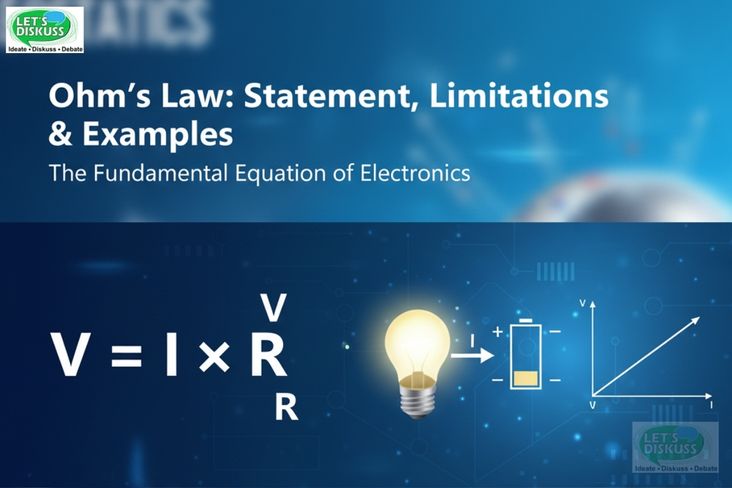
Ohm's Law, which was found in 1828, states that voltage (V) across a conductor is proportional to the current (I) that passes through it, which is V = I x R. It may seem to be more of a math problem, but it is a practical tool. Voltage is the push that causes the electrons to go through the wire, current is the flow of these electrons, and resistance is what makes them slow down like traffic in a congested road. We are told by the formula that, knowing two of these values, we can determine the third. R is the constant of proportionality and the resistance in ohms, denoted as R, which is dependent on the material and dimensions of the conductor. It is a simple correlation that has been followed by electricians, engineers, and hobbyists over the course of almost 200 years. We should dissect it a little to see what is going on in it.
Key Concepts
The resistance R, with its unit of ohms, isn’t just a random number—it’s shaped by the conductor’s makeup. Think of it as the conductor’s personality: some materials, like copper, let current flow easily with low resistance, while others, like rubber, put up a fight. This resistance also ties into how long or wide the conductor is, which we’ll explore next. The elegance of Ohm's Law is its simplicity—no need for fancy tools to use, just the elementary knowledge of such relationships. It's like a recipe for electricity, and when you've got the ingredients down, the outcome is sure to follow.
Factors Affecting Resistance
Conductor resistance depends on the length of the conductor, the area of the conductor and the material that the conductor is made out of. These are what make the current flow smoothly or tenaciously along a wire, and they are worth a more detailed consideration when you are to get a clue on the practical uses.
1. Length and Resistance
The resistance of a conductor is directly proportional to its length, and doubling the length doubles the resistance. Suppose you doubled the length of the garden hose--the water must go farther, and the stream is slower. The same is with electrons in a wire. When wiring a house, a longer cable may lead to an increase in resistance, and this could influence the amount of power making it to the appliances. This association is intuitive as soon as you consider it: the longer the distance that the electrons must cover, the more barriers they must overcome.
2. Cross-Sectional Area
The reduction in cross-sectional area of a conductor doubles the resistance, which means that they are inversely proportional. Just imagine that garden hose again, only squeeze it tighter. The water is finding it hard to pass, and the stream becomes low. Electrically, a thinner wire gives the electrons less space in which to flow, hence resistance increases. That is why the heavy-duty appliances have thick cables; they cut the resistance and save the current, which flows smoothly. It is a balancing process, and it is possible to choose the right materials to use in any project by understanding the same.
Limitations of Ohm’s Law
Although Ohm's law comes in quite handy, it is not a universal law. You do know where it does not, you will save yourself a good many frustrations in the future.
1. Material Dependence
The law of Ohm can only apply to stuff that has a constant resistance. When you warm a piece of wire, such as a light bulb filament, its resistance varies, and the V = I × R equation disintegrates. Ohm had calculated his rules under steady conditions, which means that when materials are stubborn with heat or other forces, they do not follow his book. In essence, science is based on assumptions, and the actual world can contravene such rules.
2. Non-Ohmic Conductors
Other conductors, such as diodes or transistors, are not always obedient to the law of Ohm. They do not resist current in the same way, which is different across the direction of the voltages. These are referred to as non-ohmic conductors, and they require complex models to comprehend. It is as though you were attempting to sail by a map which only serves straight lines--useful, but not the whole. Understanding such exceptions will make you use Ohm's law wisely.

Practical Examples of Ohm’s Law
Ohm’s Law finds practical use in various electrical scenarios, demonstrating its real-world relevance. Let’s walk through a couple of examples to see how it works in action.
1. Simple Circuit Calculation
To find the resistance in a circuit with an identifiable voltage of 12V and current of 2A, Ohm's Law calculates R = V/I = 6 ohms. Suppose you are diagnosing a little LED circuit. You take the reading of voltage across the light and the current through it, put the values into the formula, and—voilà—you have the resistance. This will let you know whether or not the resistor is the correct size or if something has gone wrong. It's a physical way to observe the law at work, and it's nice when the numbers match.
2. Series Connection of Slabs
When two identical slabs are connected in series with a 2V potential difference across each, the total resistance becomes 2R. Picture two blocks of the same material wired end to end. If each slab has a resistance of 5 ohms and you apply 2 volts across each, the total voltage is 4V, and the total resistance doubles to 10 ohms. This setup might come up when designing a circuit board or extending a power line. It’s a practical illustration of how resistance adds up, and it shows how Ohm’s Law scales with configuration.
Conclusion
Mastering the fundamentals of electrical engineering and more is the reason why understanding Ohm's Law, where it applies, and where it does not apply, is important. It is a device that has never been invented, just as the experiments of Ohm in the 19th century, up to the devices that we consider today. You need to know the basics of electricity, whether you are repairing a lamp, creating a circuit, or simply wondering how electricity works. This law provides you with a good background. Naturally, it is not flawless; it makes us think and adjust to the reality; its borders make us think and respond to the challenges of the real world. To bring it to a close, I would like to invite you to build a basic circuit on your own. Take a battery and a bulb, and a piece of wire, and watch Ohm's Law invest its reality in you.