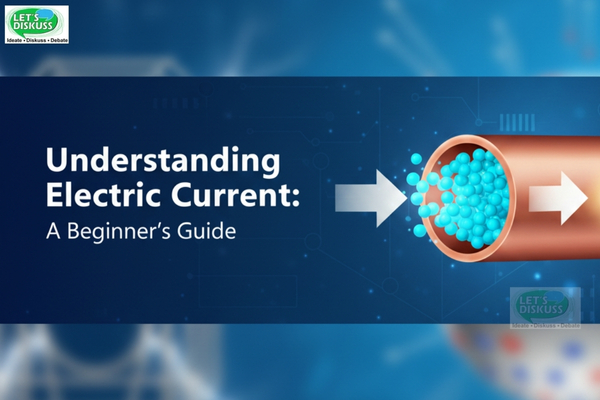
What is Electric Current?
The charges in motion, both free and bound, are usually said to be at rest. Moving charges are an electric current. In numerous cases, such currents are a natural occurrence. One such phenomenon is lightning, whereby the charges pass through the clouds and the earth through the atmosphere, which in some cases may be disastrous. The movement of charges in lightning is not constant, but in our daily life, we observe numerous things where charges move continuously in a constant fashion, as water moves in a river. An example of such devices includes a torch and a cell-operated clock. We shall learn in the current chapter some of the fundamental laws of steady electric currents.
Understanding the Basics
1. Definition of Electric Current
Imagine a small area held normal to the direction of flow of charges. Both the positive and the negative charges may flow forward and backward across the area. In a given time interval t, let q be the net amount (i.e., forward minus backward) of positive charge that flows in the forward direction across the area. Similarly, let q- be the net amount of negative charge flowing across the area in the forward direction. The total amount of charge flowing through the area in the forward direction in the time interval t, then, is I = q / t. This is proportional to t for a steady current and the quotient.
2. The Formula for Current
I = q / t is defined to be the current across the area in the forward direction. (If it turns out to be a negative number, it implies a current in the backward direction.) Currents are not always steady, and hence, more generally, we define the current as follows. Let ΔQ be the net charge flowing across a cross-section of the conductor during the time interval Δt [i.e., between times t and (t + Δt)]. Then, the current at time t across the cross-section of the conductor is defined as the value of the ratio of ΔQ to Δt in the limit of Δt tending to zero, I(t) = lim ΔQ / Δt.
Units and Measurement
1. The Ampere: Unit of Current
In SI units, the unit of current is the ampere. An ampere is defined through the magnetic effects of currents that we will study in the following chapter. An ampere is typically the order of magnitude of currents in domestic appliances. Currents in our nerves are in microamperes.
2. Microscopic Currents in Everyday Life
An ampere is typically the order of magnitude of currents in domestic appliances. An average lightning carries currents of the order of tens of thousands of amperes, and at the other extreme, currents in our nerves are in microamperes. Electric currents experience a force when an electric field is applied. If it is free to move, it will thus move, contributing to a current. In nature, free charged particles do exist, like in the upper strata of the atmosphere called the ionosphere. However, in atoms and molecules, the negatively charged electrons and the positively charged nuclei are bound to each other and are thus not free to move. Bulk matter is made up of many molecules; a gram of water, for example, contains approximately 10^22 molecules. These to individual nuclei. In some materials, the electrons will still be bound, i.e., they will not accelerate even if an electric field is applied. In other materials, notably metals, some of the electrons are practically free to move within the bulk material. These materials, generally called conductors, develop electric currents in them when an electric field is applied.
Electric Currents in Conductors
1. Force in an Electric Field
An electric charge will experience a force if an electric field is applied. If it is free to move, it will thus move, contributing to a current. In nature, free charged particles do exist, like in the upper strata of the atmosphere called the ionosphere.
2. Charged Particles in Motion
Naturally, we have some free charged particles, such as in the ionosphere. However, within atoms and molecules, the electrons and nuclei are held together and thus not freely able to move. Matter is a collection of molecules, which makes a gram of water containing approximately 10^22. The electrons no longer remain attached to one nucleus due to their high density. The electrons do not jump about in some substances--they are not set free by applying an electric field. But in other cases, in particular the metals, a portion of the electrons acts almost as a free gas within the substance. They are the conductors: when you put an electric field on them, they give out electric currents.
3. Bulk Matter and Conductivity
Here, therefore, is the point: bulk matter is merely a collection of molecules, and to give you a sense of the matter, a gram of water contains about 10^22 molecules. Due to such a large number of them being crowded together, the electrons are no longer confined to individual nuclei. In other substances, such as with some insulators, the electrons are not truly free, even though they seem like they are when a wave of a field of electricity is thrown at them. In substances such as metals, though, the majority of the electrons are virtually free to slide through the solid. Those materials we refer to as conductors, and when you apply one, you make them start tumbling around and producing currents. When we enlarge the solid conductors, the atoms are clenched together; thus, the current is carried by the negatively charged electrons. With that said, in some situations, both positive and negative charges may drift, though in our homework, we are only discussing solid conductors, meaning that we are talking about the flow of current by negatively charged electrons in a lattice of immobile positively charged ions.

Current Flow Without External Fields
1. Random Motion of Electrons
Consider first the case when no electric field is present. The electrons will be moving due to thermal motion, during which they collide with the fixed ions. An electron colliding with an ion emerges with the same speed as before the collision. However, the direction of its velocity after the collision is completely random. At a given time, there is no preferential direction for the velocities of the electrons. Thus, on average, the number of electrons travelling in any direction will be equal to the number of electrons travelling in the opposite direction. So, there will be no net electric current.
2. No Net Current
An electron colliding with an ion emerges with the same speed as before the collision. However, the direction of its velocity after the collision is completely random. At a given time, there is no preferential direction for the velocities of the electrons. Thus, on average, the number of electrons travelling in any direction will be equal to the number of electrons travelling in the opposite direction. So, there will be no net electric current.
Applying an Electric Field
1. Creating a Steady Current
We can also imagine a mechanism where the ends of the cylinder are supplied with fresh charges to make up for any charges neutralised by electrons moving inside the conductor. In that case, there will be a steady electric field in the body of the conductor. This will result in a continuous current rather than a current for a short period of time. Mechanisms that maintain a steady electric field are cells or batteries that we shall study later in this chapter. In the next sections, we shall study the steady current that results from a steady electric field in conductors.
2. Drift and Neutralization
In that case, there will be a steady electric field in the body of the conductor. This will result in a continuous current rather than a current for a short period of time. Let us now see what happens to such a piece of conductor if an electric field is applied. To focus our thoughts, imagine the conductor in the shape of a cylinder of radius R. Suppose we now take two thin circular discs of a dielectric of the same radius and put a positive charge +Q distributed over one disc and similarly -Q at the other disc. We attach the two discs to the two flat surfaces of the cylinder. An electric field will be created and is directed from the positive towards the negative charge. The electrons will be accelerated due to this field towards +Q. They will thus move to neutralise the charges. The electrons, as long as they are moving, will constitute an electric current. Hence in the situation considered, there will be a current for a very short while and no current thereafter.
Visualizing Current in a Conductor
1. The Role of Positive and Negative Charges
Let us now see what happens to such a piece of conductor if an electric field is applied. To focus our thoughts, imagine the conductor in the shape of a cylinder of radius R (Fig.). Suppose we now take two thin circular discs of a dielectric of the same radius and put a positive charge +Q distributed over one disc and similarly -Q at the other disc. We attach the two discs to the two flat surfaces of the cylinder. An electric field will be created and is directed from the positive towards the negative charge.
2. Charges at the Ends
Suppose we now take two thin circular discs of a dielectric of the same radius and put a positive charge +Q distributed over one disc and similarly -Q at the other disc. We attach the two discs to the two flat surfaces of the cylinder. An electric field will be created and is directed from the positive towards the negative charge. The electrons will be accelerated due to this field towards +Q. They will thus move to neutralise the charges. The electrons, as long as they are moving, will constitute an electric current. Hence in the situation considered, there will be a current for a very short while and no current thereafter.
3. Acceleration Due to the Field
The positive charge will be accelerated due to this field towards -Q. They will thus move to neutralise the charges. We can also imagine a mechanism where the ends of the cylinder are supplied with fresh charges to make up for any charges neutralised by electrons moving inside the conductor. In that case, there will be a steady electric field in the body of the conductor. This will result in a continuous current rather than a current for a short period of time.
Conclusion
We shall study the steady current that results from a steady electric field in conductors. Mechanisms that maintain a steady electric field are cells or batteries that we shall study later in this chapter. In the next sections, we shall study the steady current that results from a steady electric field in conductors.
So, that's the rundown on electric current. It's all about charges moving in a directed way, usually electrons in conductors, driven by an electric field. Next time you plug in a device, you'll have a better sense of what's happening behind the scenes.