Introduction
Coulomb's Law is one of the fundamentals of electrostatics, quantifying electric force among two stationary point charges. It was found centuries ago and describes how it is that charged particles interact and underpins what we know about electricity and magnetism. The law specifies that force among charges results without motion. The remarkably simple and beautiful equation applies as much to matters of subatomic particles as it does to big atmospheric events such as storms of lightning.
Coulomb's Law explains how "likes repel and opposites attract" in electricity. If you've been shocked after walking across carpet, then you've witnessed this law in action. Charging is achieved by rubbing charges onto your body, and when you reach out to metal, electrons flow in order to provide that shock. Other than such instances, Coulomb's Law forms the basis of everyday technologies like smartphones and medical imaging.
This blog post discusses Coulomb's Law, its history, mathematical representation, and current application. At the end of it, you'll get to know about this formula and get an insight of its impact from the 18th century to developments up to 2025 and beyond.
Historical Context
In late 18th century, Charles-Augustin de Coulomb conducted pioneering experiments to establish a fundamental scientific law that remains in existence even today. Born in 1736, he was educated as an engineer and was brilliant at marrying mechanics and electricity. In about 1785, in a brilliant application of a torsion balance, a delicate instrument that deflected a fiber to read small forces, much like Henry Cavendish later did for gravity, Coulomb applied it to investigate forces of interaction of charged spheres and measure electrostatic forces with precise accuracy in terms of how much the fiber was wound.
Coulomb expanded upon concepts developed by such thinkers as Benjamin Franklin, who observed that like charges repel and unlike charges attract one another. Coulomb contributed mathematical rigor, releasing his results of 1785-1789 in letters to the French Academy of Sciences. The force between charges depended upon their amount and inversely upon the square of the inter-charge distance. This "inverse-square" relationship was reminiscent of Newton's law of gravity, and this potential inter-relationship of electric and gravitational forces tantalized scientists for decades. Coulomb's work was pioneering. Not having contemporary equipment, he ingeniously employed amber rods and pith balls to show electric charge. Small forces between close, charged spheres were detected by his delicate torsion balance. That was not mere verification of theory; it was opening the possibility of being able to measure electric charge. The unit of charge, now called the coulomb (C) in his memory, bears testament to his enduring influence.
Coulomb's findings emerged at a European time of scientific advances such as that of the Enlightenment. What he had done was lay foundations upon which later giants such as Maxwell and Faraday could work, such as in unifying magnetism and electricity. Our modern systems of electromagnetism—such as power cables and devices—may well have developed much more gradually without Coulomb's precise measurements.
Importance in Physics
A knowledge of Coulomb's Law is critical to an understanding of higher concepts within electromagnetism, from atomic interactions all the way to large-scale electrical effects. In classical physics, it is the foundation of electrostatics, detailing how stationary charges affect one another. It is an integral part of Gauss's law and Poisson's equation, which account for electric fields in more complicated situations.
Quantum mechanically, Coulomb's Law covers forces between atoms and molecules. Stability of matter as such is dependent on a balance between attractive nuclear forces and repulsive Coulomb forces between the electrons. In areas of plasma physics, it's essential to understand ionized stellar or fusion reactor gases. Even in relativity, adjustments to Coulomb's Law deal with high-velocity charges, resulting in particle accelerator concepts.
Outside of theory, the significance of the law excels in applied physics studies. Students tend to recreate Coulomb's experiments using contemporary equipment, cementing the scientific process. Its basic nature renders it accessible, yet its uses are enormous, ranging from circuitry design to astrophysics. Essentially, without being able to master Coulomb's Law, one cannot begin to understand the electromagnetic forces governing our universe.
The Formula of Coulomb’s Law
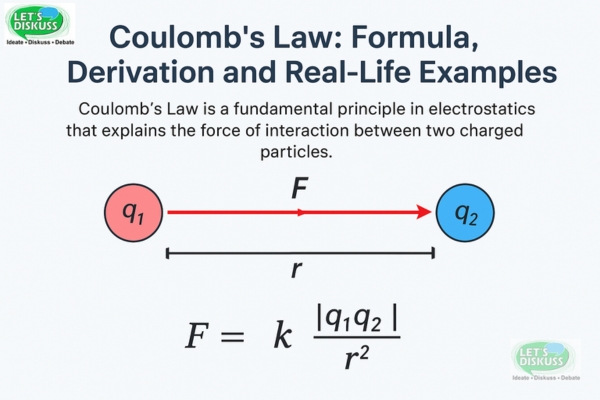
Coulomb's Law states that this electrostatic force is proportional to the product of two-point charges and inversely proportional to the square of the distance. The elegant formula captures electrostatic interactions and can be seen in science books everywhere.
Here, let q₁, q₂ be in coulombs (C) and r be in metres (m). The force F in newton (N) will act along the line of action of the two charges. If both are positive, then the force is repulsive; if it is opposite, then it will be attractive. The direction of this force is very important because forces are vectors.
It assumes a model of point charges—ideal localized charges—and air or vacuum medium, whose permittivity is that of free space. In more complicated media, such as insulators, even up to water, the formula adjusts by adding a dielectric constant, yet stays otherwise unchanged.
Scalar Form
Force F is F = k * |q₁ q₂| / r², where k is Coulomb's constant. The absolute value of this force, without concern for direction, is this variant. The absolute value keeps the force positive, because magnitude does not care about attraction, or repulsion.
Assume that there are two electrons of charge q = -1.6 × 10⁻¹⁹ C, separated by 1 nm. Then, F = k * (1.6e-19)² / (1e-9)² ≈ 2.3 × 10⁻¹⁰ N. The exceedingly small force is significant at atomic scales and is employed to estimate forces in capacitors or in ions of solutions.
The inverse-square law means the force decreases quickly with distance. Double the separation, and the force is quartered—explaining why large charges feel strong nearby but weak far away.
Vector Form
Coulomb's Law gives direction in terms of unit vectors: F₁ = k * (q₁ q₂) / r² * r̂, with direction of r̂ going from q₂ to q₁. The signs of the charges determine direction: positive means repulsion in direction of r̂, negative means attraction.
In three-space, positions r₁ and r₂ yield r = r₁ - r₂ and r̂ = r / |r|. The vector version is F₁ = k (q₁ q₂ / |r|³) r, reducing unit vector inclusion. This is key to systems with more than one charge, in which forces superpose vectorially.
For a charge in a triangular arrangement, compute and add each pair force vector. This approach is consistent with Newton's law, facilitating predictions of moving charged particles.
Coulomb’s Constant
Coulomb’s constant, denoted as k and approximately equal to 8.99 × 10⁹ N m²/C², arises from the permittivity of free space in the SI unit system. Specifically, k = 1 / (4πε₀), where ε₀ (epsilon naught) is 8.85 × 10⁻¹² C²/N m², the vacuum permittivity.
This constant scales the force, reflecting how "stiff" space is to electric fields. In cgs units, k is 1, but SI prevails in modern engineering. Understanding k helps in dimensional analysis and relating electricity to other forces.
In practice, k's large value means even small charges produce noticeable forces—think of static cling in laundry, where microcoulombs create newtons of attraction.
Derivation of Coulomb’s Law
The derivation of Coulomb’s Law begins with experimental observations, drawing parallels to Newton’s Law of Universal Gravitation due to their similar inverse-square dependence. While not derived from first principles like some quantum laws, it's empirically grounded, later justified by field theory.
Coulomb's original derivation was inductive: through repeated measurements, he inferred the proportionality. Modern derivations often start from the electric field concept, but the historical path emphasizes experimentation.
Experimental Setup
Coulomb utilized a torsion balance to measure the minute forces between charged spheres, allowing precise quantification of the relationship between force, charge, and distance. The apparatus consisted of a horizontal bar suspended by a thin fiber, with a charged sphere at one end and a counterweight at the other. A second charged sphere was fixed nearby, and the twist in the fiber proportional to the force.
To charge the spheres, Coulomb used electrified rods or friction. He varied distances with a micrometer and charges by sharing between identical spheres (halving charge each time). This setup isolated electrostatic forces from gravity or magnetism, with sensitivity to micro-newtons.
Reproductions today use digital sensors, but the principle remains: controlled variables confirm F ∝ q₁q₂ / r².
Mathematical Derivation
Assuming two point charges q₁ and q₂ separated by distance r in a vacuum, the force can be derived from the concept of electric fields, where the field E due to q₂ at the location of q₁ is E = k q₂ / r², leading to F = q₁ E. This field-based approach, introduced by Faraday, treats one charge as creating a field that acts on the other.
Mathematically, the potential energy U = k q₁ q₂ / r, and force as negative gradient: F = -dU/dr = k q₁ q₂ / r² (magnitude). For vectors, it's the gradient in 3D.
In quantum electrodynamics, it's mediated by virtual photons, but classically, the derivation suffices as empirical.
Assumptions and Limitations
This derivation assumes stationary charges and neglects relativistic effects, making it applicable primarily to electrostatic scenarios. It ignores magnetic fields from moving charges (Lorentz force) and quantum effects at tiny scales.
For extended objects, integration over charge distributions is needed. In media, dielectric constants modify k. At very small distances, like nuclear, strong forces dominate. Despite limitations, it's accurate for most macroscopic and atomic applications.
Difference Between Coulomb’s Law and Newton’s Law of Gravitation
| Feature | Coulomb’s Law | Newton’s Law of Gravitation |
|---|---|---|
| Force Type | Electric force between charges | Gravitational force between masses |
| Nature of Force | Can be attractive or repulsive | Always attractive |
| Strength | Much stronger than gravity | Much weaker compared to electrostatic force |
Real-Life Examples
Coulomb's Law is expressed in many commonplace and scientific phenomena, demonstrating the ubiquitous nature of electrostatic forces in the universe. From plastic wrap's stickiness to thunderstorms' grandeur, such instances demonstrate the law's applicability beyond laboratories.
Atomic and Molecular Structure
In atoms, the pulling force between positively charged protons within the nucleus and negatively charged electrons around them is controlled by Coulomb's Law, stabilizing the atom. The +Ze (Z atomic number) nucleus pulls electrons of -e each, with force F = k Ze² / r², countered by centrifugal force in Bohr model.
In molecules, Coulomb forces propel ionic bonds (such as NaCl) and shape covalent sharing. Even in DNA's double helix, electrostatic repulsion between phosphate groups is balanced by attractions, allowing life. Without these forces, matter would crumple or scatter.
Lightning and Atmospheric Electricity
In a thunderstorm, accumulation of opposite charges between clouds and the earth results in lightning discharges, in which Coulomb's repulsive and attractive forces initiate the enormous electrical breakdown of air. Cloud ice particles crash, splitting charges: positive at top, negative at bottom. Ground induces positive charge, resulting in a gigantic potential difference.
When the field is beyond air's dielectric strength (~3 MV/m), electrons avalanche to create a plasma channel. The force pushes charges, converting energy into light and heat. This natural phenomenon puts Coulomb's Law into perspective at gigawatt power.
Electrostatic Precipitators in Industry
In pollution control devices like electrostatic precipitators, Coulomb’s Law is harnessed to attract charged dust particles to oppositely charged plates, effectively cleaning industrial exhaust gases. Used in power plants and factories, these devices ionize particles with corona discharge, then apply fields to collect them.
The force F = qE (from Coulomb via field) pulls ash or soot to plates, removing 99% of particulates. This technology reduces air pollution, showcasing environmental applications.
Van de Graaff Generators
Van de Graaff generators demonstrate Coulomb’s Law by accumulating high voltages through the repulsion of like charges on a metal sphere, often used in educational settings to produce dramatic sparks. A belt carries charge to a hollow sphere, where repulsion spreads it evenly on the surface.
Potentials reach millions of volts, and when discharged, sparks illustrate force overcoming air resistance. These devices also powered early particle accelerators.
Other everyday examples include static cling in clothes, where friction charges fabrics, leading to attraction. Or balloon rubbing on hair: electrons transfer, making the balloon negative and hair positive, causing attraction. In painting, electrostatic spray guns charge paint droplets for even coating.
Applications in Modern Technology
Beyond natural examples, Coulomb’s Law underpins various technological innovations, from electronics to medical devices. In 2025, with advances in nanotechnology and quantum computing, its role is more critical than ever.
Capacitors and Energy Storage
In capacitors, the storage of electrical energy relies on the separation of charges, with the force between plates described by variations of Coulomb’s Law. Parallel plates hold opposite charges, with energy U = (1/2) CV², where capacitance C relates to area and distance via ε₀.
Modern supercapacitors use nanomaterials to maximize surface area, storing energy electrostatically for electric vehicles and renewables. Coulomb forces maintain charge separation without chemical reactions.
Semiconductor Devices
The behavior of electrons and holes in semiconductors, crucial for transistors and diodes, is influenced by electrostatic forces as per Coulomb’s Law. In p-n junctions, depletion regions form due to charge diffusion and resulting fields.
Transistors amplify signals by modulating these fields, enabling computers and phones. In 2025, quantum dots and 2D materials like graphene exploit Coulomb interactions for faster, efficient chips.
Other applications: Laser printers charge toner particles to adhere to paper via Coulomb attraction. Inkjet printers direct charged ink drops. Powder coating charges powders for durable finishes.
In medicine, defibrillators use stored charge for heart shocks. Recent simulations preserve Coulomb’s Law in quantum algorithms for particle modeling. AR tools teach the law interactively.
Conclusion
In essence, Coulomb’s Law not only provides a precise formula for electrostatic interactions but also offers insights into its derivation and practical manifestations across diverse real-life contexts. From atomic bonds to cutting-edge tech, it remains indispensable. As we advance into 2025, innovations in AI, quantum tech, and sustainable energy will continue to build on this timeless principle, reminding us of the enduring power of fundamental science.