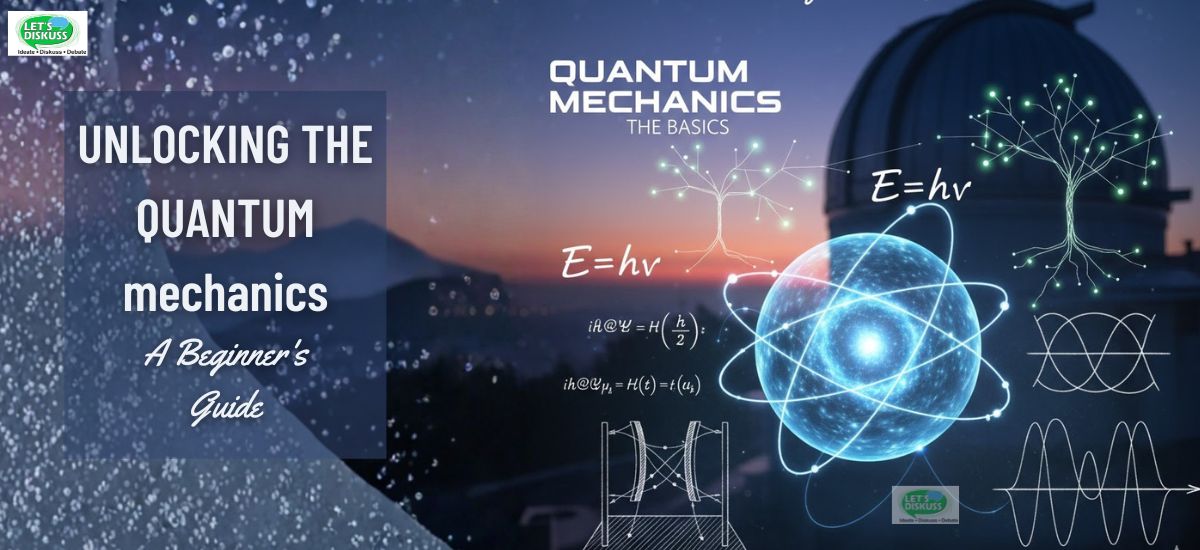
I still recall the time when I was first going to learn the basics of quantum mechanics. I hoped that it would be as though opening a door to a more developed form of physics that I was already familiar with. Rather, it was as though I was plunging down a staircase into a different universe where nothing acted in a manner that I anticipated. Subsequently, when I returned to the basics of quantum mechanics with a more mature tutor, I knew that it was not so scary. It was simply foreign, as in getting to know the rules of a new game where particles cheat on the surface and the universe is like it rolls right over its eyes. And this guide is no exception, because it takes the same route, but it is soft, inquisitive, and made of tales rather than hard preconceptions.
Introduction: Why Quantum Feels Like Stepping into Another Reality
The quantum mechanics is when you know that the universe acts incredibly different when you get a zoom-in. It took me years to read little articles and not get anywhere, and then I eventually learned to be patient in approaching quantum mechanics, and not panic. Since then, quantum mechanics began to be less of an abstract theory, and more of an odd cousin with unpredictable ways.
The Birth of Quantum Theory
1. The Classical World Comes to a Dead End
It all started when classical physics was unable to give an explanation of any strange behavior in light and atoms. Traditional laws had served classical cars and classical planets well but when scientists began posing questions about what was quantum mechanics in chemistry and why electrons were like impatient teenagers they failed miserably. Even the first efforts to provide an answer to the question what is quantum mechanics in chemistry shocked the scientists as the results did not correspond to any of the existing models.
2. Groundbreaking Experiments at an Early Age
Scientists were compelled by experiments such as the photoelectric effect and the black body radiation to reconsider the nature of how things work. These discoveries were, however, no trifling contributions to physics; they were holes. That was when the innovators resorted to weird algebra, and created instruments that later became the first quantum mechanics equations. The equations of early quantum mechanics did not clarify anything, but rewrote the book.
What Is Different about Quantum Mechanics
1. Wave-Particle Duality
Among the initial surprises, the fact that particles can act like waves and that waves can act like particles is one. I was prompted to go back to books on quantum mechanics when I heard that electrons could behave as ripples in pond. That was not the case with those quantum mechanics books; it was my assumptions.
2. The Uncertainty Principle
The concept of quantum mechanics presents uncertainty as an inalienable reality of the universe but not a error of calculation. It is as though one is attempting to follow a firefly in the darkness. The harder you study where it is the less you are aware of the rate of its movement. It is that mixture of clarity and mystery, which led scientists to the quantum mechanical model. And I later understood that the quantum mechanical model was not constructed to puzzle its purpose was to explain the truth about particles.
3. Probability Rules the Microworld
Probability depends on the global interaction between the world and the Micro World. The probability of the location of a particle is as predictable as you can get in quantum theory. I enjoyed this thought as soon as I stopped struggling with it. It is closely related to the mechanical quantum action of particles which is more of music than clockwork. The wave within mechanical systems of quantum is stochastic, but structured.
The Quantum Mechanical Model of the Atom
1. Leaving the Planetary Model behind
The mere illustration of the orbiting electrons as planets do not fly when you take a closer look. This is the reason why the scientists invented quantum mechanical atom model- a model that considers the electrons as spread out waves. It was after reading about the quantum mechanical concept of the atom that I ceased to imagine the electrons as tiny dots but instead started to imagine them in the form of shimmering clouds.
2. Orbitals and Electron Clouds
Electrons do not follow the paths but are distributed in probability regions known as orbitals. These orbitals are real by observing the atomic structure quantum mechanical model that demonstrates beautiful shaped clouds around the nucleus. The first time I saw the atomic structure quantum mechanical model I felt like I had discovered underlying design in matter.
3. Energy Quantum Jumps and Levels of Energy
Electrons are at definite energy levels and they can jump in between them in discrete quantized leaps. They do not move or slide, they teleport. That is where the concept of a quantum mechanics formula comes in handy. Any quantum mechanics you come across attempts to give a reason as to why these jumps occur in the manner they do.
Fundamentals and Principles of the Quantum Theory.
1. Learning about the Wave Function
The mathematical instrument that is used to describe all the information we have about a quantum system is the wave function. It’s strange but elegant. I recall that I looked at it hours after hours until it eventually made sense. I always discovered something new in the explanation although I went through my favorite book in quantum mechanics many times. It was that quantum mechanics book which, later on, taught me to cease thinking of the math as an enemy.
2. Explaining the Schrodinger Equation in Simple Terms
The equation by Schrödinger has been used to explain how the wave of a particle evolves with time. It is the foundation of quantum theory and one of the causes of the argument on quantum mechanics and quantum physics. Although the distinction between quantum mechanics vs quantum physics is sometimes hard to see, the work of Schrodinger would easily belong under both.
3. Quantum Numbers and their Representations
The quantum numbers aid in naming and forecasting the conduct of electrons within atoms. They represent the coordinates of the quantum world, a means of mapping something which cannot be visualized much. It is like knowing the personality of each electron rather than the precise location of that electron.
Quantum Mechanics was developed in the field of Chemistry
1. Why Chemistry is a depends on quantum laws
On the back of each chemical bond, each chemical reaction, and each chemical property that you study in chemistry is quantum behavior lurking beneath the rear carp. Bonds are established due to the fact that the electrons are stationary by virtue of the fact that they are placed in stable positions and not by orbiting them in the manner that they form miniature moons.
2. The Influence of the Electrons on the Chemical Properties
The quantum rules are used to describe the behavior of elements depending on the arrangement of electrons. Here is where the quantum world is finally introduced to real and life chemistry finally. After viewing chemistry in this light, all the periodic trends indeed became rational.
Use of Quantum Mechanics in the real world
1. Daily Technologies based on Quantum Ideas
Most of the devices that we have day to day like LEDs and GPS are only possible due to quantum effects. The microchips used in your telephone hand are based on electron tunneling and energy bands which cannot be described by classical physics.
2. Future of Quantum Computing and Future
Quantum computing takes these principles to extremes in order to solve problems that are difficult to solve using classical computers. The notion of qubits that exist simultaneously in both states seems to be science fiction, but it is now real.
The most frequently asked beginner questions on the quantum theory
1. What Is so Problematic about Visualizing Quantum?
The notion of quantum is alien to us since we are accustomed to a predictable world. The second we reduce in scale to the atomic scale, those rules with which we are acquainted break.
2. Does quantum physics = quantum mechanics?
There is a great overlap in the usage of these two terms, but their application is relative. Quantum physics represents a larger range of knowledge, whereas quantum mechanics is the mathematical model science relies on.
Learning Quantum: How to Start Learning Quantum Without Feeling Overwhelmed
1. Build Concepts Before Math
Learning quantum is best done by and through the story of its discoveries without even thinking of formulas. This solution has helped me avoid confusion.
2. Simple Model Go-Slaws to Get Confidence
The simplest obtainable systems such as the particle-in-a-box or hydrogen atom allow you to become familiar with foundations of quantum. Such little steps provide you with the assurance that you will be able to go further and deal with more complicated ideas.
Summary: Quantum Begins With Curiosity
The farther you read about quantum mechanics, the more you come to know that there is much mystery in the small dimensions of what passes as reality. Each time you go a bit further there is something that surprises you, something that makes you stop and reconsider the way the universe functions. And that is the charm of this profession: it is open to anyone who likes questions which have answers which are not by the book.