Artificial intelligence has started to become a part and parcel of our lives. At the onset, we are using it for everything we possibly can. Responding to texts, generating a paragraph,writing professional codes, or even suggestions on personal affairs! But as we are entering into the next phase of AI evolution, the technology seems to lag behind. People are realising that the machine generated is easily identified and lacks human-level authenticity.
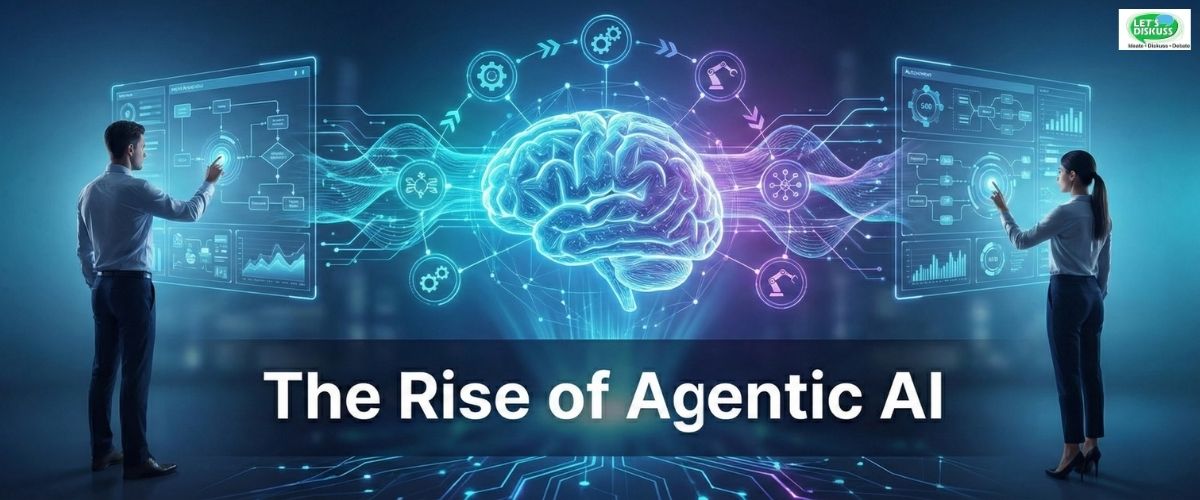
As the makers of AI agents figured this out, they are constantly making changes where the prompt-based answers are now converting to autonomous solutions. This is what defines the rise of Agentic AI. We will soon reach close to the AI systems that will operate with purpose and independence.
To put it in plain words, Agentic AI ceases the difference between telling an AI tool to “write a social media post” and asking an AI agent to “grow my Instagram presence,” and then watching it plan, dive deep, draft, test, and command on its own. This shift from generative AI to autonomous AI is the technological upgrade that will redefine the nature of work and life!
Introduction: Beyond the Chatbot
A chatbot is made to answer your questions. An agent, on the other hand, works to achieve a particular goal. That is the main difference between generative AI and autonomous AI. Generative AI has been a blessing in the life of people and thus, there is no denying how tools like ChatGPT are making our lives easier. They produce answers instantly, can create content in large volumes, and accelerate long tasks to quicker solutions. But they still rely heavily on prompts as the answer you’ll get depends mainly on your input.
Agentic AI now has something fundamentally new which is called autonomy. Instead of waiting for any prompt, agents plan their next steps by themselves, take action without being told to, and remember the past inputs. This makes them the natural evolution of language models (LLMs) and enables them to be active participants in workflows. They are also capable of solving multi-step challenges end to end.
The core thesis of the AI agentic era is that work will be completed not by humans alone, nor by AI alone. The work will be done by an autonomous system that is rightly guided by human judgment and processed by the AI. This partnership is going to reshape work in each field be it software development, marketing, sales, social media, HR, finance, and even creative fields like graphic designing.
Agentic AI Demystified
To understand more in-depth how an Agentic AI is different, we need to understand the four pillars: perception, planning, action, and memory.
Perception is used by an agent in order to understand the world. The formation of perception takes place by the AI via reading of multiple files available online, scanning the web for more info, analyzing code, or interpreting available data.
Planning is done by the agent by breaking down the goal given by a human into a sequence of steps.
Action is when the planning is being executed. The agent will write code, or send emails, or run tests, or do other tasks which are required in order to achieve the goal.
Note that this becomes a ‘Memory’ for agentic AI. Later, it ties it all together and forms a bubble of perceptions. Simply put, it learns from its previous actions, stored tasks, and uses this memory for solving future tasks.
Some AI agents are simple and have a narrow scope of working while others are part of multi-agent systems that have clusters of agents in order to collaborate on work or divide tasks. For example, if a task of creating a marketing campaign is given to the agent, a cluster of agents will work and divide the work- one can perform audience segmentation, while other can do competitor research, and content execution. The underlying principle is the same: you feed in the end goal, and let the agent handle its execution.
The New Era of AI Coding
Coding used to require a lot of effort and attention when done manually. However, with the advent of AI, coding has now become easier to go about. The leap from manually doing it to now asking an agent to do it is dramatic. Developers are already experiencing how generative AI can autocomplete a code without any additional prompt. Now, with the Agentic AI, generating a code from scratch will be a child’s play!
A manual request like “build a login flow with two-factor authentication” is enough to get the agent started. What’s more? The agent can make the architecture plan, scaffold the code, integrate APIs, do the test running, and even fix their own bugs.
From the myopic eyes, this seems like something exciting for the developers. However, sometimes it can be frustrating too. There is no denying that with the help of AI, developers can code more productively and save hours on configuration of tasks as well as debugging. But frustrations exist too, especially with the inconsistent styles and learning curve. Agentic AI is powerful, but it still needs constant supervision and oversight. Coders have to set a context beforehand.
The key here is to know how to orchestrate the AI agents to write good code by guiding these systems to produce high-quality outputs. Developers have to focus on the inputs in order to drift the AI away from making errors or inefficiencies.
Navigating the Future of Work
As Agentic AI is becoming more adaptive and capable of performing tasks, the human skills required in the workplace are changing quickly. The demand from human-skillset to the skillset of knowing how to operate AI is becoming apparent. For example, the “Agentic AI Strategist” role is emerging in companies that are planning to leverage autonomous systems into their everyday working but don’t know where to start. Learning the adaptive use of AI is thus very much required in order to survive in the work industry. The demand for people who understand both business logic and the operational capabilities of AI agents are going to be the real winners in the future.
It is true that humans cannot be 100% replaced but it is also a fact that the work they were doing will now rapidly be repositioned. Tasks that require creativity or strategic thinking, emotional intelligence, or ethical judgment will be firmly in the hands of human workers only. Agents can execute, but it has to be a human who is guarding this execution.
The shift might be risky too. There are a number of security challenges that can be faced as people with access to repositories or internal systems can leak sensitive data or magnify errors. A small misinterpretation could mean hundreds of flawed files being updated automatically. These risks make human workers’ involvement and oversight more important than ever.
Conclusion: Preparing for the Autonomous Workplace
The autonomous workplace isn’t the far fetched future! It is already here.
To stay relevant in each profession requiring a non-labour/ physical effort, one needs to adapt quickly. One of the most important steps is learning how to communicate with AI with the right prompts and actions. Understanding how to delegate tasks to AI and interpret the results obtained is a core skill set that is important to have in order to survive the changing work market dynamics.
Another important step that one must take is mastering at least one agentic framework. If you are well-versed with any AI agent framework, you will yourself at the forefront of this technological shift. Lastly, one must cultivate strategic and creative thinking, as these are core skills that AI cannot replicate.
In the long term, humans will define the vision, constraints, and ethical boundaries while the agents will execute the granular work. The future of work is not human vs. AI, it’s human plus AI, working together in harmony!
Frequently Asked Questions (FAQ)
Q1: How is Agentic AI different from Generative AI?
Generative AI works to give responses to a single prompt. Agentic AI plans, decides and gives you solutions/actions autonomously, making it a multi-step AI system without repeated human input.
Q2: Can Agentic AI fully write and deploy software on its own?
Agentic AI can plan, write and implement deployment of a software but human oversight is still necessary to validate architecture, review code for accuracy, and ensure the generated results meets all the given requirements.
Q3: What real-world jobs will be most affected by Agentic AI?
Jobs like software engineer, marketing, operations, sales, customer support, are already drifting away from the hands of humans. Roles that involve digital tasks will shift the fastest for example, generation of content pieces. Positions that require humans to employ strategy and creativity will remain human-led.
Q4: What are the biggest risks of using autonomous AI agents?
The biggest risks include amplification of error, exposure of data, incorrect steps taken at scale, etc.. This is why monitoring by humans is very much essential.
Q5: Will Agentic AI eliminate developer jobs?
No, instead of elimination, AI will change the nature of the developer job. Developers will spend less time on boilerplate, manual testing, and bug fixes, and more time on getting the AI systems to design the code architecture, complex logic, etc.
Q6: What skills should professionals develop to stay competitive?
Developers should brush up on skills such as problem-framing, prompt design for the AI, workflow orchestration, debugging AI outputs, strategic thinking, etc.