Table Of Contents
- Introduction
- Defining the Modern Workspace
- What Do Employees Prefer in 2026?
- The Productivity Battle: Remote vs. In-Office
- Work-Life Balance: The Real Winner
- Financial Impact: Salary and Savings
- Career Growth and Visibility
- The Middle Ground: Is Hybrid Work the True Future?
- Side-by-Side Comparison: Work-from-Home vs. Office
- Finding the Right Fit for You
- Final Verdict
- FAQs
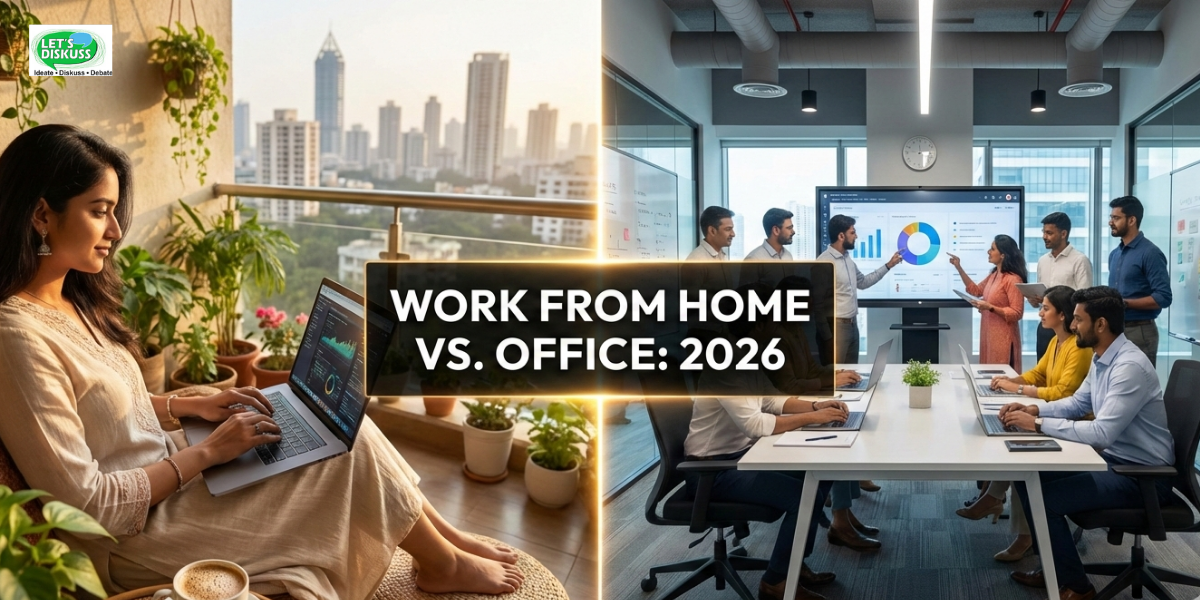
Hey there! You won’t believe this, but our professional lives are changing drastically more than the tectonic plates. In 2026, we are shifting towards just being an employee who’s present at the office desk at 9 AM sharp, to one who cares about creating an impact, whether working from home or the office.
Today, the work from home vs office debate is not just a trend, but it is a crucial aspect of our lifestyle change. Earlier, the focus was completely on “what” of the work. However, now people are talking about “where” of the work. Today, you have the option to work from a cozy cafe in Mussoorie or just have a coffee, sitting in our Bangalore apartment.
Introduction: The Great Workplace Shift
Remember that pre-pandemic era? The one where we couldn’t even think about how things in the workplace would change to this level. In 2026, our workplace will have completely shifted and evolved, and those pre-pandemic ways have become something unrecognizable.
We are now entering into a zone of modern workplace culture where the preference is given more to a flexible-first approach rather than survival mode. Companies have finally realized that you can’t really force a person to sit in the cubicle all day long and get the work done.
Work from home vs office
When we are talking about work from home vs office debate, we are actually counting on our time. Honestly, tech is dominating, and we are witnessing the rise of high-speed 6G and ubiquitous satellite internet, which is completely crushing our geographical barriers. This debate is not about asking for a perk anymore; it is, in fact, leading towards how talent views employment.
The Rise of Flexible First Mindset
Okay, I know you won’t digest this, but we are actually moving from fitting your life into work to fitting your work into your life. Companies are now interested in measuring your output, which is the impact, leaving the input, which is the number of working hours you spent in a cubicle, behind.
Defining the Modern Workspace
Office work vs. remote work
| Feature | In-Office (The 9-to-5 Grind) | Remote (The Digital Nomad Life) |
|---|---|---|
| Workspace | You have a fixed desk with provided gear. | You can choose it based on your own convenience. |
| Timing | You get to serve the rigid schedules like the classic 9-to-5. | Remote work gives you the flexibility of working when you are at your sharpest zone. |
| Teamwork | You get teammates and a good network opportunity. | You are interacting with digital tools only. It can get a bit lonely. |
| Productivity | You get to go from office politics, but then fewer home chores, too. | In comparison, productivity has a 40% boost. However, watch for the doorbell. |
| The Daily Trip | You will have to travel daily, which is time-consuming and tiring too. | No commute (saves you serious cash). |
| Switching Off | You don’t have to think about work after logging off. | Honestly, work never ends! |
The evolution of office jobs from home and the digital nomad lifestyle
Imagine Rahul, who is a copywriter. He has been working from his home for the last three months. He is doing work whenever he opens his laptop. He is not even into work from home vs office comparison, as he is only into completing his daily targets.
Why traditional in-person collaboration still holds value
Traditional in-person collaboration still holds immense value, as just imagine, you are in a room with 10 others, and brainstorming a high marketing pitch or a product development concept. This is something you can’t replicate at a Zoom meeting. In fact, you get to network with people and build relationships that can last longer.
What Do Employees Prefer in 2026?
Recent Survey trends from LinkedIn and NASSCOM prove to us that employees do not want 100% remote culture. We are witnessing a split in opinions. Yes, it’s true that people craving for work from home jobs remains high, but there’s still a growing desire for going office and connect with peers.
Generational Divide
We are in a generational shift.
Talking about Gen Z, they are more inclined towards mentorship and guidance opportunities, and want that corporate vibe.
Millennials, on the other hand, are asking for work from home vs office flexibility. It’s even normal as they have young families or are ageing parents.
Industry-Specific Needs
Tech: The tech industry is heavily favoring best wfh jobs. They are more into doing work with an impact and an effective output.
Manufacturing: The manufacturing sector still demands on-site workers for obvious reasons.
Creative: As the creative industry is rising, it’s a 50/50 split. It mostly depends on the project phase and requirements.
The Productivity Battle: Remote vs. In-Office
The work from home vs office productivity debate is where things get really spicy. Just imagine, at one end, you are in the office and focusing completely on your tasks. But when you work from home, you hear those pressure cooker whistles while you are on a Zoom call with a client.
Deep Work vs. Cubicle Chaos
Is deep work easier at home or in an office cubicle? Tell us what you think. Okay, it’s really about how much invested you are in your work. You may think that work from home jobs give you a reason to do deep work, but then think about that office environment where everyone has the same goal, that professional environment, where you are getting a push just by seeing someone sitting next to your desk. Hence, it’s really up to you when it comes to work home vs office productivity debate.
How are companies measuring output in 2026?
Companies today are more interested in knowing about your output achieved rather than the input given. It’s not about being on time, sitting for long hours, and rote doing the work. This is just the traditional way. Now, the focus is on achieving the desired output and choosing the flexible hours that can fit into an employee's life conveniently.
Work-Life Balance: The Real Winner
Mental health is the clear winner in the work from home vs. office debate. When you are in Delhi or Mumbai, and you get to save two to three hours a day on your commute is not a nice feeling; it’s impacting your life. That extra time you are getting actually lowers your cortisol levels a lot.
But there is a bad side. Work from home jobs can make people feel like they can never get away from work. When your office is only 10 feet from your bed, it's hard to tell where one ends and the other begins.
Flexibility can help you avoid burnout, but only if you have the willpower to turn off your laptop. Digital Wellness is becoming a key feature of HR policies in 2026 to make sure that flexible doesn't mean available 24/7.
Financial Impact: Salary and Savings
Let’s talk numbers. Choosing work from home jobs is essentially a Hidden Raise.
The Expense
| The Expense | In-Office (The Daily Grind Cost) | Remote (The Hidden Raise) |
|---|---|---|
| The Commute | Petrol, toll taxes, or expensive Uber/Ola rides. This is a total wallet-drainer. | ₹0. Your commute is from the bed to the desk only. |
| The Wardrobe | You will have to buy business formals, shoes, and incur dry cleaning and laundry costs too. | You may need decent clothes just for the Zoom call. And the rest will be handled by your pyjamas. |
| The Food | ₹200-₹500 on office lunches, plus those expensive stress coffees. | Home-cooked meals. Even if you order in, it’s way less frequent. |
| The Upkeep | You get those frequent haircuts, grooming, and office-ready maintenance. | This is low maintenance. You can go a bit wild until the next client call. |
| The Lifestyle | You may have to attend office parties or indulge in Friday night drinks, too. | You choose when and where you spend your fun money. |
Salary trends: Are remote roles paying as much as in-office roles?
The gap is closing when we talk about salary trends. Even the high-skill roles or middle management roles pay are getting identical to the same role within the work from home option.In 2026, we are witnessing work from home vs office pay scales favouring employees.The best wfh jobs are now offering competitive packages, perks, and flexibility, which are independent of your location.
Career Growth and Visibility
“Out of sight, out of mind” is the biggest fear for remote workers.Does office work vs remote work affect your path to the C-suite?In many traditional firms, yes. It happens due to proximity bias; we tend to favour people whom we see every day more than those we hardly meet.If you are a remote worker, you are seriously missing the watercooler conversations with your peers or the one happens in the parking lot.Office allows you to truly connect with people, seek guidance and mentorship, and make lasting relationships.To fight this, smart remote workers are creating their professional brands in places where digital is the first choice.They are more involved in social networks within the company and make sure that their wins are recorded and made public.Your Digital Presence will be your new resume in 2026.
The Middle Ground: Is Hybrid Work the True Future?
Most Indian businesses have quit fighting the work from home vs. office battle and signed a peace pact termed “Hybrid.”The best model is 3 days in and 2 days at home. Amazing? Isn’t it!The most satisfied employees work in hybrid setups.It has the best of both worlds:
-
The focused work from home vs office productivity for individual tasks
-
The collaborative spark of the office
Honestly, it's all about being intentional.You don't go to work to sit in front of a computer and talk to people.As humans, we are more into social connections and network building.
Side-by-Side Comparison: Work-from-Home vs. Office
| Feature | Work From Home (WFH) | In-Office |
|---|---|---|
| Productivity | High (for deep, solo work) | High (for collaborative work) |
| Flexibility | 9/10 (Control your environment) | 4/10 (Rigid schedules) |
| Career Visibility | Lower (Requires digital effort) | Higher (Physical presence) |
| Monthly Savings | ₹15,000 - ₹30,000+ | Low (High commute/food costs) |
| Social Connection | Digital-only (Can be lonely) | High (Real-life interaction) |
Finding the Right Fit for You
Identifying the best wfh jobs depends heavily on your personality.If you are an introvert, work from home jobs are your best fit.But if you are an extrovert, the office cubicle is calling you to fill its space, and the environment is demanding your energy and vibe.
Role-Based Considerations
You need to consider role-based considerations, too.It’s because some job roles, like a coder, writer, or data scientist, might not need an office to do their job.However, if you are in a PR managing firm or a Junior Associate, your teammates need your physical presence.
Junior vs. Senior Point of View in the Workplace
- The Goal of the Workspace
Juniors: They think of the office as a location to be seen and get advice.For seniors, the office is a place to lead. They use the physical environment to keep the team on the same page and organized.
- Ways of Communicating
They are in sponge mode as juniors.They need to listen, ask a lot of questions, and gain constant clarity to make sure they aren't making mistakes.Seniors: Their job is to motivate and guide.They spend their time giving comments and making sure everyone else knows what they are doing.
- Finding a solution
Juniors: They are focused on learning how to utilize the tools and do the steps right.
Seniors: They are seeing the big picture.They think about how a choice made today will influence the business in 2027 and plan for problems before they materialize.
- The Culture of the Company
Juniors want to be included.They want to feel like they are part of the tribe and that their peers respect them.
Seniors: They are the ones who keep the culture alive.They are focused on keeping standards high and making sure that the work is always the same.
Data shows that 43% of junior staff in India still work full-time in the office because they like learning in person.On the other hand, more than 60% of middle managers and executives prefer the flexibility of working from home.
Final Verdict: What Do Employees Actually Prefer?
In 2026, the trend is toward Personalized Work Models.
The work from home vs. office argument has shown us that there is no single option that works for everyone.Some weeks you might require the peace of your home, while other weeks you might need the energy of a coworking place.Companies that are winning the talent war in India right now are those that offer a “Menu of Options.”Success is no longer evaluated by how many people are in cubicles, but by how happy and productive a distributed team is.