Introduction
This device is used to produce high voltages, which are several million volts, which is why it is a major instrument in the acceleration of particles such as electrons, protons, and ions in high-energy experiments. There is only a slight possibility that you have come across such an enormous metal ball in a science museum that gave you the electric shivers: It is more likely that it was a Van de Graaff generator at work. Basically, it is a kind of electrostatic machine that produces huge differences in voltage without the use of highly complex electronics- just intelligent physics and mechanics. We will dive into the ways in which it functions and the reasons why.
History and Invention
This electrostatic generator was originally designed by Robert J. Van de Graaff, and is named after him, who initially developed this generator in the 1920s to investigate in finer detail the minute structure of matter. The idea was conceived by an American physicist, Van de Graaff, while at Princeton University. The model he invented in 1929 was able to generate approximately 1.5 million volts, and this was revolutionary during that period. It was a result of the necessity to have increased energies to break up the atoms and to investigate their insides, leading to the field of particle physics. As years went by larger versions were constructed, with some reaching up to 25 million volts, but most practical being lower-topped.
Working Principle
Electrostatic Induction Basics
The Van de Graaff generator is very simple and is based on the principle of electrostatic induction, or, put another way, a charge is distributed over a large spherical conducting shell of radius R, very evenly. It is just a matter of shuffling the charges and never letting them get away. You take a neutral conductor, bring a charged object near the conductor, and then the charges inside rearrange, the negatives on one side, the positives on the other. One side can be grounded and the opposite charge offloaded, leaving the conductor charged in totality.
Potential Due to a Single Charge
Suppose we have this great conducting shell of a sphere, radius R, and that there is a total charge Q on it: this charge is evenly distributed on the surface of the sphere. Outside, the potential is exactly equal to that of a point charge directly at the center: V = (1/(4πε₀)) * (Q/R). Within the shell, the potential remains equal, that of the same value, and hence practically no electric field is present there, owing to the law of Gauss.
Potential with an Inner Charge
Now, as shown in the diagram, let's suppose that in some way we introduce a small sphere of radius r carrying some charge q into the large one. This inner charge induces an opposite charge on the inner surface of the big shell, while the outer surface gets the same charge as q, but positive if q is positive. The potential inside the small sphere adjusts accordingly, but the key is that the outer shell's potential adds up from both charges.
Total Potential and Difference
Taking both charges q and Q into account, the total potential V at the large shell is given by V(R) = (1/(4πε₀)) (Q/R + q/R). For the inner sphere, it's V(r) = (1/(4πε₀)) (Q/R + q/r). The difference V(r) - V(R) = (1/(4πε₀)) q (1/r - 1/R), which is positive if q is positive and r < R. This setup lets you keep adding charge to the outer shell by repeating the process, building up huge potentials.

Construction
Key Components
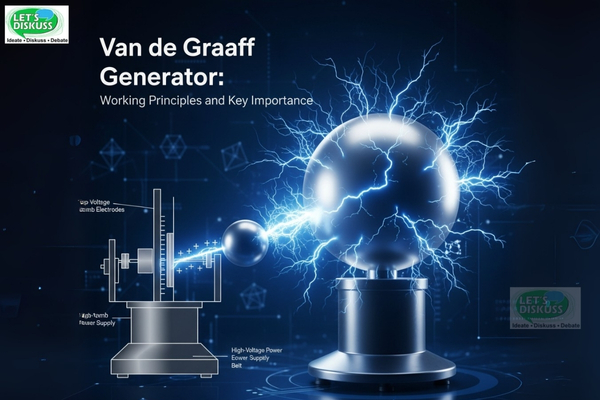
The generator features an insulating belt that runs over two pulleys, one at ground level and one at the top inside a large spherical conducting shell. There's also a motor to drive the lower pulley, metal brushes or combs for charging and collecting, and sometimes an insulating column to support the sphere. The whole thing is often enclosed in a tank of pressurized gas to prevent sparks.
Materials and Setup
A long, narrow, endless belt made of rubber or silk is wound around two pulleys, with the lower pulley driven by a motor to keep the belt moving continuously. The belt needs to be a good insulator so charges don't jump off. The upper pulley is inside the hollow metal sphere, which is usually aluminum for lightness and conductivity. At the bottom, a high-voltage source connects to a brush that sprays a charge onto the belt. Up top, another brush scrapes it off into the sphere.

How It Works
Charging Process
Charge is sprayed onto the belt at the lower pulley using a metal brush connected to a high-voltage source. This initial charge can come from a simple power supply or even friction, but it's usually positive. As the belt moves, it carries this charge upward without losing much, thanks to the insulation.
Charge Transfer Mechanism
As the belt moves upward, it carries the positive charge to the top, where another conducting brush connected to the large sphere collects it. The brush at the top induces the charge to jump off the belt onto the sphere's inner surface, which then spreads out evenly to the outer surface. Meanwhile, the belt, now neutral, heads back down to pick up more charge.
Building Up Voltage
This process repeats, allowing the large sphere to accumulate charge and build up voltages as high as 6 or 8 million volts with respect to ground. The limit comes from the air breaking down and sparking—called corona discharge. In bigger setups, they use sulfur hexafluoride gas to insulate better and push voltages higher. It's like a conveyor belt for electrons, but in reverse, piling up positives on the sphere.
Importance and Applications
Role in Scientific Research
The Van de Graaff generator VDG is fundamentally required to generate high electric fields up to the air breakdown point, allowing us to accelerate particles during physics experiments. During the initial years, it was useful in discovering new particles and in the knowledge of nuclear reactions. Imagine it was the grandfather of the current accelerators, such as the LHC, without the efforts of Van de Graaff, we would not have reached our present day so quickly.
Modern Uses
Beyond early atomic research, it remains important in educational demonstrations and certain industrial applications like sterilizing materials with ion beams. In schools and museums, it's great for showing static electricity principles. Industrially, smaller versions test insulators or generate X-rays for medical imaging. Even in cancer treatment, modified versions accelerate particles for proton therapy.
Advantages and Limitations
Benefits Over Other Generators
The first significant benefit of it is that it is capable of producing very high voltages without all that complex electronics; it uses only mechanical and electrostatic principles. It is extremely easy, dependable, and does not require giant power inputs as in the case of transformers. In addition to that, it provides a constant DC voltage, ideal in the case of fine experiments.
Potential Drawbacks
However, the generator can only achieve a limited amount of charge on the sphere before breakdown occurs in the air. Size is another issue—the bigger the sphere, the higher the voltage, but that means huge machines. They also don't produce much current, so they're not great for powering things, just for high-voltage, low-current apps. Maintenance can be tricky with the belt wearing out.
Conclusion
The Van de Graaff generator is not a novel dome to stimulate your hair- you can look up and see that, but it is a wonderful piece of ingenious work, and links the curiosity of the textbooks with the science of actual experimentation. It used the exploitation of the naive concept of bypassing charges onto a spherical shell, and led to nuclear physics, medical therapy, and participation in electrostatics demonstrations.
The Van de Graaff generator is something the world can still marvel at to this day, despite the fact that it was initially invented decades ago. It is a classic work of science, whether it appeals to the curiosity of students or to the researcher of the beauty of simplicity.