Introduction to Conductors and Insulators
Electricity depends on how materials handle electric charges. The NCERT Class 12 Physics Part 1 textbook covers this in Chapter 1. This chapter is called "Electric Charges and Fields." Think of a busy road. Cars move freely on it. These cars are like electrons in a conductor. Now think of a road with barriers. Cars cannot pass. This is like an insulator. This idea helps explain how materials act when charged.
Conductors let electric charges move easily. Electrons do most of this moving. Insulators stop this movement. They resist it. This difference is key to science. It is also key to engineering. It helps with safety in electricity. It powers everyday tech. Your phone has a metal frame. That is a conductor. The charger has rubber coating. That is an insulator. They work together. They keep things safe and useful. Now we will look at their differences. We will see their properties too. We will check real-world uses.The NCERT Class 12 Physics Part 1 textbook covers electric charges and fields. Think of a busy road. Cars move fast. That is a conductor. Electrons flow freely there. Now think of a closed road. No cars pass. That is an insulator. Nothing moves. This idea helps us see how materials hold or share charges.
Conductors let charges move. Electrons flow easily in them. Insulators stop this. They block the flow. This split matters a lot. It shapes electrical work. It builds safe systems. It powers daily tech. Look at your phone. The metal inside carries signals. The rubber outside blocks shocks. Both team up. They keep things safe and smooth. We will look at their traits. We will see real uses.
What are Conductors?
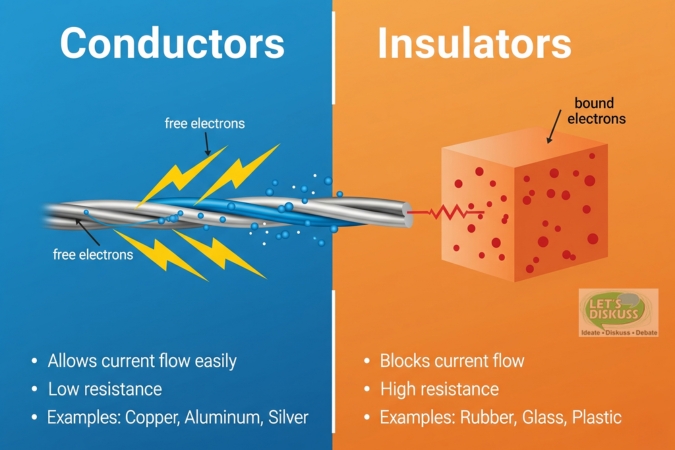
Conductors are materials that allow the smooth flow of electric current due to the presence of free electrons. These electrons are not tightly bound to atoms and can move when an electric field is applied. Metals like copper, aluminum, silver and gold top the list of excellent conductors because their atomic structure allows electrons to flow freely. The human body and the earth also act as conductors, which is why we can get static shocks or why grounding works.
When a conductor is charged, the excess charge distributes itself evenly across its surface. This happens because the free electrons repel each other and spread out to minimize repulsion. For instance, if you rub a metal rod held by hand with wool, no charge builds up—the electrons flow through your body to the ground. This property makes conductors essential in wiring, circuitry, and devices where current must flow seamlessly.
What are Insulators?
Insulators, on the other hand, are materials that hinder the movement of electric charges. Their electrons are tightly bound to atoms, preventing easy flow. Common insulators include glass, porcelain, plastic, nylon, wood, and rubber. These materials offer high resistance, making them ideal for preventing unwanted current flow.
When an insulator is charged, the charge stays localized where it was applied. Take a plastic comb rubbed with dry hair—it retains the charge and attracts paper bits because the electrons don’t escape. This ability to hold charge makes insulators crucial for insulation in electrical cables, handles of tools, and protective coatings. The NCERT textbook highlights this behavior, noting that insulators like nylon threads don’t transfer charge, unlike conductive materials.
Key Differences Between Conductors and Insulators
1. Electron Mobility
The most significant difference lies in electron mobility. Conductors have free electrons that move under an electric field, enabling current flow. Insulators lack free electrons, keeping charges stationary. For example, a copper wire conducts electricity effortlessly, while a rubber band does not.
2. Charge Distribution
In conductors, charges spread across the surface due to electron repulsion. In insulators, charges remain fixed. This is why a charged metal sphere shares its charge evenly, but a charged glass rod holds it at the point of contact.
3. Electrical Resistance
Conductors have low resistance, allowing current to pass with minimal energy loss. Insulators have high resistance, blocking current. The NCERT textbook explains this with the example of a metal rod not charging when held, versus a plastic-handled rod retaining charge.
4. Examples and Materials
Metals (copper, aluminum), human body, and Earth are conductors. Glass, plastic, wood, and nylon are insulators. This categorization, rooted in atomic structure, dictates their practical uses.
5. Charging Behavior
Rubbing a conductor like a metal spoon with wool doesn’t charge it due to grounding through the body. Rubbing an insulator like a plastic comb charges it, as seen in static electricity experiments.
6. Applications
Conductors are used in wires, circuits, and grounding systems. Insulators protect in cables, handles, and electrical safety devices. The NCERT notes grounding’s role in safety, linking it to conductor properties.
Why Charge Transfer Fails with Insulators
The experiment in the NCERT book shows something interesting. A neutral pith ball gets a negative charge when connected to a negatively charged plastic rod with a copper wire. But if you use a nylon thread or rubber band instead, no charge moves. Why does this happen? The copper wire is a conductor. It lets electrons flow from the rod to the pith ball. This charges the pith ball negatively. Nylon and rubber are insulators. Their electrons are tightly held. They don’t let charge move. So, no charge transfers when using them.
This behavior stems from the atomic level. In conductors, the outer electrons are delocalized, forming a "sea" of electrons that can move. In insulators, electrons are localized, trapped in covalent or ionic bonds. The NCERT suggests this is explored further in later chapters, likely involving energy band theory, where conductors have overlapping bands and insulators have a large bandgap.
Practical Experiments and Observations
Experiment 1: Metal Rod vs. Plastic Handle
Rub a metal rod held by hand with wool—no charge builds, as electrons leak to the ground via your body (a conductor). Now, use a metal rod with a wooden handle, rub it without touching the metal, and it retains charge. This demonstrates how insulation prevents grounding.
Experiment 2: Pith Ball and Charge Transfer
Connect a pith ball to a charged plastic rod with a copper wire. The ball charges negatively, confirming conductor-mediated transfer. Repeat with a nylon thread—no charge moves, highlighting insulator resistance.
Experiment 3: Comb and Paper
Rub a plastic comb with dry hair—it attracts paper bits due to retained charge. A metal spoon rubbed similarly shows no effect, as charge dissipates through your hand.
These hands-on activities, aligned with NCERT’s practical approach, reinforce the concept.
Properties and Behavior in Depth
Conductors: Charge Distribution and Grounding
When a conductor gets charged, its free electrons move quickly and spread out. This is why lightning rods, made of metal, protect buildings by sending the charge to the ground. Grounding, or earthing, means connecting a conductor to a metal plate buried in the earth. This safely removes extra charge. The NCERT textbook explains that home wiring has three wires: live, neutral, and earth. The earth wire stops shocks by carrying fault currents to the ground.
Insulators: Charge Retention
Insulators hold charges due to their high resistivity. This property is exploited in capacitors, where dielectric insulators store energy between conductive plates. The NCERT’s, "Electrostatic Potential and Capacitance," delves into this, showing how insulators enhance capacitance by preventing charge leakage.
Real-World Applications
Conductors in Technology
Copper wires carry electricity in homes and devices. The human body’s conductivity explains static shocks or defibrillator use in medicine. Earth’s conductivity underpins grounding systems, protecting against lightning and electrical faults.
Insulators in Safety
Rubber coatings on wires prevent shocks. Plastic handles on tools like screwdrivers ensure safety. The NCERT highlights earthing in appliances like TVs and refrigerators, where insulators and conductors collaborate to avoid injury.
Safety and Earthing
Earthing is a critical safety measure. A fault in an appliance, like a live wire touching its metal body, can energize it. Without earthing, touching it could cause a fatal shock, as the body conducts. The earth wire diverts this charge to the ground, as explained in the NCERT. Buildings use thick metal plates buried deep, connected via wires to mains, ensuring safety.
Scientific Context and Future Learning
The NCERT textbook promises deeper insights in later chapters, likely covering band theory. Conductors have a filled valence band overlapping a conduction band, allowing electron flow. Insulators have a large energy gap, trapping electrons. Semiconductors, with a smaller gap, bridge the two, used in transistors and solar cells—a topic for advanced study.
Conclusion
Conductors and insulators are the yin and yang of electricity. Conductors, with their free electrons, enable current flow and grounding, while insulators, with their resistance, protect and store charges. From the NCERT experiments with pith balls to everyday applications like wiring and safety, their differences shape our technological world. Understanding these properties not only clarifies physics but also empowers us to use electricity safely and efficiently.