
Electricity can feel almost magical until you see the simple rules behind it. One of the most interesting ideas in electrostatics is charging by induction—a way of giving an object a charge without ever touching it. Picture this: you bring a charged rod close to a metal ball, and the ball itself becomes charged. No sparks, no contact, but the effect is real. What makes it even better is that this isn’t just a neat classroom trick. The same principle is used in science experiments and in modern technology.
In this post, we’ll break down charging by induction step by step, look at experiments that show how it works, and explore some real-world examples where you’ll find it in action.
1. Introduction to Charging by Induction
Charging by induction is the process of transferring charge to an object without any physical contact. Instead of rubbing or connecting two bodies, we rely on the movement and redistribution of charges inside a conductor influenced by a nearby charged object.
The magic of induction lies in how charges “rearrange themselves” when exposed to an electric field. For students, it’s a perfect doorway into understanding forces between charges. For engineers, it’s the principle behind certain sensors and even wireless charging.
2. Why Charging by Induction Matters
You might ask—why bother with induction when rubbing balloons or connecting wires already shows charge transfer? The reason is that induction is a non-contact method. This has two big implications:
-
Safety in experiments: Objects can be charged without physical wear or loss of material.
-
Real-world applications: From dust removal in factories to touchless electronics, induction proves that charges can be manipulated cleanly and efficiently.
It also reveals an important truth about electricity: charges don’t need to “jump” from one surface to another; they only need to be influenced by the fields around them.
3. Basic Concept Behind the Process
Here’s the core idea:
When a charged body (e.g., a rod) is brought close to a neutral conductor, the free electrons within the conductor move. Opposing charges are attracted to each other, and similar charges are repelled. This doesn't produce new charges—it only redistributes the existing ones.
If you go one step further—such as grounding the conductor or insulation while it is under the influence of the rod—you can trap this new charge imbalance, with the object being left permanently charged.
Therefore induction is more a matter of redistributing pre-existing charge and then trapping it there rather than "adding charge".
4. Step-by-Step Demonstration with Metal Spheres
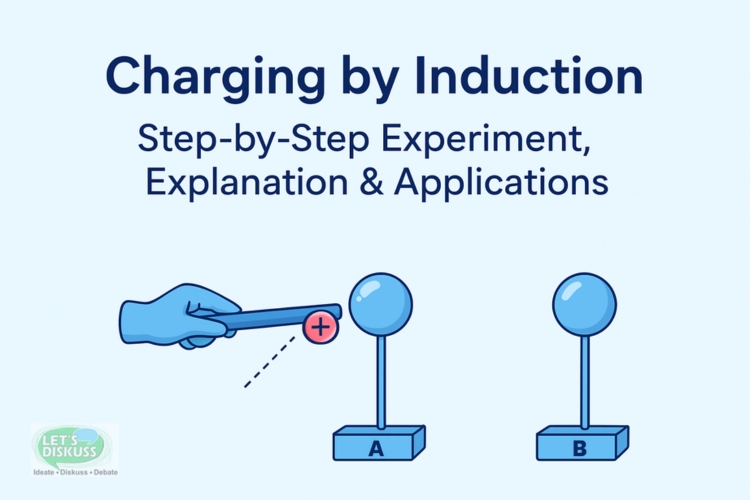
The most frequent classroom experiment employs two metal spheres on insulating stands. This is how it goes:
-
Neutral setup: Begin with two identical metal spheres, A and B, in contact with each other. They are neutral in general.
-
Bring in a charged rod: Place a positively charged rod near sphere A, but not touching it. At once, electrons in the spheres move—negative charges accumulate on A (at the rod), and positive charges build up on B.
-
Split the spheres: Holding the rod steady, slowly split the spheres apart. Now, A is more negatively charged, and B has an excess positive charge.
-
Remove the rod: When the rod is removed, both spheres are permanently left with opposite charges.
This basic setup demonstrates the essence of induction: influence, splitting, and permanence.
5. The Role of Attraction and Repulsion
The forces at work are straightforward:
-
Attraction: Opposite charges pull towards each other, so electrons move toward the positively charged rod.
-
Repulsion: Like charges push away, so similar charges gather on the far side or move onto the second sphere.
The beauty here is balance. Even though charges shift, the total charge of the combined system (before grounding or separating) remains the same. What changes is their distribution.
This explains why light objects, such as bits of paper or pith balls, are attracted to a charged rod—even if they are neutral overall. The side closer to the rod becomes oppositely charged, and attraction wins over repulsion.
6. Experiment: Charging a Sphere Positively Without Contact
Now let’s look at a classic example in detail.
Setup:
-
Place a neutral metallic sphere on an insulating stand.
-
Bring a negatively charged rod close to the sphere, but don’t touch.
What happens:
-
Electrons in the sphere are repelled and pushed to the far side. The near side becomes positively charged.
-
If you now connect the far side of the sphere to the ground using a wire, the repelled electrons flow away into the Earth.
-
Disconnect the ground while keeping the rod in place. The sphere is now left with a net positive charge.
-
Finally, remove the rod. The sphere remains positively charged.
This experiment shows that contact isn’t necessary. The combination of an influencing charge, grounding, and isolation can leave a neutral object permanently charged.
7. Observations from the Experiment
A few key insights emerge from this:
-
Charge redistribution is instant: As soon as the rod approaches, charges inside the conductor rearrange themselves.
-
Grounding plays a crucial role: Without grounding, the charges would only shift temporarily. Grounding allows excess charge to escape and makes the effect permanent.
-
The sign of the final charge depends on the influencing rod: A negatively charged rod will leave the sphere positively charged (because electrons escape). A positively charged rod would do the reverse.
-
Charges spread out evenly: After grounding and removal of the external influence, charges distribute uniformly over the surface of the sphere.
These observations confirm that induction is predictable, measurable, and reliable.
8. Practical Applications of Charging by Induction
What begins as a demonstration in class has practical applications. A few of them are:
-
Electrostatic precipitators: Plants utilize induction to clean air by removing dust and smoke particles by charging them and attracting them toward collection plates.
-
Touchless charging: Charging pads for cellphones and other gadgets depend on the principles of induction to deliver energy without contact.
-
Sensors and detection: Induction is used to detect charges on sensitive equipment, such as electrometers.
-
Static electricity in our daily lives: That minor shock you receive when you reach for a doorknob after crossing a carpeted floor? Due to charge redistribution by induction.
In both instances, the absence of contact makes induction safer and more effective than direct transfer processes.
9. Common Misconceptions
Students often carry a few myths about induction:
-
“Induction creates new charges.”
Not true. It only rearranges existing charges or allows them to escape/enter via grounding. -
“Objects need to touch for charge to transfer.”
Induction shows that influence alone is enough to charge an object. -
“Only conductors can be charged by induction.”
While metals make it easy, even insulators show polarization effects that mimic induction.
Clearing these misconceptions helps build a stronger foundation for understanding electricity as a whole.
10. Conclusion
Induction charging is more than a curiosity of physics. It's a straightforward yet impressive mechanism that accounts for the interaction of charges without transfer. With spheres, rods, and grounding wires, we can easily observe induction step by step through experiments.
From demonstrations in the classroom to contemporary wireless technology, induction demonstrates that touch isn't necessary to exert influence. The elusive push and pull of charges is sufficient to produce long-lasting effects, reminding us that electricity is subtle and profound.