Introduction to Electric Charges
Have you ever noticed that little spark when you touch a metal doorknob following the shuffling down a carpet? Or perhaps you've seen your hair standing on end following a brushing on a cold winter's day? They're more than just interesting little moments-they're manifestations of electric charges in action! Electric charges are a fundamental property of matter that induce forces in an electromagnetic field. All that we can see, from the chair beneath you to the stars in the sky at night, consists of atoms. Within these atoms are particles smaller than they are: protons (positively charged), electrons (negatively charged), and neutrons (neutral with no charge).
Most things we touch are electrically neutral, with the positive and negative charges canceling each other out. But when that balance is disturbed—let's say, through rubbing two substances together—things become interesting! This imbalance generates static electricity, the subject of NCERT Class 12 Physics Part 1 textbook Chapter 1, "Electric Charges and Fields." It's the physics of forces, fields, and potentials due to charges that don't move much, as opposed to flowing charges in your phone charger. Think of electric charges as nature's tiny magnets, attracting and repelling in ways that affect our everyday world. Let's explore this electrifying world with some easy-to-understand examples to make it all snap!
Historical Background
The story of electric charges goes back thousands of years. Around 600 BC in ancient Greece, a thinker named Thales of Miletus made a curious discovery. He rubbed amber, a golden fossilized resin, with wool or silk. To his surprise, the amber began pulling light objects like feathers and straw. This was the first clue to what we now call electricity. The word itself comes from the Greek word elektron, meaning amber. Thales couldn’t explain it at the time, but his simple experiment lit the spark for centuries of discovery.
Jump ahead to the 18th century. Benjamin Franklin pushed the idea further. The famous image of him flying a kite in a thunderstorm still captures people’s imagination. Through that risky test, he showed that lightning is a form of electricity. He also suggested that there are two types of charges: positive and negative.
In the 19th century, more breakthroughs came. Michael Faraday explored how electric and magnetic forces are connected. Then, in 1912, Robert Millikan carried out his oil-drop experiment. He measured the charge of an electron with great accuracy. His work proved that charges exist in tiny, fixed packets.
These milestones, also mentioned in the NCERT textbook, laid the base for modern technology. From light bulbs to smartphones, it all traces back to that first moment when amber attracted a feather. A small act of curiosity became the foundation for a global revolution.
Types of Electric Charges: Positive and Negative
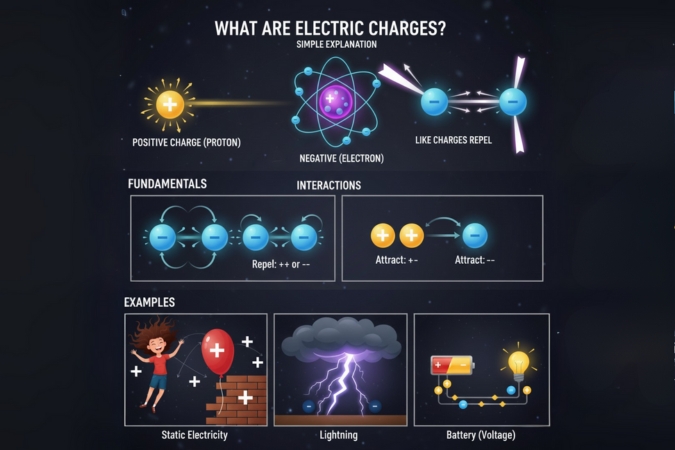
Electric charges come in just two flavors: positive and negative. Think of them as opposites that either attract or repel. Protons in an atom’s nucleus carry a positive charge, while electrons orbiting around it carry a negative one. The rule is simple: like charges push away (repel), and unlike charges pull together (attract).
Let me share a fun experiment from the NCERT textbook. Rub a glass rod with silk, and it becomes positively charged as it loses electrons to the silk, which turns negative. Bring two such glass rods close—they’ll repel each other! Now, try a plastic rod rubbed with fur; it gains electrons and becomes negative, while the fur turns positive. The plastic rod repels another plastic rod but attracts the glass one. You can even use pith balls—light balls made from plant material or polystyrene. Touch one with a charged glass rod, and it repels another similarly charged ball but attracts one charged by plastic. It’s like a tiny dance of forces!
Franklin named them positive and negative because, like numbers, they cancel out when equal amounts meet (+1 + (-1) = 0). By convention, the charge on a glass rod or fur is positive, and on plastic or silk, it’s negative. This duality is the heartbeat of electrostatics!
How Objects Get Charged
Objects become charged when electrons move, creating an imbalance. The NCERT textbook outlines three main ways: friction, contact, and induction. Let’s explore these with a personal twist.
Charging by Friction
This is the most common way charges show up in daily life. When you rub two substances together, electrons move from one to the other. I remember as a kid combing my hair on a dry day and watching it stand up—the comb stole electrons, becoming negative, while my hair turned positive. The NCERT suggests trying this with a plastic comb and dry hair—it’s a classic! Another example: shuffle your feet on a carpet, and you might get a shock when touching metal. Even rubbing paper strips and ironing them (as described on page 8) can charge them, causing the halves to repel.
Charging by Contact
Here, a charged object touches a neutral one, sharing its charge. Imagine touching a pith ball with a charged rod—it picks up the same charge and repels the rod. With conductors like metal, the charge spreads evenly. I once saw a friend charge a metal spoon by touching it with a rubbed rod, and it distributed the charge across the surface—pretty cool!
Charging by Induction
This is like magic—no touching required! Bring a charged rod near a neutral object, and it rearranges charges. The NCERT describes an experiment with two touching metal spheres. Bring a positive rod near one; electrons move, making the far sphere positive. Separate them, and you’ve got two charged objects without direct contact! This explains why a charged comb attracts neutral paper bits—it induces charges, pulling them in.
Properties of Electric Charges
Electric charges have three key traits, as outlined in the textbook: additivity, conservation, and quantisation.
Additivity
Charges add up like numbers. If you have +1, +2, and -3 units, the total is 0. This is why a positive and negative charge of equal strength neutralize each other—nature loves balance!
Conservation
Charge can’t be created or destroyed, only transferred. When you rub a rod, electrons move, but the total charge stays the same. The NCERT mentions this law’s importance, like in a neutron decaying into a proton and electron, keeping the charge at zero.
Quantisation
Charges come in tiny packets, multiples of the electron’s charge (1.602 × 10^-19 C). You can’t have half an electron’s charge! Millikan’s experiment proved this, and it’s fascinating to think how these discrete units build the world we see.
Conductors and Insulators
Materials handle charges differently. Conductors (metals, human bodies, earth) let electrons flow freely—charges spread out. Insulators (glass, plastic, wood) hold charges in place. The NCERT notes that rubbing a metal rod held by hand doesn’t charge it, as the charge leaks to the ground via your body. But with a plastic handle, it works! Grounding, a safety feature in homes, discharges excess charge to earth—vital for preventing shocks.
Everyday Applications and Phenomena
Static charges explain dust on screens or shocks in dry weather. Lightning, as Franklin discovered, is a massive charge discharge. Technologies like photocopiers use charges to attract toner, while grounding keeps fuel trucks safe. Even our bodies conduct, though static rarely affects pacemakers—nature’s balance at work!
Conclusion
Electric charges are nature’s invisible dancers, pulling and pushing in ways that power our world. From Thales’ amber to the NCERT’s detailed lessons, understanding their types, charging methods, and properties opens a window to science’s wonders. Next time you feel that static spark, smile—it’s charges saying hello!