Asked 6 years ago

What is the Lewis dot diagram for CLO3?

Education#Online discussion forum#letsdiskuss#What is the Lewis dot diagram for CLO3#clo3 lewis structure molecular geometry
0
1.7K
C
Chhavi TyagiAuthor

Advertisement

Hey, help the community by sharing your answer.

Earn up to 25 coins for helpful answers.

Login to Answer

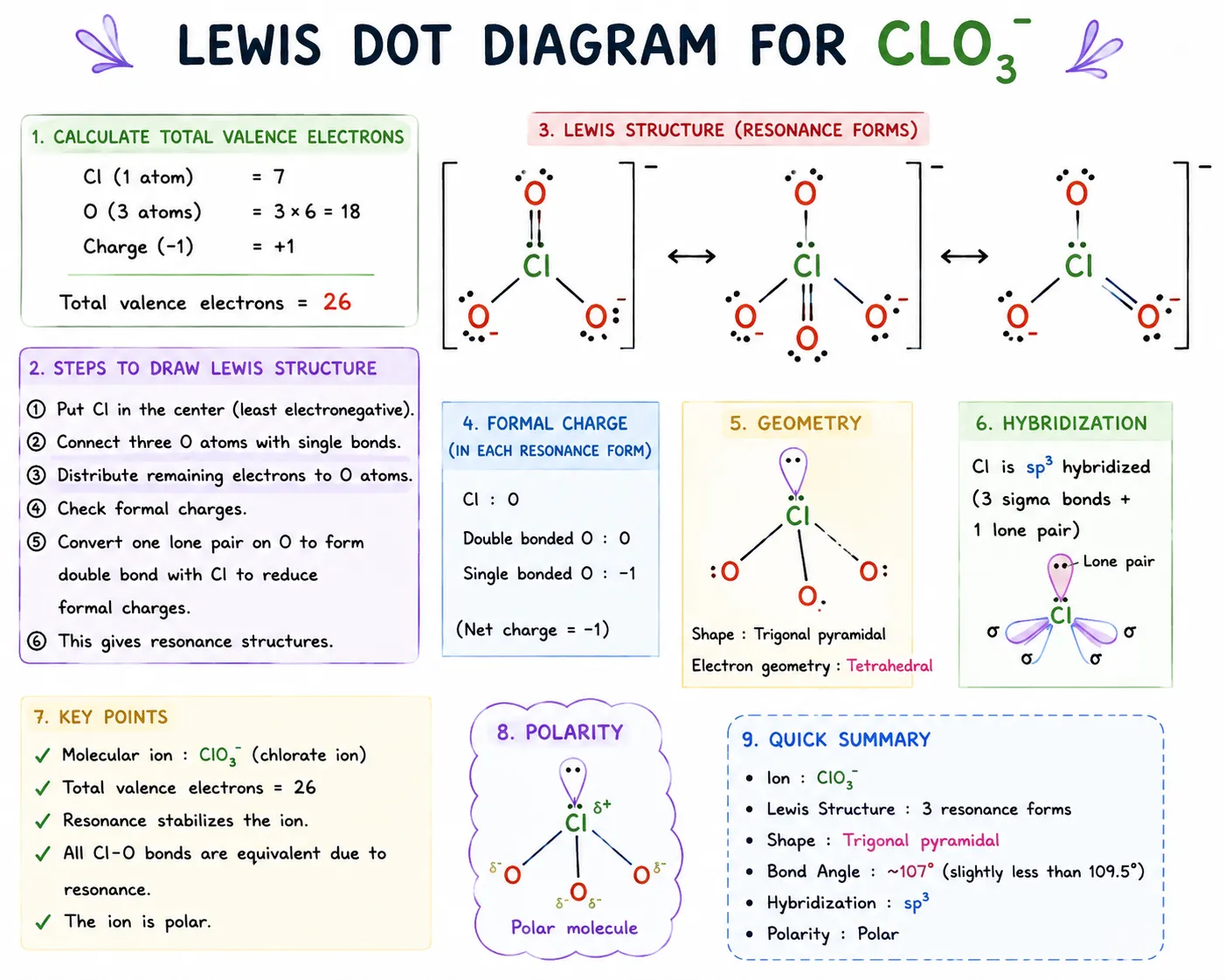
The Lewis dot diagram for ClO₃⁻ (chlorate ion) illustrates how the valence electrons are arranged around chlorine and oxygen atoms. It helps us understand the chemical bonding, lone pairs, formal charges, resonance, and the overall molecular geometry of the ion.

To draw the correct Lewis structure, you first need to calculate the total number of valence electrons. Chlorine contributes 7 valence electrons, each oxygen atom contributes 6, and because the ion carries a −1 charge, one additional electron is added. Therefore, the total number of valence electrons is:

7 + (3 × 6) + 1 = 26 valence electrons

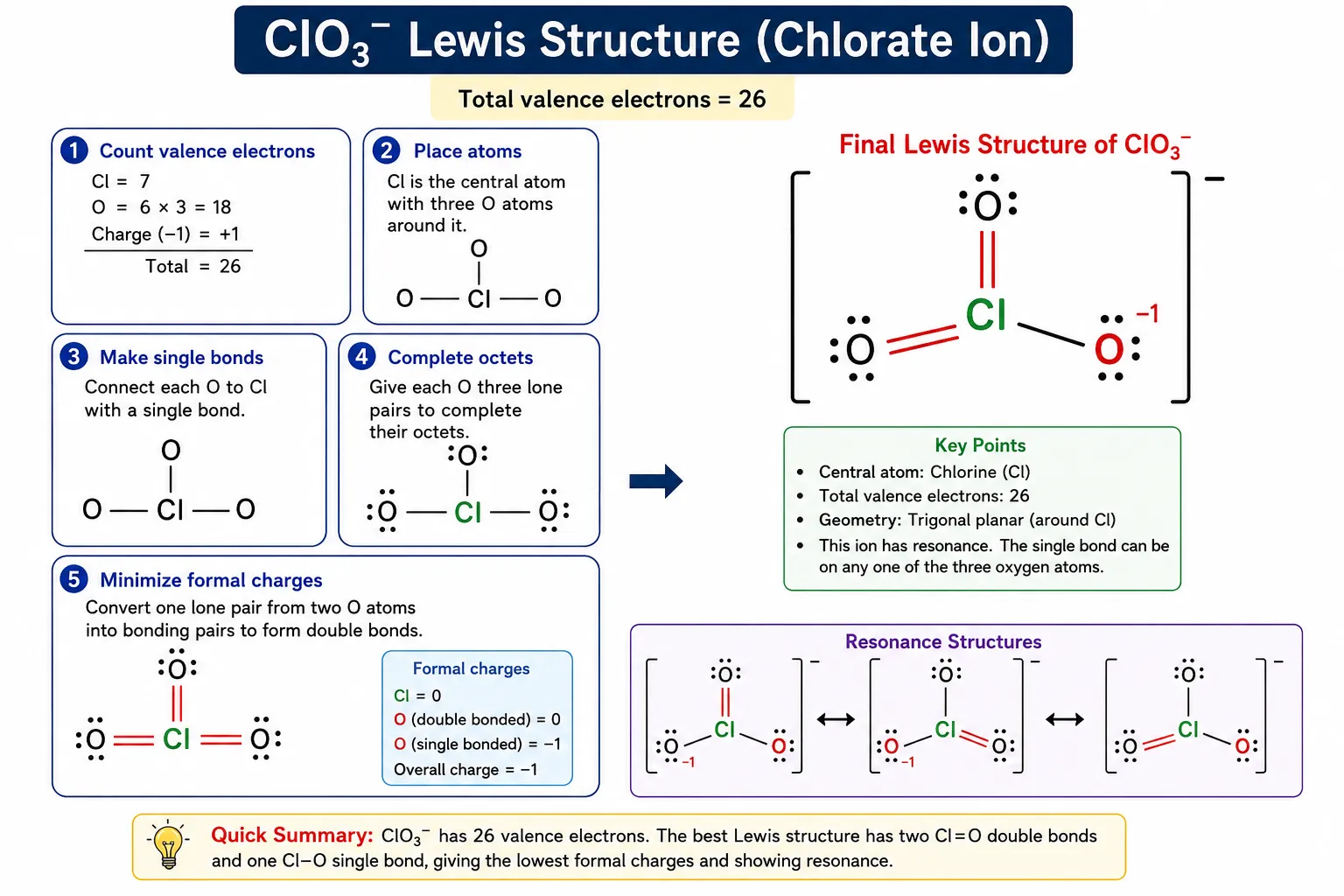
Since chlorine is less electronegative than oxygen, it becomes the central atom. Three oxygen atoms are connected to chlorine with single bonds, which initially use six electrons. The remaining electrons are distributed around the oxygen atoms to complete their octets. After filling the octets, the structure can be improved by converting lone pairs on two oxygen atoms into double bonds. This minimizes the formal charges and produces the most stable Lewis structure.

605635-image-1783686600021-293260243

A commonly accepted Lewis dot diagram for ClO₃⁻ is shown below:

          ..
          O
          ||
     O = Cl — O⁻
          :

Although this drawing is correct, it does not represent the complete picture. The chlorate ion actually has three equivalent resonance structures. In each resonance form, the double bond appears with a different oxygen atom, while the negative charge shifts accordingly. Because of resonance, all three chlorine–oxygen bonds have nearly the same bond length and strength in the real molecule.

Key Facts About the ClO₃⁻ Lewis Dot Diagram

PropertyValue
Chemical FormulaClO₃⁻
Ion NameChlorate Ion
Total Valence Electrons26
Central AtomChlorine (Cl)
Number of Resonance Structures3
Molecular ShapeTrigonal Pyramidal
Electron GeometryTetrahedral
Hybridizationsp³
Overall Charge−1

Molecular Geometry

According to VSEPR theory, the chlorine atom has four regions of electron density—three bonding pairs and one lone pair.

As a result:

  • Electron Geometry: Tetrahedral
  • Molecular Shape: Trigonal Pyramidal
  • Hybridization: sp³
  • Approximate Bond Angle: 107°

The lone pair on chlorine slightly compresses the bond angles, giving the molecule its trigonal pyramidal shape.

Step-by-Step Lewis Structure of ClO₃⁻

Step 1: Count the valence electrons

  • Chlorine = 7
  • Oxygen = 18
  • Extra electron = 1

Total = 26 valence electrons

Step 2: Choose the central atom

Chlorine is placed in the center because it is less electronegative than oxygen.

Step 3: Draw single bonds

Connect chlorine to each oxygen atom using three single bonds.

Step 4: Complete the octets

Place the remaining electrons around the oxygen atoms first. If electrons remain, place them on chlorine.

Also read : How many questions iit jee ask from Chemistry ?
 

R

Answered By Rajesh Yadav

Author
View Profile
Answered on07/10/26
0

Advertisement

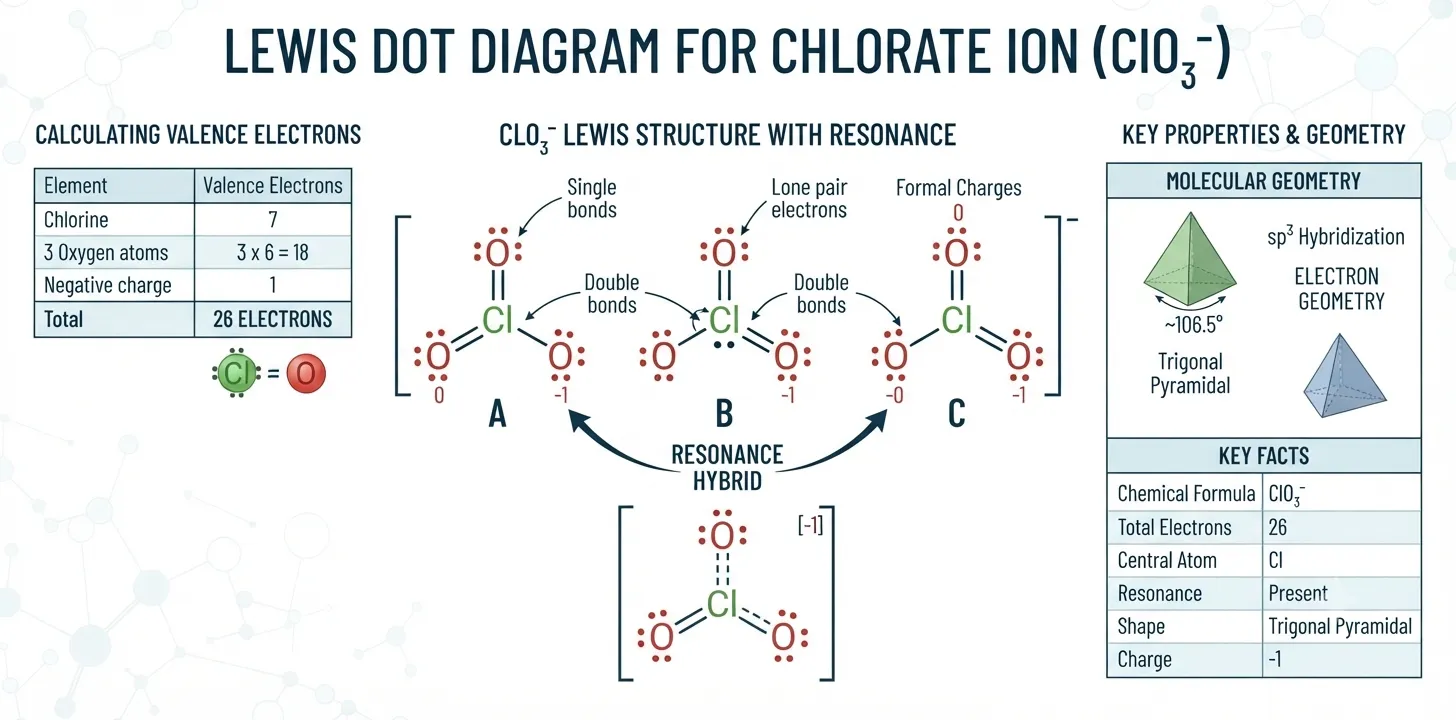
The CLO3 structure (chlorate ion, ClO₃⁻) explains how chlorine and oxygen atoms arrange their electrons to form a stable chemical structure. The Lewis dot diagram for CLO3 helps visualize valence electrons, chemical bonds, lone pairs, and resonance in the chlorate ion.

10000372-image-1783591675633-114940487

Lewis Dot Diagram for CLO3

The chlorate ion contains:

  • 1 Chlorine (Cl) atom
  • 3 Oxygen (O) atoms
  • 1 negative charge (-1)

Chlorine is placed in the center because it is less electronegative than oxygen. The three oxygen atoms surround the chlorine atom and form bonds with it.

Valence Electrons in CLO3

To draw the lewis dot structure of clo3, first count the total valence electrons:

ElementValence Electrons
Chlorine7
3 Oxygen atoms18
Negative charge1
Total26 electrons

These electrons are arranged around the atoms to complete their octets and create a stable structure.

How to Draw the CLO3 Lewis Structure

  1. Place chlorine as the central atom.
  2. Connect three oxygen atoms with chlorine using single bonds.
  3. Add remaining electrons as lone pairs around oxygen atoms.
  4. Create resonance structures by forming a double bond between chlorine and oxygen.
  5. Check formal charges to get the most stable arrangement.

The final structure contains resonance, meaning the double bond can shift between the oxygen atoms.

Resonance in CLO3 Structure

The lewis dot structure for clo3 cannot be represented by only one structure because the electrons are spread across the molecule. The chlorate ion has three resonance forms.

Resonance provides:

  • Greater stability
  • Equal Cl–O bond lengths
  • Better distribution of negative charge

Molecular Geometry of CLO3

According to VSEPR theory, the CLO3 structure has:

  • Electron Geometry: Tetrahedral
  • Molecular Geometry: Trigonal Pyramidal
  • Hybridization: sp³

The lone pair on chlorine changes the shape and makes the ion polar.

Key Facts About CLO3

PropertyDetails
Chemical FormulaClO₃⁻
Central AtomChlorine
Total Electrons26
ShapeTrigonal Pyramidal
ResonancePresent
Charge-1

Frequently Asked Questions

What is the Lewis dot structure of CLO3?

The Lewis dot structure of CLO3 shows chlorine as the central atom connected to three oxygen atoms with 26 total valence electrons and multiple resonance structures.

Why does CLO3 have resonance?

CLO3 has resonance because the double bond and negative charge can be distributed among the three oxygen atoms, creating a more stable structure.

Connect the Oxygen Atoms

Draw single bonds between chlorine and each oxygen atom.

Check Formal Charges

After placing all electrons, calculate the formal charges. If necessary, convert one or more single bonds into double bonds to minimize formal charges.

The Lewis dot diagram for CLO3 shows the arrangement of electrons and bonds in the chlorate ion. The CLO3 structure contains one chlorine atom, three oxygen atoms, 26 valence electrons, and resonance. Understanding this structure helps explain important chemistry concepts like bonding, molecular shape, and electron distribution.

Also read : How to Stay Safe in a Chemistry Laboratory?

T

Answered By Tara Verma

Ten years in the classroom, shaping minds — bringing the same clarity and purpose to every piece she writes about education.
View Profile

Tara Verma is a practising teacher and education content writer with over 10 years of classroom experience across primary and secondary levels. She holds a Master's degree in Education (M.Ed.) from Delhi University and a Bachelor of Education (B.Ed.) from Jamia Millia Islamia — qualifications that ground her writing in both pedagogical theory and the day-to-day realities of teaching in India. Her content covers exam preparation strategies, learning methodologies, curriculum guidance, student mental health, career counselling for students, and the evolving state of school and higher education in India. Her work has appeared on platforms including TeacherVision India, Jagran Josh, and Careers360, where she writes for students, parents, and fellow educators who need content built on actual teaching experience — not theory alone. Over a decade of working directly with students across age groups and learning levels has given Tara a practical understanding of how education content should be written — clearly, accessibly, and with genuine awareness of the challenges students and teachers face on the ground. She has taught 1,000+ students, contributed to school curriculum development initiatives, and published 250+ articles on education across digital platforms. She is an active member of the National Council of Teachers of English (NCTE) India. Across all her writing, every recommendation is classroom-tested, every insight comes from direct teaching experience, and every article is held to the same standard she applies in her own classroom — accuracy, clarity, and genuine usefulness for the reader.

Updated on07/09/26
0

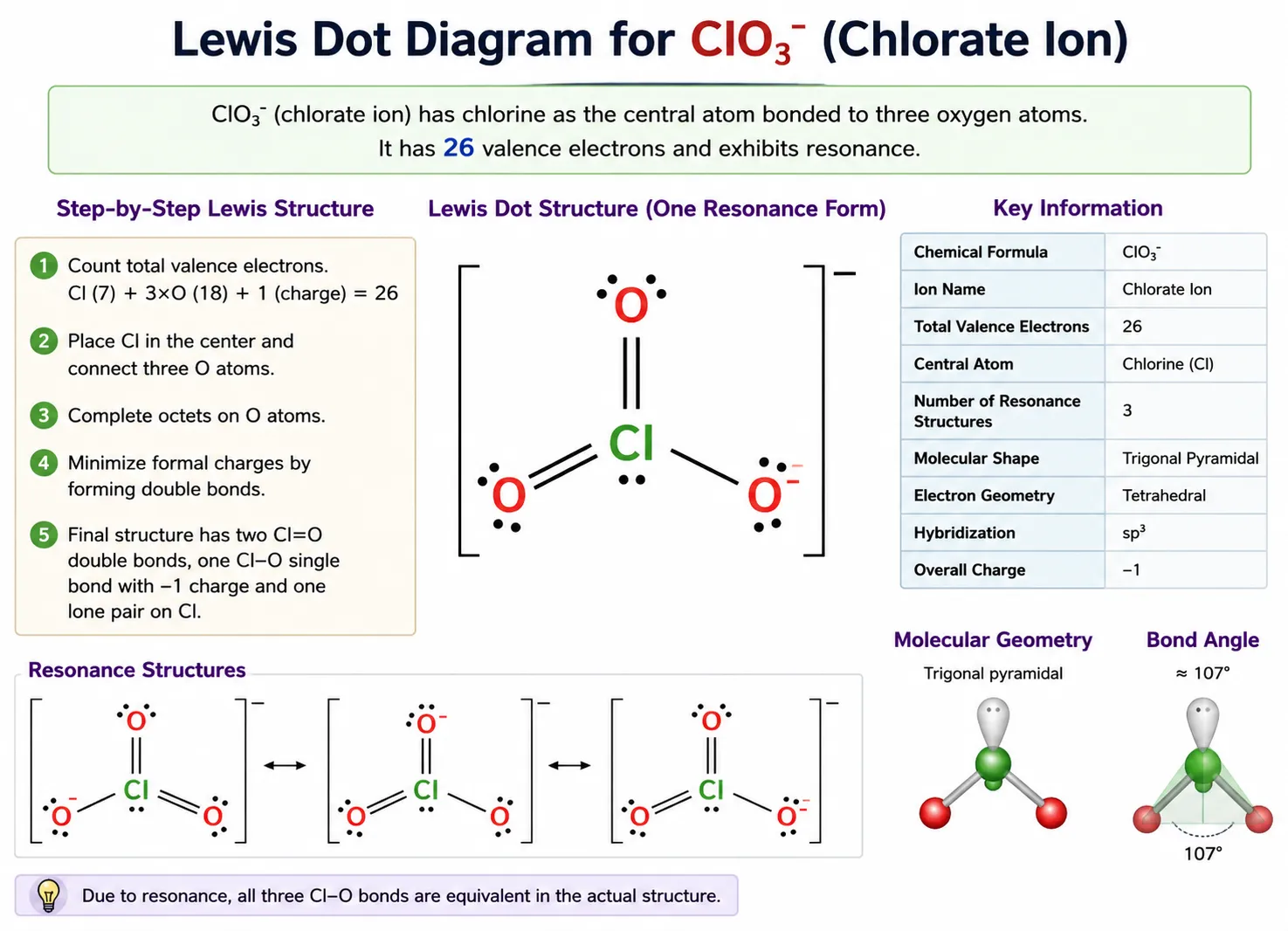
The Lewis dot diagram for ClO₃⁻ (chlorate ion) shows how atoms are arranged and how valence electrons are shared between one chlorine atom and three oxygen atoms. In this structure, chlorine is the central atom bonded to three oxygen atoms, and the ion carries an overall −1 charge.

To draw the Lewis structure, first count the total valence electrons. Chlorine (Cl) has 7 valence electrons, each oxygen (O) has 6, and the extra −1 charge adds one more electron:

                                                                    7+(3×6)+1=26 valence electrons

Chlorine is placed in the center and connected to three oxygen atoms. After distributing electrons to satisfy the octet rule, the most stable structure usually shows one Cl=O double bond and two Cl–O single bonds, along with a lone pair on chlorine. Because of resonance, the double bond can appear with different oxygen atoms, meaning the actual electron distribution is shared across all three oxygen atoms.

In simple terms, the Lewis dot structure of ClO₃⁻ contains a central chlorine atom bonded to three oxygens with resonance structures and an overall −1 charge, helping explain the molecule’s bonding and stability.

Also read : How to Create Engaging Scientific Diagrams for Learning

A

Answered By Aanya Sharma

Chemical Bonding & Lewis Structure Researcher Molecular Chemistry Enthusiast
View Profile

Aanya Sharma is a science and technology writer with over 5 years of experience and 300+ published articles across leading digital platforms. She holds a Bachelor's degree in Science (Physics) from Delhi University, which grounds her writing in scientific literacy and gives her the ability to evaluate technical claims with accuracy. Her work has appeared on platforms including The Wire Science, Analytics India Magazine, and Digit.in, where she has covered artificial intelligence, space exploration, consumer technology, environmental science, and emerging tech policy. With a focus on accuracy and clarity, her writing makes complex scientific and technological developments accessible to readers without a technical background. Aanya has participated in science communication panels at events including the India Science Festival and has been recognised as a contributor to responsible tech journalism in India. She is an active member of the National Association of Science Writers (NASW) and maintains a public portfolio of her published work. Across all her work, her writing is grounded in verified sources and a commitment to editorial standards — delivering content that readers can rely on in a space where misinformation spreads easily.

Answered on06/16/26
0

Advertisement

Since ClO3 is a polyatomic atom (chlorate ion) with a charge of -1 it's far represented with 1 chlorine atom and three oxygen atoms. The chlorine atom has two double bonds with two oxygen atoms and an unmarried bond with the last oxygen atom.

 
Here is a comic of the structure (please pardon the terrible drawing):
 
 
Remember to position rectangular brackets across the Lewis dot shape to signify it is a polyatomic atom and upload a terrible signal to signify its charge!
 
The atom has a charge of -1 because there are 26 electrons in its structure even though oxygen has 6 valence electrons (three oxygen atoms have 18) and chlorine has 7 valence electronics, which makes a complete of 25 valence electrons inside the atoms themselves. This way the polyatomic atom needs a further electron to have atoms with stable octet valence shells inflicting a negative fee of one.
C

Answered By Chhavi Tyagi

Author
View Profile

Hi , I am Chhavi Tyagi. Basically i have done B.tech from computer science . I am a Digital Marketer as a profession

Updated on03/14/20
0