

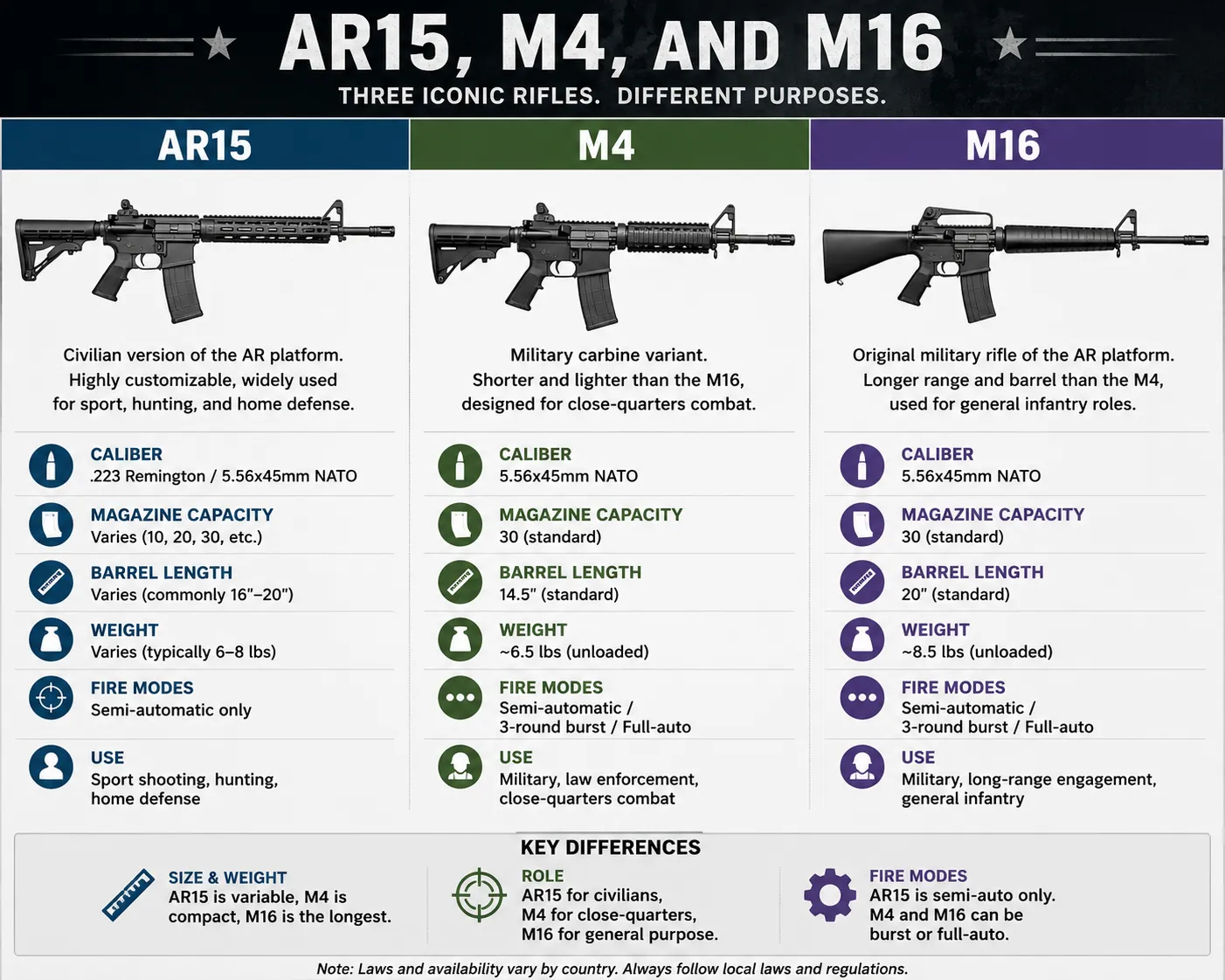
The main difference between the AR-15, M16, and M4 lies in their intended user, fire modes, and size. The AR-15 is a civilian, semi-automatic rifle. The M16 is a full-sized, select-fire military rifle with a 20-inch barrel. The M4 is a shorter, lighter, select-fire military carbine variant of the M16 featuring a 14.5-inch barrel and a collapsible stock.
In this guide you will learn:
- The historical origins of the ArmaLite platform
- The technical differences between the AR-15, M16, and M4
- Key variations in barrel length, fire modes, and ergonomics
- Answers to the most frequently asked questions
Introduction
If you consume action movies, play video games, or read the news, you have likely heard the terms AR-15, M16, and M4 used interchangeably. Because they look incredibly similar on the outside, it is easy to assume they are the exact same firearm.
However, in the worlds of military history and firearms manufacturing, these designations mean very different things. All three weapons belong to the same core "family," but decades of evolution, military requirements, and civilian laws have separated them. In this guide, we will break down the exact difference between an AR15, M4, and M16, helping you understand the unique purpose and design of each platform.
Core Definitions and History
To understand how these rifles differ, we must look at how they evolved from a single prototype into distinct platforms.
1. The AR-15: The Civilian Foundation
Designed in the late 1950s by Eugene Stoner for the ArmaLite corporation, the original "AR-15" was a select-fire military prototype. However, ArmaLite eventually sold the design rights to Colt. Today, the term AR-15 almost exclusively refers to the modern, civilian-legal version of the rifle.
By law, modern civilian AR-15s are strictly semi-automatic, meaning one trigger pull fires exactly one round. While they maintain the outward appearance and modularity of their military counterparts, they lack the internal components required for fully automatic or burst fire.
2. The M16: The Military Standard
When the United States military adopted Colt's AR-15 design for use in the Vietnam War during the 1960s, they gave it the official military designation M16.
The M16 is a full-sized infantry rifle. Unlike the civilian AR-15, the M16 is select-fire, meaning a soldier can switch between semi-automatic and fully automatic (or three-round burst, depending on the variant, such as the M16A2 or M16A4). It traditionally features a fixed stock and a long 20-inch barrel, which maximizes the velocity and effective range of the 5.56x45mm NATO cartridge.
3. The M4 Carbine: The Modern Evolution
As warfare evolved, the military realized that the long 20-inch barrel of the M16 was cumbersome in tight environments, urban combat, and inside vehicles. In the 1990s, the U.S. Armed Forces adopted the M4, a shortened "carbine" version of the M16.
The M4 maintains the select-fire capabilities of the M16 but features a much shorter 14.5-inch barrel and a collapsible stock. This makes the weapon significantly lighter and easier to maneuver in close-quarters battle (CQB). Today, the M4 (specifically the M4A1 variant) is the standard-issue service weapon for the U.S. Army and Marine Corps.
Summary Comparison Table
Here is a quick look at how the three platforms stack up against one another today:
| Feature | AR-15 (Modern) | M16 | M4 Carbine |
| Primary User | Civilians & Law Enforcement | Military (Historically) | Military (Current Standard) |
| Fire Modes | Semi-Automatic only | Select-Fire (Burst or Auto) | Select-Fire (Burst or Auto) |
| Barrel Length | Usually 16 inches (by US law) | 20 inches | 14.5 inches |
| Stock Type | Variable (often adjustable) | Fixed solid stock | Collapsible (multi-position) |
| Effective Range | ~400 to 600 meters | ~550 to 600 meters | ~500 meters |
Key Differences at a Glance
If you are trying to tell them apart, look for these specific characteristics:
- Internal Fire Control Group: The most legally and technically significant difference is the trigger group. The M16 and M4 contain an "auto sear" that allows for burst or fully automatic fire. A civilian AR-15 lacks this component and cannot fire automatically.
- Barrel Length and Ballistics: The M16's 20-inch barrel provides the highest bullet velocity and longest effective range. The M4 sacrifices some of this velocity for a shorter 14.5-inch barrel, prioritizing mobility. To avoid falling under strict Short-Barreled Rifle (SBR) regulations, standard civilian AR-15s feature a 16-inch barrel.
- Ergonomics and Modularity: The classic M16 features a fixed stock, which cannot be adjusted for shooters of different heights or for soldiers wearing heavy body armor. The M4 solved this with a telescoping stock, a feature heavily adopted by the civilian AR-15 market.
Conclusion
Understanding the difference between an AR15, M4, and M16 comes down to tracing their shared lineage. They all operate on the exact same direct-impingement gas system invented by Eugene Stoner. However, the M16 represents the original, full-sized military combat rifle; the M4 represents the modern, compact military carbine; and the AR-15 represents the highly modular, semi-automatic civilian platform.
Frequently Asked Questions (FAQ)
1. What does "AR" in AR-15 stand for?
A common misconception is that "AR" stands for "Assault Rifle" or "Automatic Rifle." It actually stands for ArmaLite Rifle, named after the company that originally designed the weapon in the 1950s.
2. Can a civilian legally own an M16 or M4?
Generally, no. Under the National Firearms Act (NFA) and the Firearm Owners Protection Act of 1986, it is highly restricted and exceedingly expensive for a civilian to own a fully automatic weapon (like an M16 or M4) in the United States. Most civilians own the semi-automatic AR-15.
3. Do the AR-15, M16, and M4 use the same ammunition?
Yes. All three platforms were traditionally designed to fire the 5.56x45mm NATO cartridge (which is nearly identical in dimensions to the commercial .223 Remington cartridge).
4. Which is better, the M16 or the M4?
Neither is universally "better"; they serve different tactical purposes. The M16 is better for long-range engagements in open environments due to its longer barrel and higher muzzle velocity. The M4 is better for urban combat and close-quarters maneuvers due to its compact size and lighter weight.
5. Are parts interchangeable between the three rifles?
Many basic components—such as magazines, grips, and handguards—are highly interchangeable. However, internal fire-control components (like the bolt carrier group and trigger assembly) differ significantly between the civilian AR-15 and the military M16/M4.
Also Read: Which country has the most powerful army?
 Answered by