Quick Answer
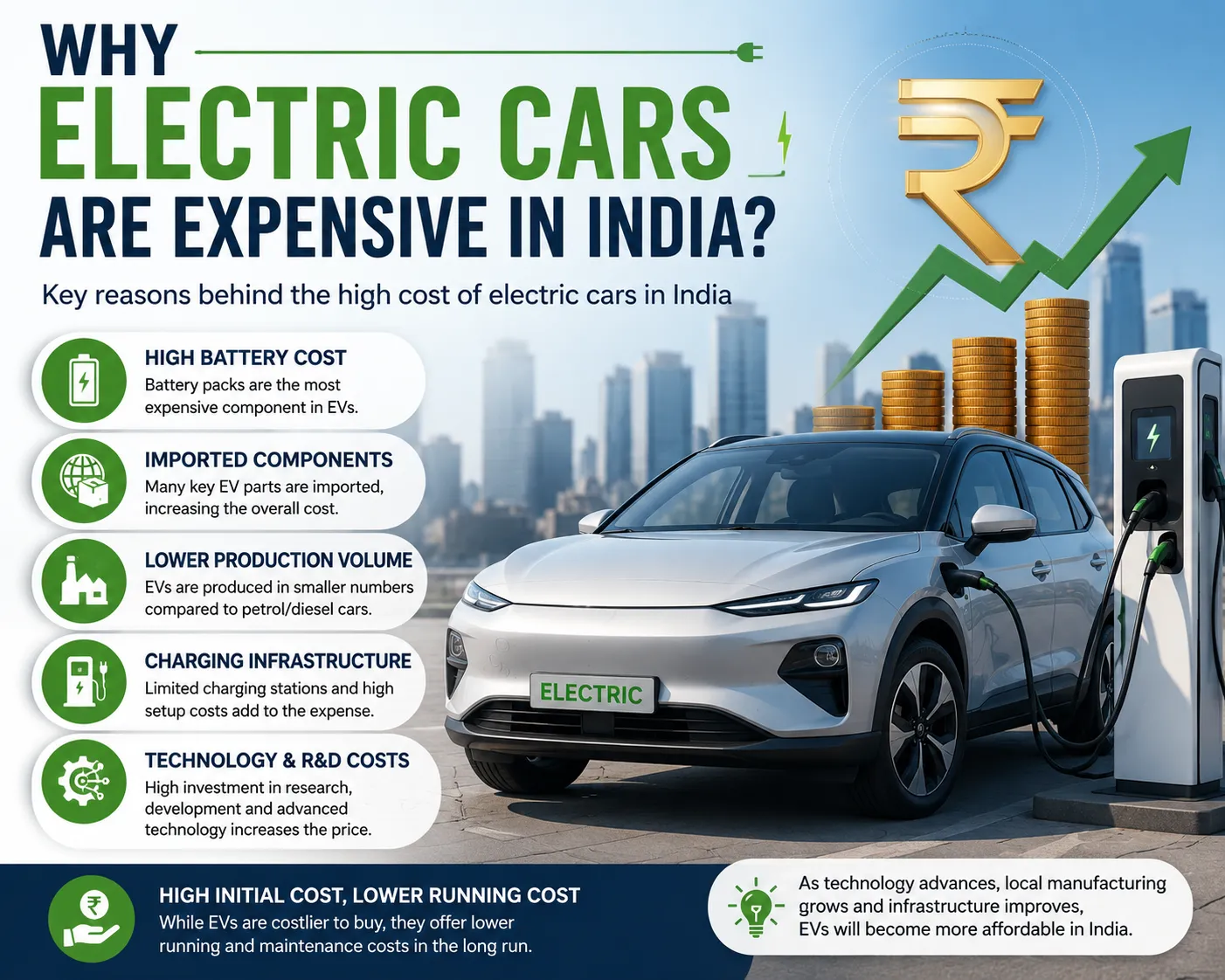
When exploring the future of mobility, a common question arises among modern buyers: "Why Electric cars are expensive in India?" The high initial cost is primarily driven by the lithium-ion battery pack, which typically makes up 40% to 50% of the vehicle's total price. Furthermore, India still relies heavily on importing critical battery cells and electronic components, which attracts import duties and supply chain markups. When you compare electric cars to traditional petrol cars or diesel cars, the current lack of mass domestic manufacturing scale and elevated semiconductor requirements push the final showroom price significantly higher.
The Heart of the Problem: Battery Costs
The most crucial component of any EV is its battery. Modern electric cars run on advanced lithium-ion battery packs that require rare earth metals such as lithium, cobalt, nickel, and manganese. Currently, India does not have large-scale domestic production for these specialized cells. While the country recently discovered lithium reserves, extraction and refining infrastructure is still in its infancy.
As a result, automakers must import finished cells predominantly from countries like China. Because global demand for these minerals is skyrocketing, international prices fluctuate, and importing them adds substantial logistical costs. Until localized battery manufacturing—supported by the government's Advanced Chemistry Cell (ACC) Production Linked Incentive (PLI) scheme—reaches massive scale, the battery will continue to be the single biggest reason for the premium price tag on EVs.
Import Duties and Supply Chain Complexities
While conventional internal combustion engine (ICE) cars have enjoyed decades of localized manufacturing in India, the EV supply chain is still developing. For traditional petrol cars and diesel cars, automakers source almost 90% to 95% of their mechanical parts from local Indian suppliers, driving costs down through economies of scale.
For EVs, the story is quite different. The import of lithium-ion cells involves a layered tax structure, including Basic Customs Duty, Integrated Goods and Services Tax (IGST), and Social Welfare Surcharges. Additionally, electric cars utilize more than double the number of semiconductor chips (Electronic Control Units) compared to their fuel-powered counterparts. While the government has recently waived customs duties on critical minerals like lithium and cobalt to ease these burdens, the heavy reliance on imported electronics continues to keep initial vehicle costs elevated.
Electric vs. Traditional Cars at a Glance
To better understand where the money goes when you purchase a vehicle, here is a quick breakdown comparing the cost structures of different types of passenger vehicles:
Component / Aspect | Electric Cars | Petrol Cars / Diesel Cars |
|---|---|---|
Primary Cost Driver | Lithium-ion battery pack (40% to 50% of vehicle cost) | Internal combustion engine and complex transmission |
Component Localization | Low (Heavy reliance on imported battery cells and chips) | Very High (Most mechanical parts made domestically) |
Running / Fuel Cost | Extremely low (Electricity is far cheaper than fossil fuels) | High (Subject to fluctuating global crude oil prices) |
Maintenance Cost | Low (Fewer moving parts, no engine oil or filter changes) | Moderate to High (Regular engine and transmission servicing required) |
Government Subsidies | Available (Lower 5% GST, state-level registration waivers, PM E-DRIVE scheme) | None (Higher GST brackets and full road taxes apply) |
Why the EV Investment is Still Worth It
Despite the high showroom price, millions of smart buyers are transitioning to electric mobility. Here are the top reasons why the initial premium can be justified over the lifespan of the vehicle:
Massive Savings on Running Costs: Charging an EV at home is significantly cheaper per kilometer compared to refueling with expensive petrol or diesel at the pump.
Lower Maintenance Overhead: Electric cars lack complex engines, exhaust systems, and multi-speed transmissions. Fewer moving mechanical parts mean far fewer expensive trips to the mechanic.
Tax Benefits and Subsidies: The Indian government levies a much lower GST rate of just 5% on EVs, compared to up to 28% for ICE vehicles. Furthermore, initiatives like the PM E-DRIVE scheme aim to support the ecosystem, and many states waive road tax and registration fees.
Environmental Impact: Driving an EV produces zero tailpipe emissions, directly combating severe air pollution in heavily congested Indian metropolitan cities.
Silent and Smooth Drive: The lack of engine vibration and mechanical noise provides an incredibly smooth, premium driving experience that traditional vehicles struggle to match.
Frequently Asked Questions (FAQs)
Will electric cars ever get cheaper in India?
Yes, industry experts project that as domestic battery manufacturing ramps up under government PLI schemes and technology matures, the manufacturing cost of electric cars will eventually drop. Price parity with traditional petrol cars and diesel cars is widely expected as economies of scale improve.
Is the government doing anything to lower EV prices?
Absolutely. The government has drastically reduced the Goods and Services Tax (GST) on EVs to a mere 5%. Additionally, recent union budgets have granted import duty exemptions on critical minerals like lithium and cobalt. Schemes like PM E-DRIVE and PLI are actively encouraging localized manufacturing to slash long-term costs.
Are electric cars more expensive to insure?
Generally, yes. Because the vehicle's initial purchase price is higher and specialized battery replacements can be costly in the event of severe accidental damage, comprehensive insurance premiums for EVs tend to be slightly higher than those for standard ICE vehicles.
Conclusion
Whenever a prospective buyer asks, "Why Electric cars are expensive in India?", it is essential to look at the broader economic picture. The current price disparity is the natural result of a transitional phase in the automotive industry. High battery costs, a heavy reliance on imported electronic components, and a lack of massive local economies of scale make the upfront purchase undeniably steep. However, when you factor in the incredibly low running costs, minimal maintenance, and strong government tax benefits, electric cars often prove to be a smarter, more cost-effective financial decision in the long run compared to conventional petrol cars and diesel cars.
Sources & References: TaxGuru & Financial Reports
Also Read: Are electric cars expensive to run?


.jpeg)