
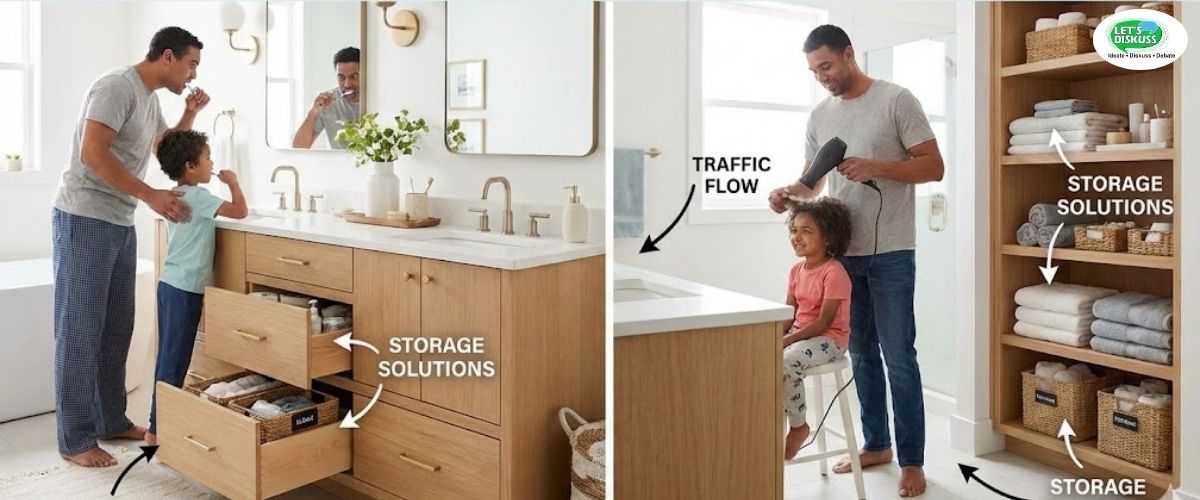
Morning in a busy family bathroom can feel like a traffic report: one parent trying to shave, another doing skincare, a teen hunting for the good hairdryer, a younger kid yelling that someone stole their toothbrush spot again. The room itself hasn’t changed, but the number of people trying to use it at the same time has. No wonder so many families start dreaming about “just one more sink” as the answer to all their problems.
A smartly designed double sink vanity along with luxury bathroom vanities can absolutely calm that chaos, but only if you treat it as a planning tool, not just a pretty cabinet with two bowls. The layout, storage, and traffic flow matter more than the fact that there are two sinks. Get those right and your mornings feel more like a relay than a wrestling match. Get them wrong and you simply add more fixtures to an already stressed space.
Why double sinks are such a big deal for families
For couples with kids, mornings and bedtime are the highest pressure moments of the day. Everyone is on a clock, and the bathroom becomes a bottleneck. Two sinks let two people be “in action” at once, but the real magic is in specialization. One person can be on teeth-and-hands duty while someone else is deep in hair or makeup without constantly swapping positions at the mirror.
This becomes even more important with teens. Older kids bring more products, more tools and more time in front of the mirror. Parents still need a place to brush their teeth and wash their face without waiting for someone to finish curling every strand of hair. Two distinct stations let different routines happen in parallel instead of in a frustrating queue.
Different family scenarios, different layouts
The “right” layout depends a lot on who is actually using the bathroom.
For parents and teenagers sharing a primary or hall bath, the best solution is often a long vanity with two clear posts. Each person gets their own sink, mirror zone and storage. The teen’s side can handle the explosion of hair tools and skincare, while the parents’ side stays more minimal. The key is to give both sides equal dignity: usable drawers, good lighting, and enough counter space to work on, not just a decorative bowl.
In a bathroom shared by two kids, you can lean harder into symmetry. Two similar sinks with matching drawers below help avoid arguments about whose space is whose. If the kids are different ages or heights, you might subtly tailor storage: lower drawers and step stool storage for the younger one, more vertical space and organizers for the older one. Over time, the layout grows with them rather than becoming something they fight against.
There is also the guest bath plus kids’ bath combo, where one room does double duty. In that case, a double vanity can serve two roles at once. One side functions as the kids’ everyday station, with toothbrushes, hairbrushes and kid-level storage. The other side stays cleaner and more neutral, with a bit of open counter space and a simple set of guest towels and essentials. When guests arrive, they get a tidy, adult-feeling station, and the everyday chaos can be contained mostly to the children’s half.
Zoning the vanity: fast lane and beauty corner
One of the smartest tricks for busy families is to treat the vanity as a tiny floor plan on its own and create zones within it. Instead of thinking “two identical sinks,” think “two different types of work.”
The fast lane is the side for quick tasks: brushing teeth, washing hands, rinsing a face. It needs clear access to the basin, a simple mirror and just enough storage for everyday basics. The focus here is speed and turnover. People come in, do what they need to do, and make room for the next person.
The beauty corner is the deeper, slower station. This is where hair dryers, flat irons, skincare and makeup live. It might have a wider mirror, better lighting, a stool if space allows, and more sophisticated storage. Here, deep drawers with vertical dividers keep bottles upright and tools untangled. If you’re going to hide outlets inside drawers or cabinets, this is the side that benefits the most, because tools can stay plugged in yet hidden when not in use.
By turning one side into a fast lane and the other into a beauty corner, you protect quick routines from long ones. Parents can blast through teeth and skincare while a teen settles into the beauty corner without feeling like they’re hogging “the sink” from everyone else.
Deep drawers, hidden outlets and smart dividers
Storage is where double vanities become truly family-friendly instead of just pretty. Doors and one big open cabinet shelf rarely cut it once you factor in multiple people and multiple routines.
Deep drawers under each station are game changers. One drawer can be dedicated to morning routines, another to evening, or one to each person. Inside those drawers, simple dividers turn chaos into order: one section for toothbrushes and toothpaste, another for hair ties and brushes, another for skincare. People are much more likely to put things back where they belong when the space is clearly defined.
Hidden outlets inside drawers or cabinets are worth serious consideration in a family setting. They let you leave electric toothbrush chargers, shavers and hair tools plugged in without cords draping across the countertop. That means fewer visual distractions, fewer tripping hazards and less time spent plugging and unplugging. In the beauty corner, a deep drawer with a built-in outlet becomes a parking spot for hot tools that can cool safely, out of reach of small children.
All of these details matter because they turn the vanity into a working system. When everyone has a clear home for their things, the countertop stays clearer, and the whole room feels calmer, even during peak traffic.
Planning traffic flow so people stop bumping into each other
A double vanity only helps if people can actually reach it without playing human pinball. That means thinking about where the door swings, where the shower or tub entrance is, and where you hang towels.
If the bathroom door opens right into the vanity, consider flipping the swing or using a pocket door. That small change can free up a surprising amount of usable space in front of the sinks. If the double vanity sits opposite a shower, you want enough distance that someone stepping out of the shower doesn’t collide with someone bent over the sink.
Towel placement is another overlooked part of traffic flow. If everyone has to cross in front of both sinks to reach the only towel bar, you will constantly have dripping, crossing paths and small frustrations. Hooks or bars near each station, or at least close to the edge of the vanity, let people stay in their own lane instead of crisscrossing the room.
When you look at your bathroom, imagine three or four people moving through it in a five-minute window. One walks in the door, one steps out of the shower, two stand at the vanity. The layout should let them move in loops, not dead ends, with as few points of collision as possible.
Common mistakes that make life harder, not easier
It is very easy to spend money on a double vanity and still end up with a bathroom that doesn’t work any better than before. One of the most common mistakes is cramming two sinks into a 48 inch cabinet with almost no counter between them. On paper you have a double; in real life, you have two tiny bowls and nowhere to set anything down. Elbows bump, bottles fall into the sink and the surface looks cluttered even when you are trying to be tidy.
Another mistake is forgetting about storage completely. A double sink with no real drawers underneath turns into a wider surface for piles of stuff. Families need depth and structure in their storage, not just more inches of flat countertop. Without that, the vanity becomes a daily reminder that you installed extra plumbing but not extra function.
Too few outlets is another quiet killer of good design. Families use a lot of electricity in bathrooms: toothbrushes, shavers, hairdryers, curling irons, straighteners, sometimes even phones or tablets. If you only have one or two outlets for a multi-person space, cords will stretch across bowls and counters, and people will constantly unplug each other’s devices. Planning enough outlets at each station, and some hidden inside storage, prevents a lot of small daily arguments.
The last big mistake is lighting and mirrors that only really work for one person. A single mirror centered between two sinks with one small bar light above it might look neat in a drawing, but in practice one person gets the good light while the other stands in shadows at the edge. Good layouts give each station its own mirror zone and lighting, so two people can actually see what they are doing at the same time.
A family-friendly double vanity checklist
Before you commit to a layout, run your plan through this quick checklist and answer honestly with your family in mind.
- Can two people stand at the vanity, use the sinks and open drawers without bumping into each other or blocking the door or shower entry?
- Does each sink station have at least one deep drawer or cabinet section that belongs clearly to one person or one type of routine, rather than everything being thrown into one shared space?
- Is there enough countertop between and beside the sinks to set down a hairdryer, toothbrush holder and a few daily products without everything crowding the basins themselves?
- Are there enough outlets positioned so that a parent and a teen can both plug in their tools without cords crossing, and are any of those outlets hidden inside drawers or cabinets where chargers and hot tools can live safely?
- Does the room layout allow people to move in smooth paths from door to vanity to shower to towels, or are there obvious bottlenecks where everyone will have to squeeze past one another?
- If guests will sometimes use this bathroom, is there a way to keep at least one side of the vanity feeling clear and welcoming rather than making visitors fight their way through family clutter?
- Does the mirror and lighting setup give each user a clear, well lit view of their face, or will one person always be stuck in the darker “second-class” spot at the edge?
If you can honestly say “yes” to most of these questions, your double sink layout is likely to make mornings smoother rather than more crowded.
Bringing it all together
For busy families, the best double sink bathroom vanity layouts are the ones that treat the cabinet like a command center, not just a piece of furniture. Two sinks are useful, but two well planned stations are transformative. When each person has a defined spot, proper storage, access to power and good lighting, the bathroom stops being a battleground and starts functioning like a tiny, efficient backstage area for the entire house.
In the end, the goal is simple: fewer arguments, less tripping over each other, and a space that still looks calm in the middle of a hectic day. With the right layout, zoning and storage, a double sink vanity can give your family exactly that, turning chaotic mornings into something closer to a routine you can actually live with.