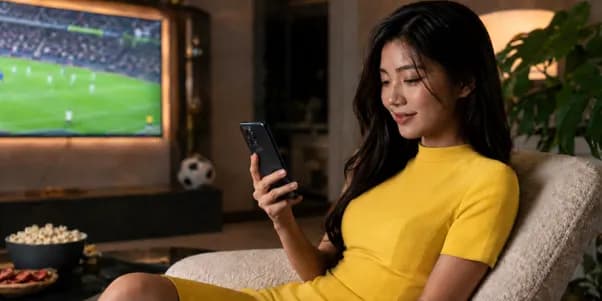
In the early years of video games, play was a place you visited: an arcade down the street, a plastic console hooked to the family TV. Today, for billions of people, the game never fully powers down. Newzoo estimates that around 3.4 billion people will play games in 2024, with total industry revenue approaching $190 bln. Most of that energy is used by devices that also handle school timetables, work email, and maps.
On a single smartphone, you can jump from a study group to a battle royale, from a football stream to a shopping app, and then into an online casino lobby without ever stepping outside the same glowing rectangle. Mobile games now account for almost half of global game revenues, and in Europe, more than 90% of gaming income comes from digital purchases rather than boxed discs. For younger players, the idea that "real life" is something separate from these screens feels increasingly artificial.

From playgrounds to platforms
The clearest symbol of this new reality might be a concert that never took place on a physical stage. In April 2020, rapper Travis Scott performed his “Astronomical” show inside Fortnite; Epic Games reported more than 12 million concurrent players watching the event live, beating the game’s previous records. For many fans, it felt less like logging into a game and more like attending a shared cultural moment, rendered in polygons.
Fortnite is not alone. Roblox hosts millions of user-created experiences and occasional branded events for its hundreds of millions of monthly users. Minecraft worlds double as classrooms and community spaces; teachers use them to recreate historical sites or run coding lessons. Esports tournaments such as the League of Legends World Championship attract peak audiences of over 6.4 million concurrent viewers on tracked platforms, not counting Chinese services, blurring the line between sports fandom and game viewership.
Sport, fandom and the second screen
Traditional sports have quietly absorbed gaming habits. On a match night, fans follow football or basketball not just through a television broadcast but through a web of live-score apps, fantasy leagues, and prediction games. In Europe and North America, official data feeds from major leagues supply tracking statistics that underpin both broadcast graphics and in-play betting markets.
Esports platforms add another layer, with Twitch or YouTube Live chats scrolling alongside the action. Viewers earn channel points for correct predictions, vote on which replay angle to watch, or unlock cosmetic rewards in the game itself simply by staying tuned in. The old idea of a clear boundary between “just watching” and “actively playing” makes less sense when a live stream hands out loot as readily as a game level.
Cities with a game layer on top
Sometimes the overlap is literally mapped onto the pavement. When Pokémon Go launched in 2016, it turned city streets into hunting grounds where players chased virtual creatures pinned to GPS coordinates. The game surged past 500 million downloads in its first year and still logs tens of millions of monthly active users, enough to support live events and sponsored locations worldwide.
Niantic’s later titles, from Pikmin Bloom to Monster Hunter Now, follow a similar pattern, encouraging players to treat a walk to the shop as a quest. Other publishers experiment with augmented-reality filters tied to sports teams, tourism campaigns, or retail chains. In each case, the city becomes a kind of board game whose rules are written across phone screens rather than signposts.
Work, learning, and life quests
As gaming language spreads, it seeps into less playful territories. Productivity apps award streaks and badges for consecutive days of focus. Fitness platforms turn step counts and heart rates into experience points and level-ups; the Apple Watch’s rings or Strava’s challenges are recognisable to anyone who has ever ground through a role-playing game. Language-learning apps such as Duolingo tie progress to daily quests and leaderboards that feel closer to a mobile game than a traditional classroom.
For some, this “gamification” brings a welcome shot of motivation. For others, it risks turning every corner of life into a set of metrics to optimise and compare. Either way, it shows how deeply game design techniques have infiltrated systems that claim to be about health, knowledge, or productivity rather than entertainment.
Learning to live in blended spaces
If gaming is becoming a new kind of default reality, the challenge is no longer to keep the online world at bay but to navigate it with some care. Psychologists and health agencies warn that excessive screen time, compulsive play, and high-risk gambling can erode sleep, concentration, and finances, especially for younger players. Governments in countries from the United Kingdom to Bangladesh have begun tightening rules on loot boxes, advertising, and unlicensed betting sites in response to growing concerns.
Players, meanwhile, stitch their own strategies together. Some set app-timer limits, while others agree on screen-free evenings with friends or family. Guides that explain how to configure parental controls, set spending caps, or download melbet app apk on licensed platforms are part of a broader digital literacy: the skill of moving between worlds without getting trapped in any of them.
The line between online and offline is not disappearing so much as melting into a gradient. A walk in the park might also be a location-based game session; a football match might also be an esports viewing party; a study break might also be a climb up a ranked ladder. For better and for worse, gaming has slipped its old boundaries and become one of the languages in which everyday life is written.