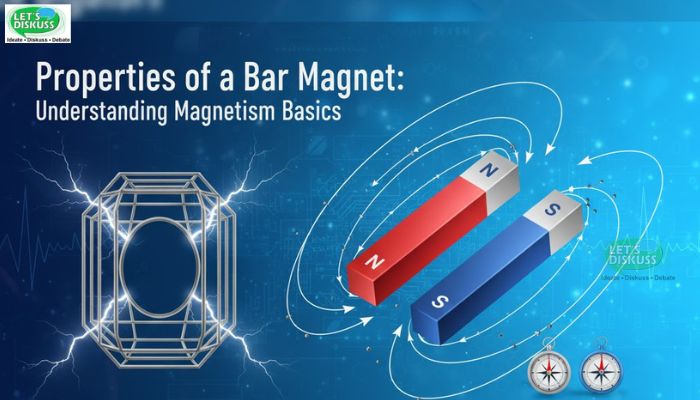
1. Introduction to Bar Magnets
Take a small piece of iron or steel, a rectangle, whose dimensions are small so that it can trap small metallic objects like paper clips or iron nails. This item is essentially a bar magnet, which represents a multiplicity of fundamental concepts of magnetism. When the bar magnet is magnetized, it will acquire new areas of magnetic effects that are known as magnetic poles, and are located at its ends.
The interesting fact about a bar magnet is not only that it will either attract or repel other magnetic bodies, but it also demonstrates a set of properties that are clearly defined and explain the underlying physics of magnetism. An in depth study of these properties supplies the knowledge of how these magnetic fields can be generated, how they interact and how such forces can be practically utilized in other forms of technology.
2. Magnetic Poles: The Heart of Magnetism
What Are Magnetic Poles?
Bar magnets have two poles with respect to magnetism i.e. the North (N) and South (S) poles. These areas denote the localizations of the magnetic field strength and they are traditionally located at the ends of the magnet (see Fig. 1).
When a magnet is placed near a refrigerator, the polarizing magnets conduct contact and either attraction or repulsions are observed.

Properties of Magnetic Poles
- Similar poles repel: The repulsive force between similar poles of magnetic poles is found to be on the repulsion between two similar poles with the same polarity: as two poles are of the same polarity, the repulsive force between the poles tends to increase the distance between them.
- Opposite poles interact: The north and south magnetic poles interact: the poles will be attracted as they are brought close in proximity, where the magnetic interaction across the poles brings the poles together.
- Poles are always at the ends: The poles are constant on the ends: however the magnet may be subdivided, the fragment that results will have a North pole and a South pole. It is therefore not possible to isolate individual magnetic poles.
Why Do Poles Exist?
The presence of poles can be explained by the idea of magnetic dipoles - tiny loops of current or magnetic moments of atoms which form a whole magnet field. The poles are associated with the spatial areas of the strongest magnetic field.
3. The Magnetic Field: Invisible Lines of Force
What Is a Magnetic Field?
A magnetic field is a region around a magnetic object where magnetic forces can be felt. It's invisible, but its presence is revealed through the behavior of magnetic materials and compass needles.
Visualizing the Field: Magnetic Field Lines
The magnetic field around a bar magnet is represented by magnetic field lines—imaginary lines that show the direction and strength of the magnetic field.
- Emerging from the North pole and entering the South pole.
- The density of these lines indicates field strength; the closer the lines, the stronger the magnetic field.
- These lines form closed loops, meaning they continue from the South pole back to the North inside the magnet itself, completing the magnetic circuit (Fig. 2).

Key Properties of Magnetic Lines of Force:
- They never intersect.
- Outside the magnet, they begin at the North pole and finish at the South pole.
- They complete the loop inside the magnet by running from south to north.
Because it describes how magnets interact and exert forces over distance, an understanding of the magnetic field is essential.
4. Magnetic Moment: The Magnet’s Strength and Direction
Defining Magnetic Moment
A vector quantity that shows the direction and strength of a magnet's magnetic influence is called the magnetic moment (m).
Imagine it as the "power" and "orientation" of the magnet. Its orientation aligns with the magnetic field, pointing from the South pole to the North pole inside the magnet.
Expression in Mathematics
The magnetic moment of a basic bar magnet can be roughly calculated as follows:
m=mn^
where:
- mmm is the magnitude of the magnetic moment,
- n^ is a unit vector pointing from the South pole to the North pole inside the magnet.
How to Calculate Magnetic Moment
For a bar magnet of length l with poles of pole strength p, the magnetic moment is given by:
m=p×l
This quantity helps quantify the strength of the magnet and predict how it will interact with other magnetic objects.
Example
Suppose a magnet has pole strength p=1 A\m and length l=0.1 m. The magnetic moment:
m=1×0.1=0.1 A\m2
5. Magnetic Field of a Bar Magnet: A Dipole Perspective
Magnetic Dipole Model
A bar magnet can be modeled as a magnetic dipole—a pair of equal and opposite magnetic poles separated by a distance.
Field Equations and Derivations
The magnetic field at a point outside the magnet can be calculated using the dipole equations:
- Along the axial line (the line passing through the poles):
Baxial=μ0/4π x 2m/r3
- Along the equatorial line (perpendicular bisector):
Bequatorial=μ0/4π x m/r3
where:
- μ0 is the permeability of free space,
- r is the distance from the magnet's center to the point.
Fig. 3 illustrates the magnetic field lines and the points along the axial and equatorial lines where the field strength can be measured.

Significance
These equations highlight the localized nature of magnetic influence by demonstrating that the field strength rapidly decreases with distance (r3).
6. Properties of Magnetic Lines of Force: The Invisible Pathways
The lines of force magnetic, or magnetic flux lines, have some important properties which enable us to know how the magnetic fields behave:
- They radiate out of the north pole and end at the south pole.
- They create closed loops and keep repeating in a north-south direction in the magnet.
- The density of lines gives the intensity of the field.
- The lines do not intersect; it would mean that the magnetic field has conflicting directions at the intersecting point.
Implication: These characteristics provide a steady and even distribution of magnetic fields, which is essential for comprehending magnetic attraction and repulsion.
7. Attraction and Repulsion: The Interaction of Magnets
Observation
- Like poles repel each other.
- Opposite poles attract each other.
Explanation
This behavior stems from the interaction of their magnetic fields. When the poles are brought close, the lines of force interact:
- Opposite poles’ lines tend to connect, pulling the magnets together.
- Like poles’ lines repel, pushing the magnets apart.
Examples
- Two bar magnets will attract one another if they are positioned with their opposing poles facing one another.
- When two North poles are pushed together, a force pushes them apart.
8. Magnetic Properties of a Bar Magnet: Retentivity and Permeability
Retentivity (Remanence)
The ability of a magnet to retain its magnetism after the external magnetizing field is removed.
- High retentivity means the magnet remains magnetic for a long time.
- Iron and steel have high retentivity, making them suitable for permanent magnets.
Permeability
The measure of how easily a magnetic field can pass through a material.
- Materials with high permeability (like soft iron) allow magnetic flux to pass through easily.
- This property is exploited in transformers and electromagnets.
9. Practical Applications of Bar Magnets
Uses in Everyday Life and Industry
- Compass needles: The magnetic field of the Earth is relied on by the traditional navigational tool in order to position the needle along the magnetic poles of the Earth.
- Electric motors and generators: Electric currents and mechanical motion are produced by magnetic fields.
- Magnetic separation: Magnetic separation is a technique used to separate magnetic materials from non-magnetic ones.
- Magnetic recording devices: Hard disk drives make use of the magnetic fields to capture and store digital information.
Real-World Examples
- Doorbells: These are electromagnets that magnetically capture metallic elements, hence causing the chime system.
- Medical imaging: Using magnetic fields to produce finely detailed internal images of the human body is known as magnetic resonance imaging, or MRI.
10. Summary: The Magnetic Essence of a Bar Magnet
In summary, the properties of a bar magnet form the basic aspects of understanding magnetism:
- It has two poles, north and South, that are attracted and repelled.
- The magnetic field is made of closed loops, which start at the North pole and end at the South pole.
- The magnetic moment is used to quantitatively measure the strength of the magnet and its orientation.
- It is a magnetic dipole,e and its field strength decreases rapidly with distance.
- The force of interaction of the magnets depends on the pole arrangement of the magnets and on the overlap of the magnetic fields of the magnets.
- All these features form the foundations of numerous technological applications that define our modern-day society.
Final Thoughts
Another ideal introduction to the study of magnetism is introduced by the use of magnetic materials, specifically elementary bar magnets. The salient properties of these objects, their poles, the magnetic fields between them, and their magnetic moments, are not confined to theoretical constructions but are actually used in the daily instrumentation and in the modern high technology to a significant extent.
In the work with a compass or watching an electric motor at work, one must remember about the basic properties of the elementary bar magnet under which those phenomena are based.