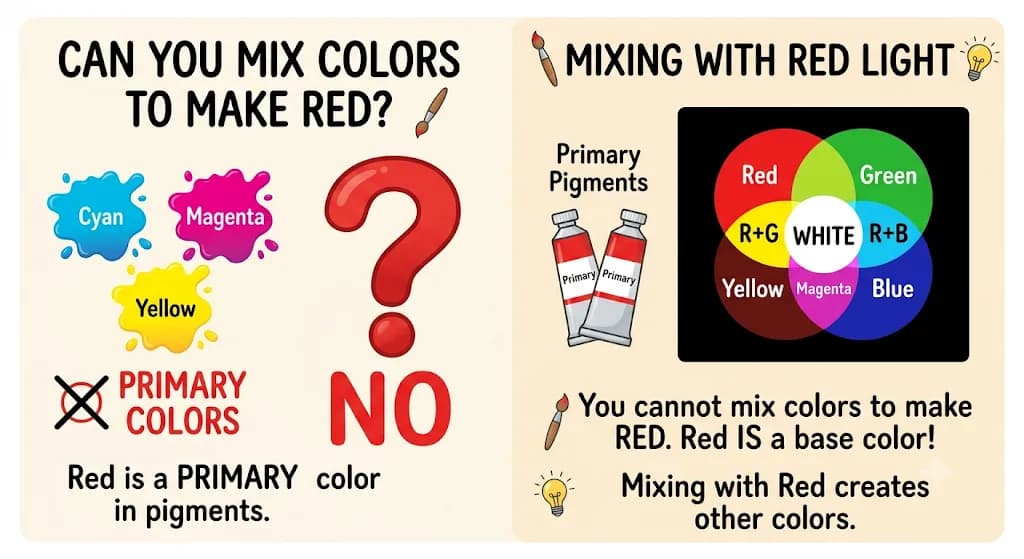
Can you mix colors to make red? The answer depends on your medium. In traditional painting (the RYB color model), red is a primary color, meaning you technically cannot mix other primary colors to create a true, pure red. However, in the modern subtractive color model used in printing (CMYK), the answer to exactly what colors make red is a balanced mixture of Magenta and Yellow.
If you already have a basic red paint and simply want to know how to alter it, you can mix it with yellow to create warm reds (like scarlet), blue to create cool reds (like crimson), or a touch of green/black to create deep, moody reds (like burgundy).
In this guide you will learn:
The difference between traditional and modern color theory.
Exactly what color to make red using the CMYK printing method.
Expert tips for mixing different shades and tints of red.
Answers to common FAQs about primary and secondary color combinations.
The Great Debate: Is Red Really a Primary Color?
If you ever took a basic art class, you were likely taught the RYB (Red, Yellow, Blue) color model. In this traditional system, red is considered a fundamental primary color. According to this rule, primary colors cannot be created by mixing other colors together; instead, they are the building blocks used to create every other color on the wheel. So, if you run out of pure red acrylic paint, traditional theory says you are out of luck.
However, modern science and digital printing have given us a different answer to what make red.
The CMYK Method: Magenta + Yellow = Red
Printers use the CMYK (Cyan, Magenta, Yellow, and Key/Black) color model. This is a subtractive color model. In this scientifically accurate system, the true primary colors of pigment are actually cyan, magenta, and yellow.
If you are wondering exactly what color to make red using this modern scientific model, you simply mix pure Magenta and pure Yellow.
Magenta absorbs green light and reflects red and blue.
Yellow absorbs blue light and reflects red and green.
When mixed, the blue and green light are both absorbed, leaving only Red to reflect back to your eyes.
Therefore, if you have a tube of primary magenta paint and a tube of primary yellow paint, you can mix them together to create a vibrant, brilliant red!
How to Mix Different Shades of Red
While creating a pure primary red from scratch requires magenta, you will often find yourself needing to modify an existing red paint to fit your specific artistic needs. By adding trace amounts of other colors, you can shift the temperature and depth of your red.
Here is a quick reference guide on how to modify a basic red base:
Target Shade | Base Color | Colors to Add | Resulting Vibe |
|---|---|---|---|
Crimson | Pure Red | Tiny drop of Blue | Cool, deep, and dramatic |
Scarlet / Tomato | Pure Red | Small amount of Yellow | Warm, fiery, and energetic |
Maroon / Burgundy | Pure Red | Touch of Brown, Black, or Green | Rich, dark, and sophisticated |
Pink / Rose | Pure Red | White | Soft, delicate, and pastel |
Coral | Pure Red | White + tiny drop of Yellow | Tropical and vibrant |
Expert Tips for Mixing Red Paint
If you are standing at your canvas wondering what color make red darker, lighter, or more muted, follow these expert color-mixing rules to avoid creating a muddy mess:
To darken red, use its complementary color: While your first instinct might be to add black to make a dark red, black can quickly make red look dull or "dirty." Instead, add a microscopic touch of green (red's complementary color on the color wheel). This darkens the red while keeping it rich and vibrant.
Always add dark to light: When mixing your own red using magenta and yellow, start with a large pool of yellow (the lighter color) and slowly mix in the magenta. It is much easier to darken a light color than to lighten a dark one.
Watch your color temperatures: Remember that not all reds are created equal. If you are painting a vibrant sunset, lean towards mixing your red with yellow for a warm scarlet. If you are painting a dark rose, mix your red with a touch of blue for a cooler crimson.
Use Titanium White carefully: When trying to lighten red, adding white will immediately turn it pink. If you want a lighter red without losing its fiery identity, try adding a bright, opaque yellow instead.
Frequently Asked Questions (FAQ)
Can I make red if I only have primary colors? If you are using traditional RYB primary colors (Red, Yellow, Blue), you cannot mix yellow and blue to create red. Red is already a primary color in this system. However, if your "primary" colors are CMYK (Cyan, Magenta, Yellow), you can mix magenta and yellow to create red.
What colors make red darker without using black? To darken red without making it look muddy or gray, add a very small amount of its complementary color: green. Alternatively, a tiny drop of dark blue (like Ultramarine) will create a deep, beautiful burgundy.
If I mix pink and orange, will it make red? Mixing a highly saturated, dark pink (which contains magenta) with a vibrant orange (which contains yellow and red) can yield a warm, peachy-red color, though it will likely lack the brilliant punch of a pure primary red.
What make red look warmer? To make a red appear warmer, mix in a small amount of yellow or bright orange. This pushes the hue toward a fiery scarlet or vermilion.
Conclusion
Understanding what colors make red is a fantastic gateway into the broader world of color theory. While traditional art rules dictate that red is an unmixable primary color, modern CMYK science proves that a perfect blend of magenta and yellow will give you a brilliant, true red. Whether you are adjusting digital graphics or mixing acrylic paints on a palette, knowing how to manipulate red with yellows, blues, and complementary greens will elevate your creative projects to the next level.
Also Read: What color does mixing green and blue make?