Asked 5 years ago

What Does Hinduism Teach About Karma and Reincarnation?

0
1.3K
M
manish singhAuthor

Hey, help the community by sharing your answer.

Earn up to 300 points for helpful answers.

Login to Answer

OUR WISE RISHIS OF LONG AGO wanted to know the secrets of life and demise. What occurs in the afterlife? For what reason is there such a lot of bliss for a few and languishing over others in a lifetime? The Gods uncovered to the rishis in their most profound contemplations the responses to these confounding inquiries. They uncovered the laws of karma and resurrection which are presently two of Hinduism's most focal convictions. They capsulize our antiquated religion's perspective on life, demise and interminability. All Hindus realize that they take numerous births and get the aftereffects of their own behavior in this and future lives.

Karma is the law of activity and response which administers life. The spirit conveys with it the psychological impressions it got during its natural life. These attributes are all things considered called the karma of the spirit. Karma in a real sense signifies "deed or act", and all the more comprehensively portrays the standard of circumstances and logical results. Karma isn't destiny, for God enriched his youngsters with the influence to act with unrestrained choice. Exclusively, karma alludes to the entirety of our activities and their corresponding responses in this and every past life, all of which decide our future.

Have a go at striking the highest point of a table with your exposed knuckles? It would hurt, wouldn't it? The harder you strike, the more the torment. Activity is trailed by response. Furthermore, the response is equivalent to the activity. Likewise, on the off chance that you cause agony to another person, you can be sure that a similar torment will return to you. It may not return promptly, perhaps not in any event, during this lifetime. However, it will return in your next life, or even in some life after that. At the point when the response to your past activity of making torment another being gets back to you, you will feel a similar torment. In the event that the agony perpetrated was mental, mental torment will return. On the off chance that the agony exacted was enthusiastic, passionate torment will return. In the event that the torment incurred was physical, actual torment will return. Be it mental, passionate or physical. That is the reason even great individuals endure. They might be paying for some activity that was done in a previous existence. On the off chance that you do great, as well, the kindness be gotten back to you some way or another.

WHAT IS REINCARNATION

Life doesn't end at the passing of the actual body. The body passes on however the spirit doesn't. It lives on in a partner of the actual body which is known as the astral body. The astral body is made of astral matter and dwells in a world much the same as this one, called the Devaloka or Second world. As such, to consummate itself, to profoundly unfurl and develop, the spirit lives on in another body after death, the astral body. At the opportune time, as indicated by its karma, it is renewed into a tissue body. In this manner the astral body, with the spirit inside it, enters another actual body. This equivalent cycle is rehashed ordinarily until the spirit profoundly unfurls and arrives at a specific condition of flawlessness or develop advancement. These rehashed patterns of births and passings are known as samsara. The spirit passes starting with one actual body then onto the next. Each time it does as such, the Hindu says, the spirit has resurrected. This is the interaction to which the name "resurrection" is given.

In this way, the Hindu doesn't have faith in a solitary life on earth, trailed by unceasing bliss or agony. Hindus realize that all spirits resurrect, take one body and afterward another, advancing through experience throughout significant stretches of time. To a Hindu demise isn't fearsome. Like the caterpillar's transformation into the fragile butterfly, passing doesn't end our reality yet liberates us to seek after a considerably more noteworthy turn of events. The spirit won't ever pass on. It is undying. Actual demise is a most characteristic progress for the spirit, which endures and, guided by karma, proceeds with its long journey until it is unified with its maker, God. Resurrection is the common pattern of birth, demise and resurrection, called samsara. At the point when we kick the bucket, the spirit leaves the primary world actual body, it lives for some time in the Devaloka, the Second World, prior to comeing again on earth, the Bhuloka or First World.

P

Answered By parvin singh

Author
View Profile
Updated on06/17/26
0

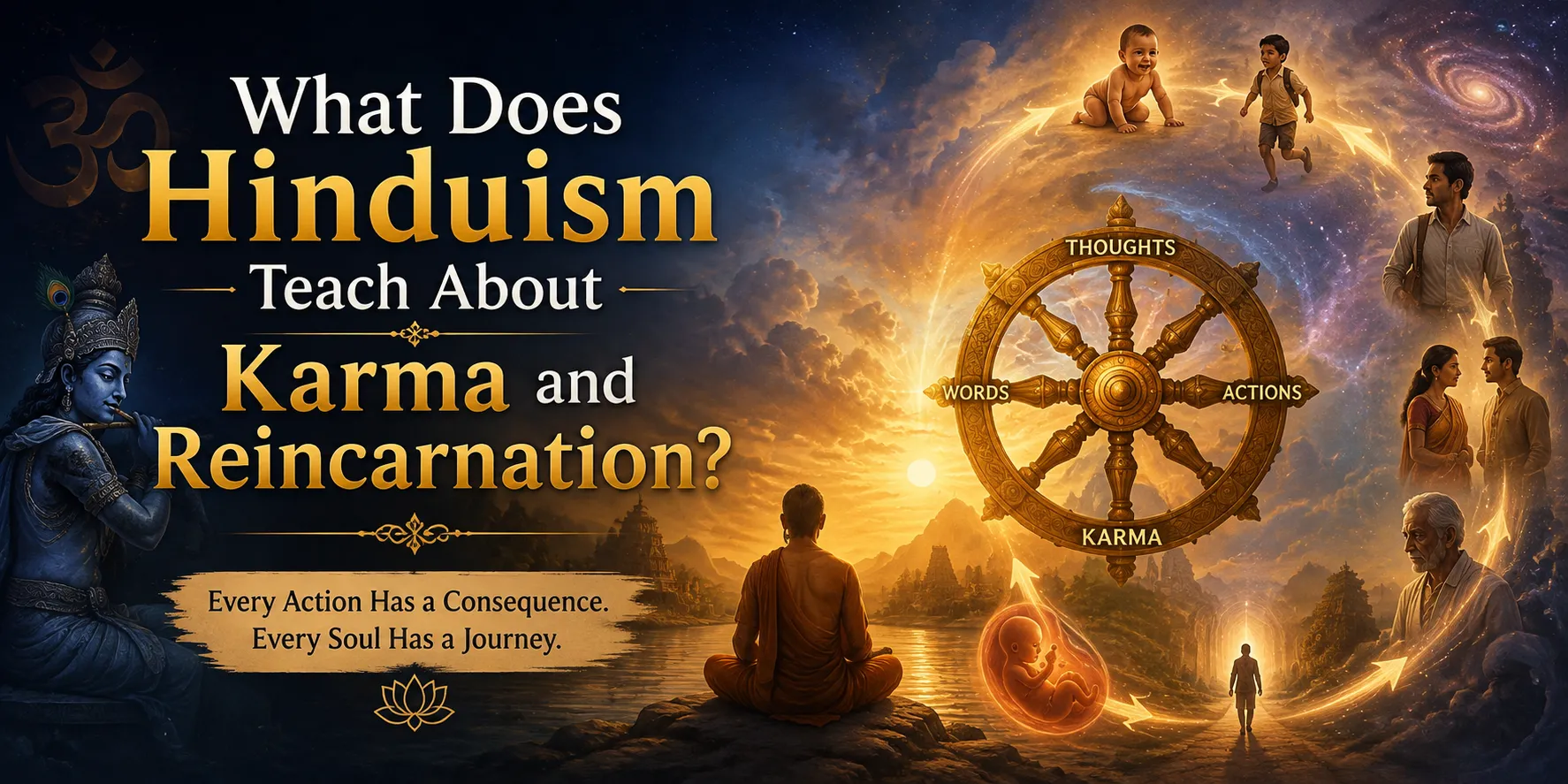
Hinduism teaches that karma and reincarnation are closely connected concepts that influence a person's spiritual journey. Karma refers to the belief that every action has consequences, while reincarnation is the belief that the soul is reborn after death. Together, these teachings help explain how actions in one life can influence future experiences.

In Hinduism, karma is not simply about reward and punishment. It is the principle that a person's thoughts, actions, and intentions can shape their future. Good actions are believed to lead to positive outcomes, while harmful actions may result in negative consequences. This teaching encourages individuals to act responsibly and consider how their behavior affects others.

Reincarnation, also known as rebirth, is the belief that the soul does not die when the body dies. Instead, it is reborn into another life. Hindu teachings describe this continuous cycle of birth, death, and rebirth as samsara. According to Hindu beliefs, this cycle continues until the soul achieves moksha, which is liberation from the cycle of rebirth.

Key Teachings About Karma and Reincarnation

  • Every action has consequences

  • Good deeds can lead to positive outcomes

  • The soul is reborn after death

  • Life is part of the cycle known as samsara

  • Spiritual growth and self-improvement are important goals

  • Moksha represents freedom from the cycle of rebirth

These teachings encourage people to live with honesty, compassion, self-discipline, and a sense of responsibility. By focusing on positive actions and personal growth, individuals are believed to move closer to spiritual progress and eventual liberation.

For many Hindus, karma and reincarnation provide a framework for understanding life's challenges, opportunities, and moral responsibilities. Rather than viewing events as random, these teachings suggest that actions can have lasting effects that extend beyond a single lifetime.

So, according to Hinduism, karma influences a person's future experiences, while reincarnation explains the soul's continued journey through multiple lives. The ultimate goal is to achieve moksha, or liberation from the cycle of birth, death, and rebirth.

Read More: What does Islam teach?

Tara Verma

Answered By Tara Verma

Curious about people, ideas, and the world around us, always learning something new.
View Profile

Tara Verma is a practising teacher and education content writer with over 10 years of classroom experience across primary and secondary levels. She holds a Master's degree in Education (M.Ed.) from Delhi University and a Bachelor of Education (B.Ed.) from Jamia Millia Islamia — qualifications that ground her writing in both pedagogical theory and the day-to-day realities of teaching in India. Her content covers exam preparation strategies, learning methodologies, curriculum guidance, student mental health, career counselling for students, and the evolving state of school and higher education in India. Her work has appeared on platforms including TeacherVision India, Jagran Josh, and Careers360, where she writes for students, parents, and fellow educators who need content built on actual teaching experience — not theory alone. Over a decade of working directly with students across age groups and learning levels has given Tara a practical understanding of how education content should be written — clearly, accessibly, and with genuine awareness of the challenges students and teachers face on the ground. She has taught 1,000+ students, contributed to school curriculum development initiatives, and published 250+ articles on education across digital platforms. She is an active member of the National Council of Teachers of English (NCTE) India. Across all her writing, every recommendation is classroom-tested, every insight comes from direct teaching experience, and every article is held to the same standard she applies in her own classroom — accuracy, clarity, and genuine usefulness for the reader.

Answered on06/17/26
0